
Amazon-Anthropic Deal Exposes AI Vendor Lock-In Risks for Companies
Serge Bulaev
The Amazon-Anthropic contract changes show that companies may face higher costs and become more dependent on specific AI vendors. Pricing changes and special hardware needs might make it harder for customers to switch providers. Experts suggest using contracts that protect customer data and demand open formats for models to help avoid being locked in. Separating data, control, and compute in technical design may also make it easier to switch vendors. This story suggests companies may face sudden price changes, but careful contracts and flexible systems might help reduce risks.

The recent Amazon-Anthropic partnership highlights significant AI vendor lock-in risks for companies, showing how sudden pricing model shifts and proprietary hardware dependencies can escalate costs and limit flexibility. This development serves as a critical case study for organizations using large language models (LLMs) from major providers.
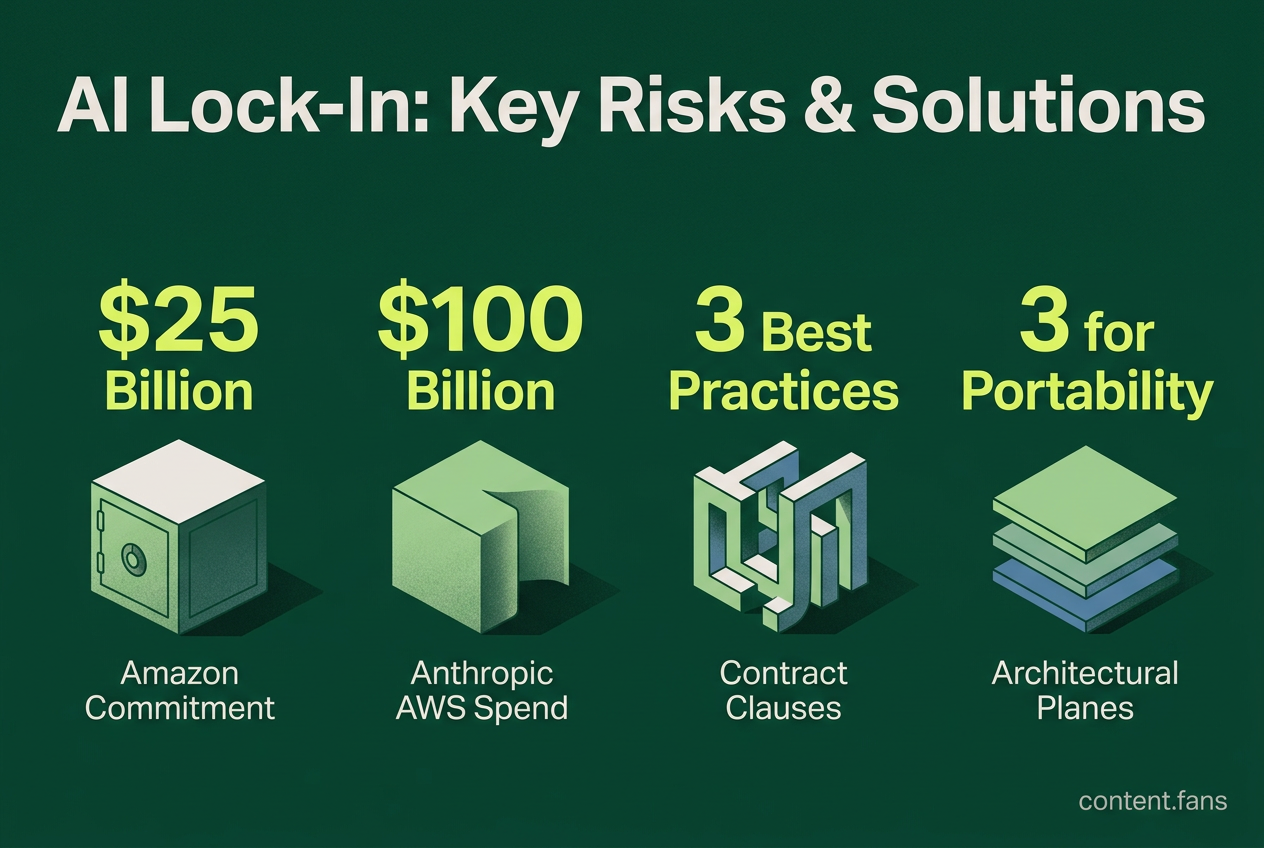
Amazon shifted to token-based billing effective 2025/26. While payable costs are now tied to token consumption (traffic), Amazon disputed reports that this would increase their total costs, stating the partnership is grounded in technical collaboration. Amazon committed up to $25 billion total, while Anthropic pledged over $100 billion in AWS spend over 10 years. The partnership involves AWS technologies, deepening interdependence between model labs and cloud providers and exposing downstream customers to significant risk.
Using Contracts to Mitigate AI Vendor Lock-In
To avoid AI vendor lock-in, experts advise negotiating specific contract clauses, such as data portability rights and prohibitions on vendors training on customer data. Architecturally, separating data, compute, and control planes and using open standards allows for easier migration between different AI service providers without major disruption.
Legal advisers emphasize that portability begins in the contract, not the data center. No-training, data portability, and exit/migration clauses are recommended best practices to avoid AI vendor lock-in:
- No-Training Provision: Bar vendors from using customer data to fine-tune any general-purpose AI model, as recommended in CS Disco's governance blueprint.
- Data Portability Clause: Guarantee the client can extract all inputs and outputs in an open format if terms change.
- Exit and Migration Clause: Oblige the provider to hand over model weights in an open format like ONNX or HuggingFace upon termination.
Retaining ownership of prompts and embeddings via data portability clauses may facilitate benchmarking competing models.
Architectural Best Practices for AI Portability
Technical architecture choices can either reinforce or undermine contractual safeguards. The data plane, control plane, and compute plane architecture is a theoretical concept in system design that can help ensure portability:
- Data Plane: Store features in open formats like Parquet or Iceberg on S3-compatible buckets, avoiding cloud-specific databases.
- Control Plane: Manage infrastructure using code with tools like Terraform or Crossplane to ensure every environment is reproducible.
- Compute Plane: Serve models in containers orchestrated by Kubernetes and place cloud-specific endpoints like Bedrock or Vertex behind a neutral API gateway.
This three-plane architecture allows an application using a router like LiteLLM to swap a backend model from Claude to GPT-4o without altering business logic.
Operational and Financial Guardrails
Even with strong contracts and architecture, portability rights are useless if renewals are not managed proactively. General vendor management advice suggests aligning renewals with business cycles and using cost simulations for consolidation or single-vendor optimization. They also recommend running quarterly cost simulations that replay production traffic against the public price sheets for major models like OpenAI, Gemini, and Claude. When the token-based Amazon-Anthropic pricing takes effect, such simulations will be crucial for determining if a dual-vendor strategy is financially viable.
Quick Checklist for AI Procurements
- Confirm the provider cannot train on your data.
- Demand model weights in an open format upon exit.
- Shift IP infringement liability to the vendor.
- Build to meet the EU's high-risk AI standard to cover multiple jurisdictions.
- Maintain an internal, lightweight model as a failover against cost spikes.
The Amazon-Anthropic story is a clear signal that vendors of scarce frontier models can rewrite prices mid-partnership. Organizations that proactively combine stringent contract language with a portable architectural framework will be best positioned to minimize disruption and maintain strategic control.
Why did the Amazon-Anthropic renegotiation rattle enterprises that embed Claude or Bedrock?
When Amazon shifted to token-based billing (effective 2025/26), Amazon's internal costs to serve Claude became directly tied to customer traffic.
Key stat: Amazon committed up to $25 billion total, while Anthropic pledged $100 billion in AWS spend over 10 years. The partnership involves AWS technologies.
For outside companies, the episode shows that frontier-model labs can rewrite pricing terms with little notice, turning a predictable line item into a variable, volume-driven expense.
Which contract clauses should procurement teams insist on to retain bargaining power?
- Price-review trigger: annual CPI-linked cap or a right to reopen if published rates change.
- Portability guarantee: vendor must deliver model weights, config files and data schemas in open formats (ONNX or HuggingFace) on exit.
- No-training clause: explicit ban on supplier using customer data to refine its own models.
- Termination assistance period: 90-day runway with free or discounted inference to allow migration.
- Multi-cloud license: right to redeploy the same model version on any hyperscaler without surcharge.
What technical patterns make an AI service provider-agnostic?
Architecture teams are adopting a three-plane separation:
Data plane - store features in Parquet, Delta or Iceberg and expose them via S3-compatible APIs.
Compute plane - wrap every model in a container and run on vanilla Kubernetes; avoid Bedrock-only or Vertex-only endpoints.
Control plane - put a neutral API gateway in front of each model and route traffic through tools such as LiteLLM or LangChain; this abstraction lets code call the same endpoint even if the back-end switches from Claude to Llama or GPT-4o.
How can finance teams model the impact of a sudden vendor price hike?
Run a cost-scenario matrix:
- Base case - today's token price.
- Spike case - significant price increases according to industry reports.
- Transfer case - add engineering overhead for dual-vendor maintenance and cache hit-rate loss.
Compare spend at projected monthly volumes and set a renewal decision gate 120 days before budget lock so product launches align with contract anniversaries. Many adopters report significant savings by switching models mid-cycle, even after migration overhead.
Which lightweight fallback models are proving effective in production?
Teams typically keep models in the 7-9 billion parameter range (Llama 3.1 8B, Mistral 7B) on standby in their own Kubernetes cluster. Fine-tuning small models can improve performance on routine tasks with cost savings varying significantly by implementation.
Operational pattern: multi-model orchestrator sends traffic to Claude for complex prompts; if latency or cost exceeds preset thresholds, traffic auto-fails over to the self-hosted model, keeping critical services alive even if the upstream vendor changes terms.