
AlphaFold Slashes Drug Discovery Time From Months to Seconds
Serge Bulaev
AlphaFold may reduce the time and cost needed to discover new drug targets, with some protein structures now appearing in seconds instead of months. Case studies suggest that AlphaFold models can speed up drug discovery in about one-third of projects, and target selection may become more effective using large-scale genetic data. Automation and single-cell assays might improve the accuracy and speed of early drug screening. Financial reports and partnerships appear to show growing industry trust in these new AI tools, though experimental checks and regulatory proof are still required. Experts suggest these computational methods could make research and development more efficient, but results can vary by case.

By slashing drug discovery time from months to seconds, AI tools like AlphaFold are delivering major R&D productivity gains in biotechnology. Where determining a single protein structure once took 6-18 months, AlphaFold now provides it in seconds via a free database, a timeline detailed in a DeepDNA report. This analysis of timelines, costs, and success metrics demonstrates how computational biology is accelerating programs, cutting costs, and improving drug target selection.
AlphaFold shortens hit discovery cycles
AlphaFold accelerates drug discovery by providing accurate 3D protein models almost instantly, eliminating the lengthy and expensive experimental process of structure determination. This allows researchers to immediately begin virtual screening and computational design, drastically shortening the time required to identify and validate promising new drug candidates.
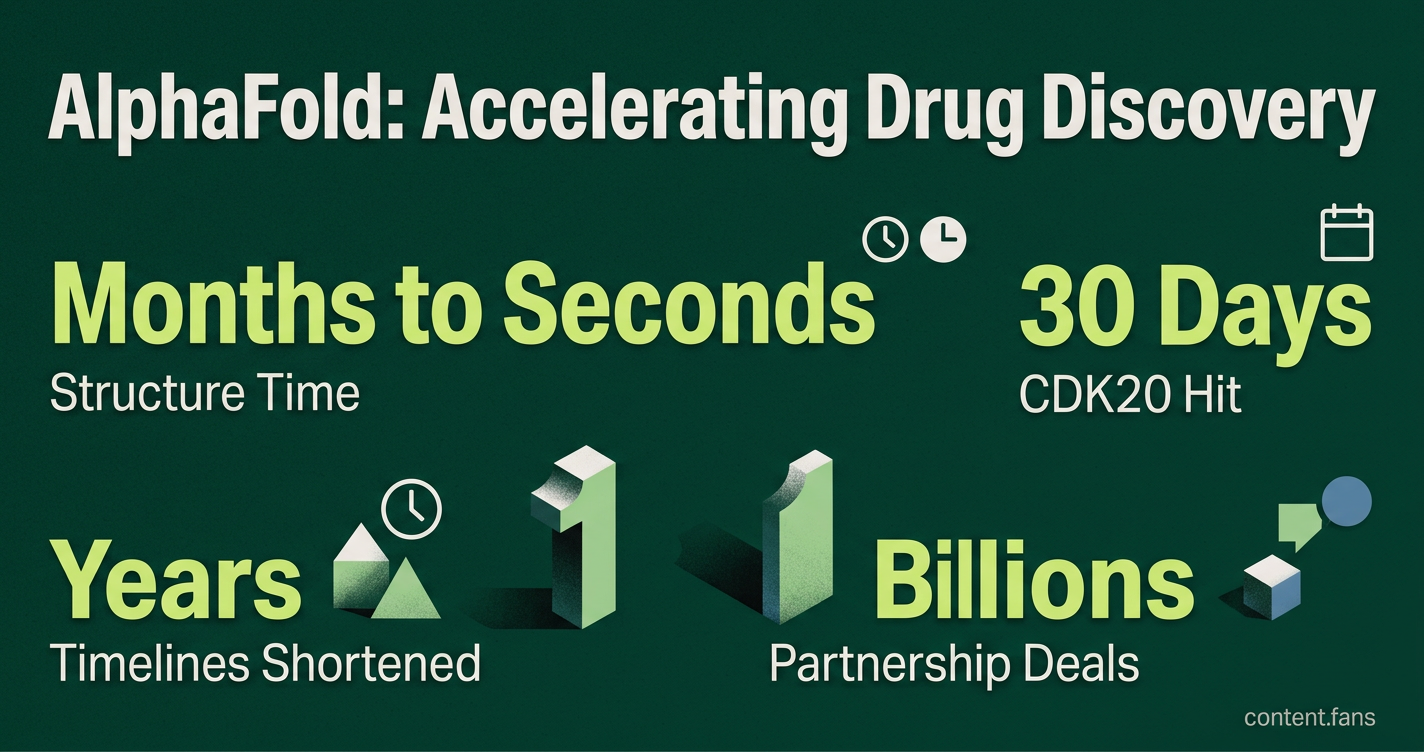
- CDK20 Small-Molecule Program: A team used AlphaFold models to achieve a validated hit in just 30 days, synthesizing only seven compounds. An NIH-hosted study documents a binding affinity of Kd 9.2 ± 0.5 µM for the compound.
- TAAR1 Antipsychotic Development: Researchers used AlphaFold structures for virtual screening, discovering selective agonists that produced antipsychotic-like effects in mice, as reported in a Science Advances article.
- Malaria Vaccine Research: At the University of Oxford, investigators predicted a critical parasite protein structure, enabling the design of novel vaccine candidates and demonstrating the tool's impact beyond commercial drug targets.
A 2024 report highlighted in News-Medical suggests that in approximately one-third of ligand discovery projects, AlphaFold models shorten timelines by up to "a few years" and provide results comparable to traditional crystal structures for virtual screening.
Financial signals and scaling questions
Industry confidence is underscored by major financial commitments. According to industry reports, Isomorphic Labs has secured significant partnership deals with major pharmaceutical companies, with substantial upfront payments and potential milestone payments reaching billions of dollars. Analysts view these figures as proof that major pharmaceutical companies value the efficiencies of AI, while still acknowledging that experimental validation is essential.
Population-scale sequencing boosts target prioritization
The synergy between AI and large-scale genetic data is amplifying target prioritization. As genome sequencing costs continue to decline significantly, AI can effectively mine this data to identify superior targets. Recent genomic priority scoring studies suggest that the highest-ranked targets are substantially more likely to have existing drug indications. Furthermore, top-ranked targets show significantly higher likelihood of advancing through clinical phases. This suggests that using population-level genetic data can de-risk programs by triaging targets before costly lab work begins.
Single-cell assays and automation refine discovery funnels
Automation and advanced assays are further refining the AI-driven discovery funnel. Multimodal single-cell integration improves biological signal quality, leading to higher confidence in cell-type-specific targets. In parallel, high-throughput automated proteomics pipelines can process samples significantly faster than classical methods while maintaining high reproducibility. This combination of speed and precision in early-stage screening helps researchers make better decisions faster.
Regulator and capital market context
Regulatory bodies and capital markets are adapting to these new technologies. Recent FDA draft guidance emphasizes that AI tools require context-specific, auditable validation, ensuring a focus on reliability. This disciplined approach is mirrored in the market, where substantial increases in computational biology valuations signal that investors are rewarding measurable efficiency gains. Increased federal funding and corporate consolidation of AI teams suggest a strategic shift from speculative hype to disciplined integration into R&D workflows.
Ultimately, these case studies provide concrete metrics - protein structures in seconds, validated hits in 30 days, and significant enrichment in target success rates. Such data allows stakeholders to move beyond broad promises and map these demonstrated productivity gains directly onto their own research and development workflows.