
AI's Infrastructure Crisis: Power, Compute, and Cost in 2026
Serge Bulaev
AI infrastructure may face big problems in 2026, including not enough computer chips, high power needs, and rising costs. Experts say always-on AI uses so much power and money that it could make up 60-70% of costs compared to on-premises systems. Some organizations report that power and cooling limits are already slowing down AI projects. Regulatory changes might push companies to use local or regional computer systems, which could make vendor choices harder. New educational sessions are suggested to help teams understand these challenges and plan better for the future.

The AI infrastructure landscape is defined by critical bottlenecks in power, compute, and cost, shifting the industry's focus from model development to physical-world constraints. As enterprises scale AI from experimental pilots to always-on production systems, they face an intertwined set of challenges that extend beyond simple model scaling. The American Action Forum notes this new phase "places infrastructure and regulation at the core of the AI agenda," while firms like Bessemer Venture Partners map the next wave to new frontiers like world-modeling systems, magnifying the pressure on power grids and data centers.
Why is AI infrastructure being called a "crisis"?
The term reflects a fundamental shift in bottlenecks. While previous years focused on chip availability, the current crisis is one of physical and operational limits. Electricity grids, data center capacity, and regulatory permitting are now the primary constraints on AI expansion. As AI evolves from chatbots to more autonomous models, the strain on infrastructure intensifies. This shift to production-scale AI creates sustained pressure that most enterprise data centers were not designed to support, with many organizations reporting that energy and thermal limits are constraining their AI rollouts.
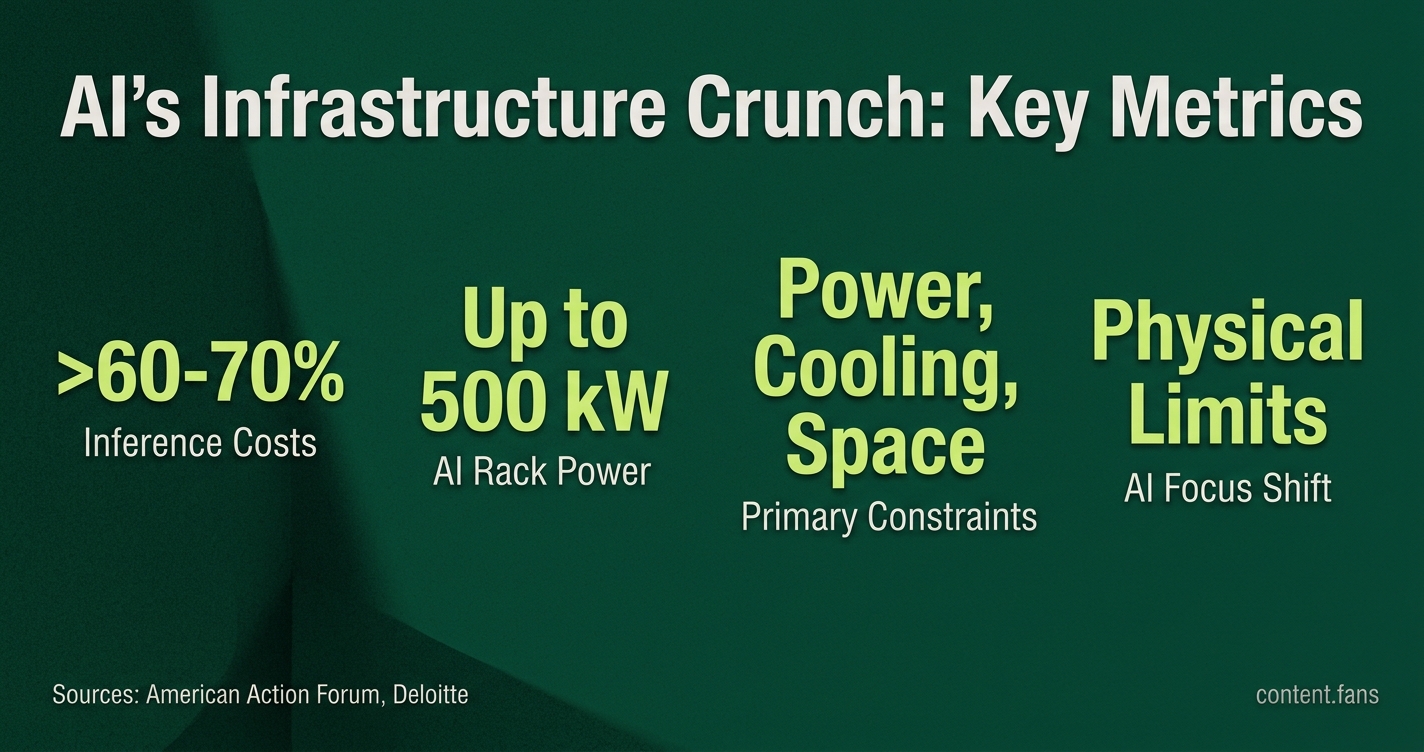
The crisis stems from a convergence of factors where physical limitations - power grids, cooling capacity, and data center real estate - have become the primary growth bottlenecks. As AI workloads move from intermittent training to constant, always-on inference, this creates sustained pressure that most existing enterprise infrastructure cannot support.
What makes inference economics different from training costs?
Inference, not training, has become the dominant long-term cost driver in production AI. Unlike model training, which is a capital-intensive but often intermittent process, inference workloads are continuous and operational, scaling directly with usage. According to Deloitte, these recurring inference costs can exceed 60% to 70% of the price of equivalent on-premise systems, creating a significant tipping point. This transforms cost management into a strategic workload placement decision, forcing leaders to evaluate which tasks benefit from cloud elasticity versus which are more economical to repatriate.
How are power and cooling constraints affecting deployment decisions?
Physical infrastructure limitations are now dictating AI deployment strategy. High-density GPU clusters generate immense heat and power demands, with some AI racks drawing up to 500 kW - far exceeding the design limits of most traditional enterprise data centers. This means AI growth is no longer just limited by GPU availability but by utility power capacity and site-level thermal constraints. In response, organizations are pursuing aggressive thermal redesigns, including liquid cooling and modular data center pods, and adopting distributed infrastructure strategies to balance performance with physical limitations.
Which vendor approaches are proving most effective for frontier model deployment?
The market is coalescing around model-agnostic platforms that give enterprises control over governance and deployment rather than locking them into a single ecosystem. For deploying frontier models, a multi-tiered vendor landscape is emerging. Large cloud providers like Microsoft Azure AI Foundry, Amazon Bedrock, and Google Vertex AI offer managed access and deep enterprise integration. Specialized infrastructure providers such as CoreWeave and Lambda Labs compete on raw GPU performance-per-dollar for high-scale inference. As noted in Forrester's Q3 2026 AI Platforms Wave, the most successful vendors are model-agnostic, reflecting enterprise demand for platforms that can run diverse models with robust governance and operational tooling.
What should procurement teams prioritize when evaluating AI infrastructure investments?
Procurement teams must adopt new evaluation frameworks to navigate the AI infrastructure market. Three priorities are essential:
- Analyze by Workload Type: Differentiate between the cost structures of training, fine-tuning, and inference. Since always-on inference is now the largest long-term expense, it requires the most rigorous financial scrutiny.
- Calculate Total Cost of Ownership (TCO): Move beyond simple cloud unit pricing. Factor in data egress fees, latency, and the rising importance of data sovereignty, which may favor regional or private compute deployments for certain workloads.
- Prioritize Operational Excellence: The primary bottleneck is shifting from hardware acquisition to production deployment. Prioritize vendors and platforms that demonstrate mature operational tooling, strong governance capabilities, and a clear strategy for managing costs and complexity at scale.