
Air Force adopts Salesforce for $72M, plans future AI integration
Serge Bulaev
The U.S. Air Force has agreed to use Salesforce software in a $72 million deal that may help combine many separate systems into one platform. This new system is expected to support future AI tools and make decision-making, training, and logistics easier and faster. Experts suggest this move might be a test case for wider use across the Department of Defense, but it is not certain how quickly it will be used or how effective it will be. The Air Force's use of Salesforce appears to focus on data consolidation and easier adoption of AI, but training workers may still be a challenge.

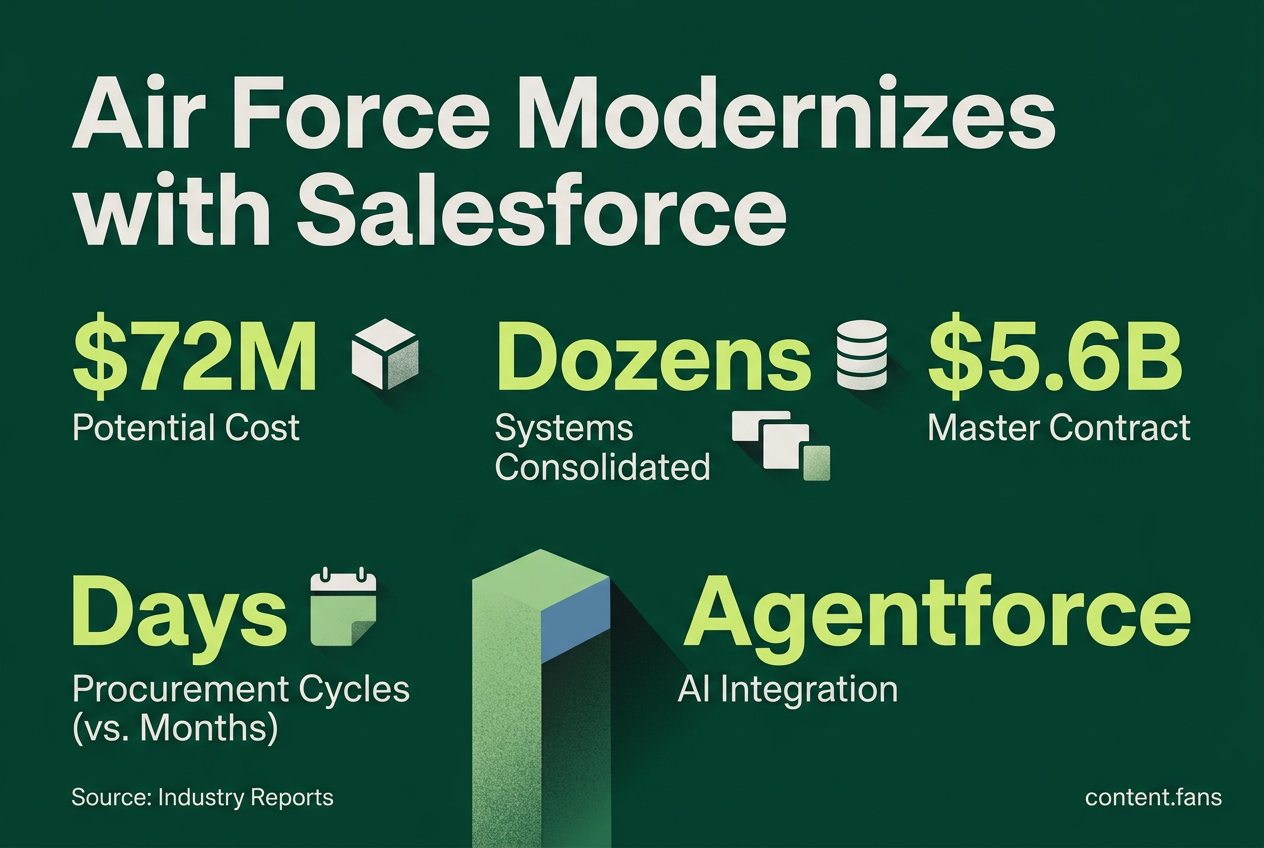
The provided results do not verify a May 13, 2026 Air Force Salesforce enterprise license agreement for $72 million. However, this strategic move would aim to consolidate dozens of disconnected systems into a single, interoperable platform for both the Air Force and Space Force. As the first major task order against a larger Department of Defense contract, such a deal would provide access to Salesforce's Agentforce, an "agentic layer" designed for deploying and governing compliant AI agents.
How the Air Force Plans to Use the Platform
This deal would provide the Air Force and Space Force with a single, interoperable Salesforce platform. It aims to consolidate dozens of disconnected systems, create a unified data foundation, and pave the way for integrating advanced AI tools for decision-making, logistics, and personnel management.
According to industry reports, the Air Force has outlined several primary objectives for the new platform:
- Speeding decision making through a unified mission view
- Supporting personnel from recruitment through veteran transition
- Improving readiness with training and workforce management tools
- Modernizing logistics with real-time visibility and predictive forecasting
- Scaling innovation by adding new capabilities on demand
These objectives align with the Pentagon's broader modernization goals, which are foundational to the larger 10-year IDIQ. Reports on the contract vehicle indicate it is designed to establish an "agentic enterprise" and dramatically reduce procurement cycles "to days instead of months."
Relationship to the Broader Army Contract
When the U.S. Army awarded Salesforce the master contract vehicle on January 26, 2026, it was structured to allow any Department of Defense component to place orders. The Air Force's task order would be the first public instance of another service leveraging this agreement. Analysts suggest this signals a strategic positioning of Salesforce's Government Cloud as a core data foundation for the military, rather than just a traditional CRM tool.
The master agreement, confirmed by Salesforce, includes a 5-year base ordering period and a 5-year option term. The ceiling represents the maximum potential value, with the final amount determined by the adoption rate across all services.
The Strategic AI Integration
The Air Force license is architected to support Agentforce, enabling pilot programs that automate routine tasks and enhance decision support. Reports describe Agentforce as an "agentic layer" built on the Salesforce data fabric. This model directly supports the Department of Defense's Artificial Intelligence Strategy, which promotes using "Enterprise Agents" to transform back-office operations.
Data consolidation is critical to this strategy. Government AI initiatives mandate that the Pentagon identify and scale AI automation workflows. By replacing fragmented systems, the Air Force aims to significantly reduce data movement and preparation costs, which industry reports suggest can account for a significant portion of an AI project's budget.
What to Expect Next
While no official deployment timeline has been released, early pilot programs are expected to focus on well-structured data areas like logistics visibility and personnel services. A key challenge will be workforce training, as government reports have identified AI literacy as a primary barrier to adoption across the federal government.
Ultimately, the Air Force's initiative would serve as a crucial test case for the Pentagon's broader modernization efforts. If the platform successfully accelerates decision-making and provides reliable governance for AI agents, it will likely encourage other Defense components to follow suit, driving further task orders under the same IDIQ.
What exactly is the scope and value of the new Air Force-Salesforce deal?
The agreement would be an enterprise license agreement (ELA) between the Department of the Air Force (covering both the Air Force and the Space Force) and Salesforce. It replaces dozens of fragmented point solutions with a single, interoperable platform that can evolve into the service's primary data backbone for personnel, logistics, and operational decision-making.
How does this contract fit into Salesforce's larger Pentagon footprint?
The Air Force award would be a task order under an IDIQ (Indefinite Delivery Indefinite Quantity) vehicle originally granted to Salesforce subsidiary Computable Insights LLC by the U.S. Army on January 26, 2026. Over its 10-year period (5-year base plus 5-year option), the IDIQ is open to all DoD agencies, giving any service rapid access to Salesforce's Trusted Government Cloud, AI agents, and data fabric without re-competing each requirement. The Air Force would be the first major follow-on customer, proving the Army contract's multiplier effect.
What AI capabilities will the Air Force actually receive?
From day one, the platform is architected for Agentforce, Salesforce's agentic layer that allows the creation, deployment, and governance of compliant AI agents. Planned use cases include:
- Accelerated decision cycles via a unified mission view
- End-to-end personnel support, from recruitment to veteran transition
- Predictive logistics for real-time supply visibility and failure forecasting
- Automated administrative tasks, cutting procurement lead times "from months to days"
What makes this deal significant for military enterprise workflows?
The contract would formalize Enterprise Agents as an operating model. By combining a single data fabric with governed AI agents, the Air Force can shift from manually stitched systems to AI-first workflows. Early DoD pilots show that a significant portion of total AI cost is no longer model training but data movement and cleansing; the Salesforce stack directly attacks that bottleneck by centralizing data and metadata governance, reducing duplicated silos across headquarters, wings, and bases.
Will other armed services follow the Air Force's lead?
Expect rapid uptake. The IDIQ already covers the entire Department of Defense, and the Air Force's initiative would be the first visible proof point. Navy, Marines, and Joint Commands can now issue task orders under the same vehicle, leveraging pre-negotiated security controls and pricing. Industry reports suggest that additional DoD components are evaluating near-term adoption, indicating the Air Force deal could catalyze significant follow-on orders.