
AI Won't Fix Advertising, Coordination Will
Serge Bulaev
Overall, improving structure and coordination appears to be more important than just adding new AI models.

The idea that AI won't fix advertising, but coordination will, is gaining traction as marketing teams see campaign results plateau despite investing in new models. The core issue isn't a flawed algorithm; it's the operational chaos from disconnected data, tools, and KPIs. This article explores why these data silos persist and how integrated platforms are the key to unlocking true performance.
Why Silos Keep Draining Media Budgets
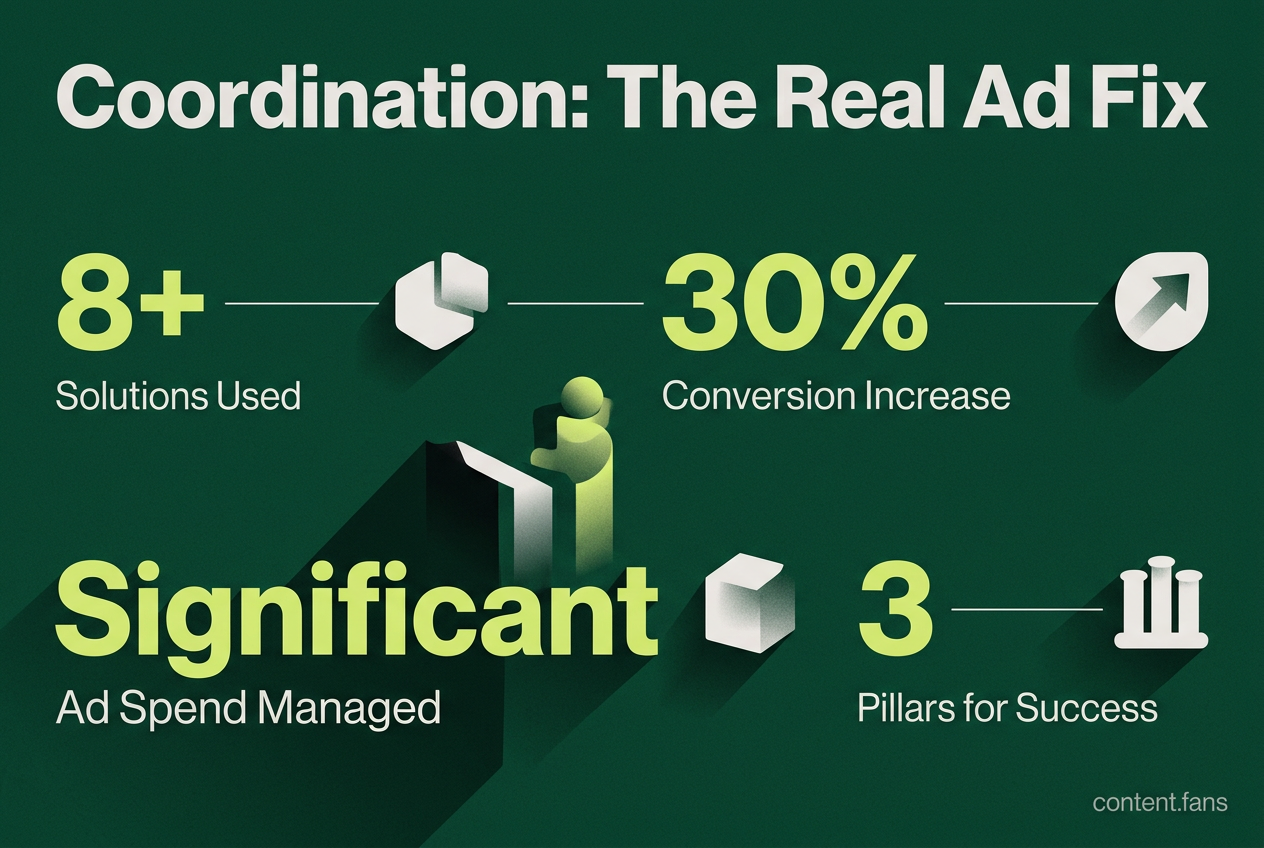
Fragmented campaign insights and wasted spend are common when advertisers use eight or more separate solutions. This environment creates data silos where walled gardens trap audience IDs, making vital cross-channel frequency capping nearly impossible. As industry experts note, "the future of advertising is structure-first, then AI-enabled," underscoring that effective coordination must be established before automation can succeed.
Advertising performance suffers not from a lack of sophisticated AI, but from a lack of structural coordination. When planning, creative, buying, and measurement tools operate in isolation, they generate fragmented data. AI models fed this incomplete information can only produce partial, suboptimal outcomes, failing to improve results.
Early Moves Toward Coordinated Platforms
Major technology platforms are recognizing the immense commercial value in creating integrated advertising ecosystems. For example, closed-loop AI systems are projected to manage a significant portion of global ad spend in the coming years, with retail media representing a growing share of digital advertising budgets (CommunicateOnline). This trend is validated by AI-powered generative search (Google SGE) which resulted in a 30% increase in conversion rates, proving that shared data drives performance.
The Three Pillars of a Coordinated Structure
Before deploying more advanced AI, experts identify three foundational prerequisites for success:
- Shared Taxonomies: A common data language is needed to align streams from PR, SEO, creative, and paid media.
- Quality Checkpoints: Automated systems must include triggers for human review when specific risk thresholds are met.
- Unified Attribution: A single attribution model must track the customer journey from initial discovery to final purchase.
By implementing these, brands can shift algorithmic optimization from simple proxy metrics like CPMs toward full-funnel profitability.
Multi-Agent Collaboration is Taking Shape
The future of coordination lies in multi-agent AI systems. Early experiments demonstrate specialized agents - for audience modeling, creative personalization, and offer timing - communicating in real time to optimize campaigns. Industry analysts see the coming years as pivotal for these systems, assuming compute costs are manageable. This collaborative approach enables continuous learning across the customer journey, reducing the need for manual campaign resets.
Why DSP Inputs Still Decide Outcomes
Ultimately, the performance of any Demand-Side Platform (DSP) is determined by the quality of its inputs. Research highlights that for many organizations with low decision-making maturity, AI merely amplifies existing errors. To build reliable bidding strategies, essential quality mechanisms like data validity checks, bias monitoring, and logs of human-AI disagreements are non-negotiable. An advanced DSP is useless if the data it receives is flawed.
What is the biggest obstacle to better advertising results today?
Siloed systems that refuse to talk to each other. DSPs, creative studios, audience platforms, and measurement tools run on separate data sets and KPIs. The result is the same shopper seen as three different people, the same dollar counted three different ways, and optimization loops that reset every quarter. AI can only amplify what it receives; if each layer hands it a partial picture, the output stays partial.
How are leading brands solving the integration problem?
They are moving from "AI-first" to structure-first, then AI-enabled. A shared data layer is built before any model is switched on, giving every AI agent the same customer ID, cost log, and outcome feed. Google's AI Max for search campaigns shows conversion lifts of 14-27% according to early pilots, demonstrating that when search, shopping, and YouTube budgets sit in one bucket, performance improves significantly. Amazon DSP is gaining adoption among advertisers, partly because its SKU-level supply chain data is already wired into the bid stream.
Does better AI input really improve DSP performance?
Yes. Industry studies found that many firms still run low-maturity decision processes; when those firms plug AI into their DSP, poor inputs simply scale faster. Teams that added quality checkpoints and human-AI disagreement logs saw significantly lower wasted spend within two quarters. The lesson: clean signals, shared taxonomies, and traceable overrides turn AI from a noise amplifier into a performance lever.
What will "coordination" look like in future campaigns?
Autonomous agents will negotiate media buys with each other while a conductor agent watches the full journey. If a shopper abandons cart on mobile, the conductor can:
- tell the search agent to raise ROAS bids for her exact keyword
- trigger the creative agent to swap desktop hero images to the product she viewed
- alert the email agent to wait 30 min before sending the discount code
All of this happens without human tickets or CSV hand-offs.
Where should marketers start this week?
- Map every place your customer data is born - CRM, site pixel, POS, app - and pick one ID spine.
- Force your creative, audience, and bidding teams to share a single cost file every morning; no Excel, one cloud table.
- Before you green-light any new AI vendor, ask for a diagram of how its outputs feed your DSP in real time. If the arrow stops at a dashboard, walk away.