
AI Transforms Email Marketing in 2026: 4 Ways Campaigns Adapt
Serge Bulaev
AI in email marketing in 2026 may help make each message more personal by using data on what people do and want. Platforms appear to use predictive models and generative tools to change subject lines, send times, and content based on real-time behavior. Reports suggest that AI can increase open and conversion rates, but results may depend on the quality of the data used. Analysts note that measuring success with AI can be tricky, and recommend tracking revenue for each subscriber. Overall, the technology seems strongest when it connects all parts of the email workflow and is guided by human strategy and rules.

AI is transforming email marketing from a broadcast tool into a system for intent-driven orchestration. Mainstream platforms now use predictive models and generative AI to dynamically shape every campaign element, from subject lines to send times, creating individualized experiences at scale that adapt to real-time customer behavior.
Predictive engines rewrite the segmentation playbook
AI tools can help keep lists fresher by monitoring decay signals and verifying contacts, but static lists are not shown to be obsolete. Best practices center on behavior- and intent-driven segmentation. A trend briefing from Backstroke states that platforms continuously update subscriber models, automatically adjusting journeys when a customer browses, clicks, or abandons a cart. Salesforce reports similar functionality, where its AI layer recommends offers in near real-time based on lifecycle stage and predicted purchase intent. This allows for dynamic changes to send frequency, content, and incentives without manual intervention.
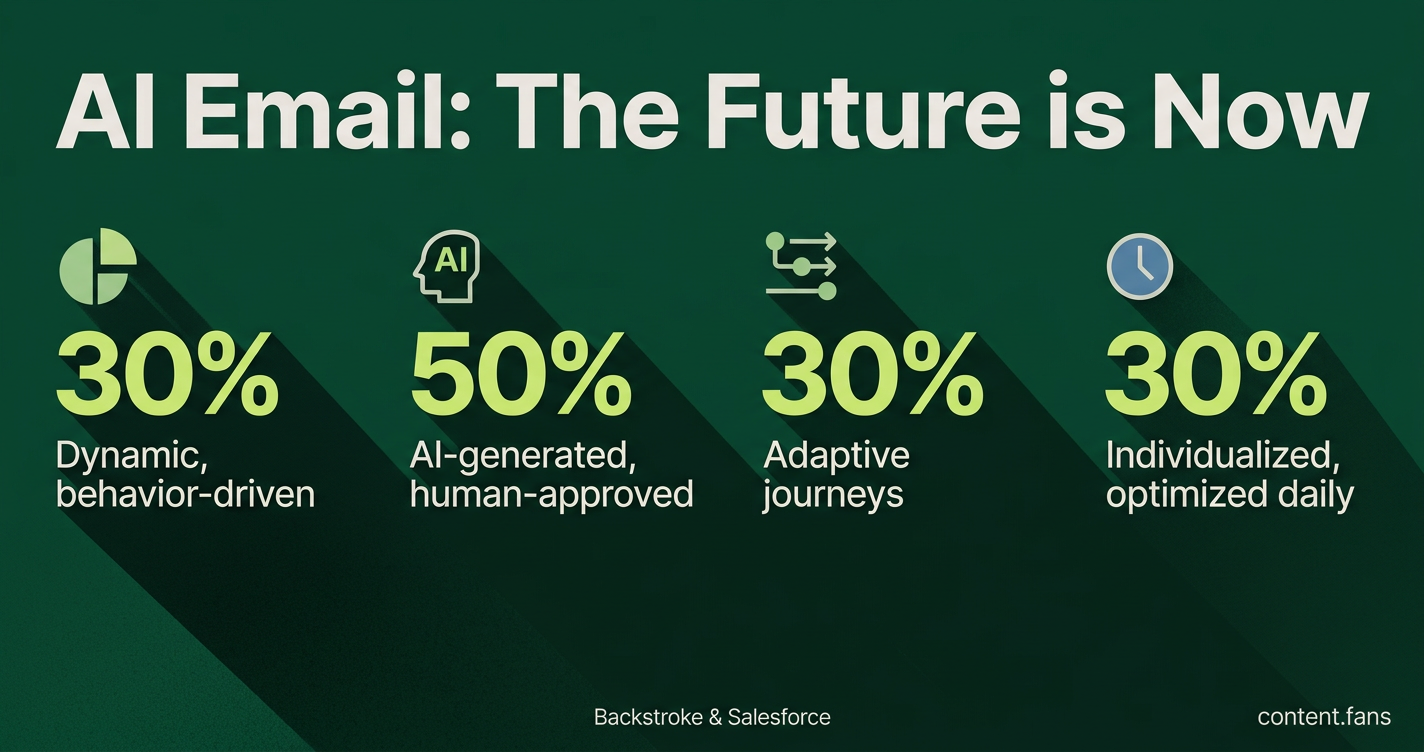
AI is revolutionizing email segmentation by replacing static lists with dynamic, behavior-driven models. Instead of manual grouping, AI systems continuously analyze real-time user actions - like browsing, clicks, and cart activity - to automatically adjust marketing journeys, ensuring that content and offers remain relevant to each individual subscriber's current intent.
Dynamic creative at scale
Generative AI now extends far beyond simple subject line ideas. Modern workflows involve feeding brand guidelines into text and image generators to produce campaign creative, which then passes through human approval. According to industry reports, AI-generated subject lines can significantly improve open rates, with notable revenue increases for campaigns combining AI copy with predictive timing. This enables powerful, intent-driven creative; a customer viewing winter gear could receive an email with AI-generated copy about thermal lining, while a lapsed user gets a concise, incentive-focused message. Marketers stress the importance of human governance through brand-voice rules and compliance guardrails.
Adaptive sequencing and send-time optimization
Fixed drip campaigns are giving way to adaptive journeys that re-route subscribers based on real-time engagement. If a user opens or clicks, the AI can alter the sequence within minutes. This approach drives significant results, with automated journeys achieving substantially higher open rates and conversions compared to static campaigns. AI systems constantly evaluate recent interactions and historical data to find the next-best send time for each individual, updating schedules daily for maximum impact.
To prepare for this shift, teams should follow this readiness checklist:
- Verify first-party data quality and consent status before feeding models
- Map lifecycle triggers (browse, cart, support ticket) to content variants
- Define brand-voice parameters inside generative tools
- Establish human review for high-risk segments such as regulated products
- Benchmark AI readability scores alongside traditional deliverability metrics
Measuring ROI without overpromising
While AI promises significant returns - with advanced adopters showing substantially higher ROI according to industry reports - measuring success requires a new mindset. Experts caution that results hinge on data quality and cross-channel strategy. Instead of focusing on campaign-level lifts, analysts recommend tracking incremental revenue per subscriber, a more accurate metric for adaptive systems that blur the lines between individual sends.
Ultimately, the power of AI lies in orchestration. As AI manages the tactical work of segmentation, creative, and timing, marketers can focus on high-level strategy and governance. The greatest gains are realized when AI integrates the entire marketing workflow, from CRM to web analytics, into a unified, intelligent system.
How is AI redefining email personalization?
AI has moved past simple {first-name} tokens and static segments. The most advanced platforms use behavior- and intent-driven orchestration, stitching together real-time browsing data, lifecycle stage, and purchase intent to create an individualized message for every subscriber. The result: brands report significant open-rate lifts and substantial revenue increases per campaign when these systems are fully deployed.
What are the four campaign models that have emerged with AI?
- Predictive Personalization at Scale - AI chooses subject lines, offers, and content blocks for each recipient.
- Micro-Moment Triggers - Emails fire when a shopper hits a specific page depth, abandons a cart, or lingers on a product.
- Dynamic Creative Generation - Generative AI drafts copy, images, and CTAs that still pass human brand-voice approval.
- Adaptive Sequencing & Send-Time - Journeys evolve in real time; the send time for the next message is recalculated for each person based on their last interaction.
Why does inbox AI filtering matter to marketers?
Gmail and Apple Mail now summarize and rank incoming mail before a human even sees it. Marketers must optimize for deliverability, clarity, and AI readability instead of classic open-rate tricks. Clear subject-line semantics, concise pre-headers, and structured schema markup are quickly becoming table stakes for reaching the primary tab.
How does AI change the marketer's daily workflow?
- Manual segmentation decreases - the system creates a segment-of-one automatically.
- Creative sprints shorten - AI drafts multiple subject lines in seconds, freeing the team to focus on strategy, brand governance, and compliance.
- Testing happens continuously - multivariate tests run inside the same campaign, so human oversight is about setting rules and safety rails.
What KPI gains can teams expect?
Across industry reports, AI-driven programs show significant improvements:
| Metric | Traditional Benchmark | AI-Driven Result |
|---|---|---|
| Open rate | Industry average | Significantly higher |
| Click-through rate | Industry average | Substantially improved |
| ROI | Standard returns | Notable increases |
| Revenue lift vs. manual | - | Meaningful gains |
Teams that achieve these gains share three traits: unified first-party data, real-time CRM sync, and human-in-the-loop approval processes to keep the brand voice consistent.