
AI Transforms Email Marketing: $76K Revenue From One Message
Serge Bulaev
AI may be changing email marketing by making messages more personal and adaptive, rather than just scheduled blasts. Recent reports suggest that tools now use live data to decide what content to send, when to send it, and to whom, which might increase engagement and revenue. Some case studies claim that AI-personalized emails have led to more opens, clicks, and higher sales, but these results are self-reported and may not apply to everyone. Experts suggest that the biggest benefits come when AI is used across several parts of the email process, not just for writing. Looking forward, research suggests email systems could become even smarter, making more decisions automatically, but transparency about these choices appears to be increasingly important.

The way AI transforms email marketing is by shifting campaigns from static broadcasts to adaptive, one-to-one conversations. Modern platforms now use live data to orchestrate content, timing, and segmentation for each subscriber, driving significant lifts in engagement and revenue. While case studies report major gains, experts note the best results come from applying AI across the entire workflow, not just copywriting. As systems grow more autonomous, transparency around automated decisions has become a critical focus.
Marketers experimenting with AI-driven personalization in email marketing are seeing their newsletters behave less like scheduled blasts and more like adaptive conversations. Over the last 24 months, software development teams have woven predictive models and automation engines into existing platforms, letting campaigns decide timing, content, and even next steps on the fly.
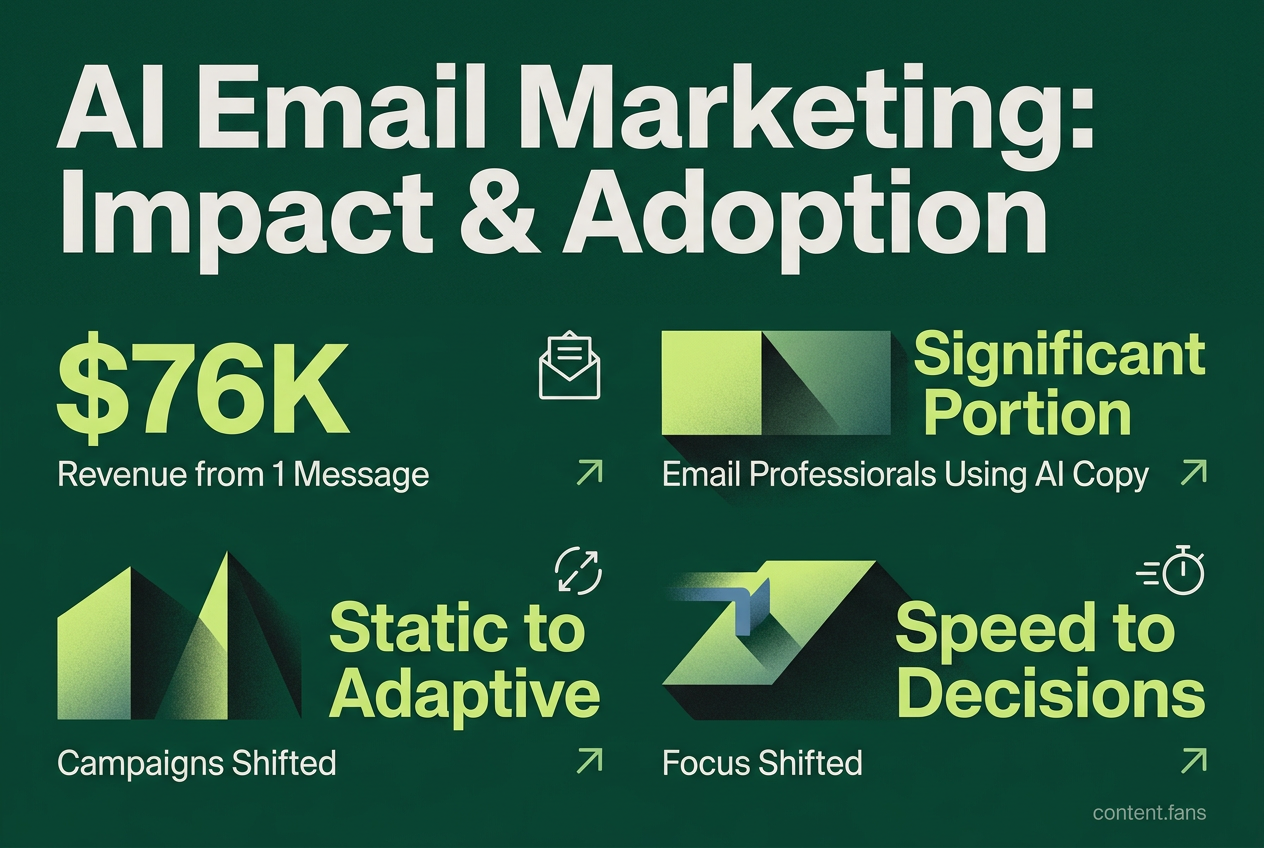
Industry research from recent years suggests that the push toward real-time orchestration is reshaping every stage of the email workflow, from copywriting to lifecycle strategy.
AI-driven personalization in email marketing: Current snapshot
AI-driven personalization uses machine learning algorithms to tailor email content, send times, and offers to individual subscribers in real time. Rather than sending one message to a large segment, the system analyzes behavioral data like browsing history and past purchases to assemble a unique message for each person.
Early gains focused on speed. Generative systems drafted subject lines and body copy in seconds, a practice that Litmus says a significant portion of email professionals now use occasionally for copywriting (Litmus). Recently, attention shifted toward decision engines that pick send times and content blocks per subscriber. Salesforce notes that these engines optimize segmentation, personalization, and timing inside its platform, improving engagement odds (Salesforce).
From segmentation to orchestration
The newest tools assemble emails in real time using live behavioral data. Reports indicate that platforms evaluate browsing signals, purchase history, and engagement velocity before choosing:
- product recommendations that appear inside the message
- the precise minute a send lands in each inbox
- whether to trigger a re-engagement flow or a sales offer
Braze characterizes this as an orchestration layer that selects the "next-best action" for every recipient, suggesting campaigns act more like adaptive journeys than fixed sequences (Braze).
Measured lifts - with caveats
Vendor case studies claim tangible uplifts, though the figures are self-reported and may vary by program:
• Industry reports cite significant improvements in open rates and click-through rates from AI-powered subject-line generation across major e-commerce platforms.
• Multiple analyses attribute substantial revenue increases to AI-personalized email programs when compared with manual campaigns.
• Direct-to-consumer brands reportedly earn significant revenue from single back-in-stock messages driven by behavioral signals.
These results suggest that targeting, timing, and automated lifecycle triggers often matter more than copy tweaks alone. Experts believe the strongest returns come when AI influences multiple layers of the journey rather than just the text.
What development teams are building now
Engineering roadmaps emphasize several key capabilities:
- Predictive send-time models that retrain daily on open and click logs.
- Dynamic content rendering through modular, schema-based templates.
- Reinforcement loops that promote winning variants after multivariate tests run at subscriber level.
Marketers integrating these features note shorter production cycles and faster test-and-learn cadences. However, CIO-level surveys caution that transparency is becoming essential. Enable Services warns that users will soon require explanations for every automated decision, framing explainability as a "non-negotiable" rather than a luxury.
Looking ahead to agentic systems
Research aggregated by AlphaBOLD and Mission Media indicates that CRM suites are evolving from passive data stores into agentic systems capable of executing approved tasks. In email, that may mean autonomous selection of offers, suppression of over-messaged contacts, or real-time channel switches. While forecasts differ, industry projections suggest that a significant portion of enterprise apps could host task-specific AI agents in the coming years, illustrating how quickly these functions may enter mainstream tooling.
The trajectory described by current studies hints at a future where email remains a central channel, yet operates through continuous feedback loops, adaptive logic, and code-backed transparency.
What specific AI technologies turned a single email into significant revenue?
Dynamic content rendering, behavior-based segmentation, and next-best-action orchestration combined to deliver impressive results. DTC brands trigger back-in-stock alerts only to shoppers who had previously browsed the product, display complementary accessories unique to each recipient, and schedule send-time to each user's predicted attention window. These campaigns produce substantial revenue from individual messages.
How has AI-driven email marketing evolved in recent years?
Early tools focused on generating subject lines faster.
- Recent systems introduced predictive send-time and behavior-triggered flows.
- Current systems operate as full orchestration engines, selecting content blocks, timing, and next-best actions in real time. Salesforce and Braze both note that AI is now managing entire lifecycle journeys instead of static drip sequences.
Which metrics improve most with AI personalization?
Across industry case studies, vendors report:
- Substantial revenue increases versus non-AI programs
- Significant improvements in open rates and click-through rates from AI subject-line optimization
- Major revenue increases for campaigns using AI segmentation compared to broadcast lists
These figures come from platform case studies and should be viewed as industry claims, not guarantees.
What makes AI "agentic" in modern CRM platforms?
"Agentic AI" means the system executes tasks autonomously within guardrails set by humans. Instead of recommending a follow-up email, the CRM can now:
- schedule and send the message
- qualify the lead based on real-time behavior
- update the pipeline without human clicks
Enable Services calls explainability "non-negotiable" so marketers can audit every automated decision.
How can a brand start adopting these capabilities today?
- Connect behavioral data to your email platform (browse, purchase, support tickets).
- Activate predictive send-time and dynamic product blocks first - these deliver the fastest measurable lift.
- Run holdout tests: keep a portion of the list on legacy workflows to validate revenue impact before full rollout.
Industry reports indicate that many marketers already use AI for copywriting occasionally, so early experimentation is now mainstream rather than bleeding edge.