
AI Transforms Consulting: Billable Hours Fade by 2026
Serge Bulaev
AI appears to be moving the consulting industry away from charging by billable hours, according to several 2026 reports. Instead, firms may offer fixed-price services, subscriptions, and contracts linked to client outcomes. Analysts suggest this is happening because AI can do research faster and clients want clear results. Some sources note the shift is not happening everywhere and traditional billing is still used in complex cases. Overall, the change seems to be growing but is not yet complete across the industry.

As AI transforms consulting, the industry is accelerating its move away from traditional billable hours toward outcome-based and performance-based pricing, though this transition is gradual rather than an immediate replacement. In its place, firms are increasingly adopting value-based pricing structures, including fixed-scope projects, recurring subscriptions, and contracts directly linked to client performance.
What is replacing the billable hour in consulting?
Consulting firms are replacing the billable hour with value-centric models like fixed-price projects, outcome-based contracts, and recurring subscriptions. This shift allows clients to pay for measurable results and packaged expertise rather than the time spent by consultants, aligning costs more directly with delivered value.
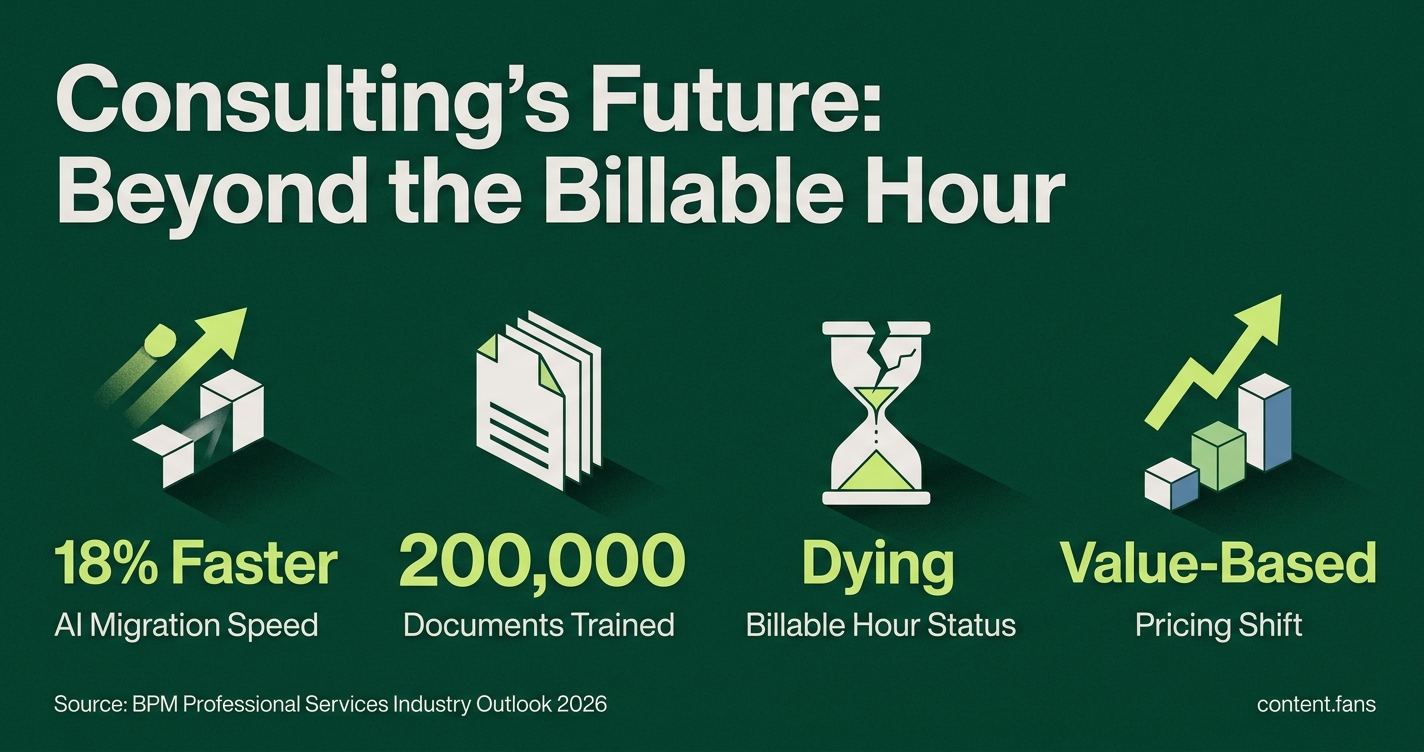
The primary alternatives are outcome-based pricing, subscription models, and productized services. According to BPM's Professional Services Industry Outlook 2026, "the billable hour is dying" as firms prioritize "pre-agreed outcomes for pre-agreed prices." Plunkett Research confirms this trend, noting that as AI completes work in minutes that once took weeks, hourly billing is giving way to value-based pricing and performance incentives. Major firms like PwC are already building platforms like PwC One to support subscription and outcomes-based models.
Why does AI make time-based billing less defensible?
Time becomes a weak proxy for value when AI can produce the same output dramatically faster. By automating research, analysis, and draft creation, AI significantly reduces the labor required for tasks that once consumed many billable hours. This capability compression creates pricing pressure, as clients rightly expect to pay for tangible results and systems, not the hours used to produce them. FTI Consulting warns this will lead to "pricing compression and EBIT pressure" in service lines most exposed to AI automation.
What does "productized consulting" look like in practice?
Productization involves packaging expertise into repeatable, standardized offerings with a defined scope and predictable delivery. Instead of bespoke projects, clients purchase scalable solutions. Common examples include:
- Fixed-scope diagnostic assessments
- AI-driven analysis tools
- Subscription access to advisory services
- Performance-linked engagements tied to specific KPIs
- Client-facing workflow platforms
A concrete example is KPMG and SAP's AI Migration Copilot, trained on 200,000 documents, which accelerates complex migrations by 18%. This approach turns institutional knowledge into a reusable asset.
How is AI changing the nature of client engagements?
Engagements are shifting from one-off reports to continuous capability building. Instead of simply delivering a final recommendation, firms now use AI to embed expertise directly into client operations. This model involves AI-assisted delivery, direct client team enablement, and feedback loops for sustained improvement. For example, McKinsey and QuantumBlack AI developed a "capability building engine" for Deutsche Telekom to ensure client teams could maintain performance long after consultants left.
What should firms prioritize to succeed in this transition?
The key differentiators are proprietary assets, deep implementation expertise, and a focus on measurable outcomes. Firms with unique data sets, custom AI tools, and proven workflow platforms can defend margins and justify recurring revenue. According to industry reports, major consulting firms are increasingly generating significant portions of their revenue from outcome-based contracts. To navigate this shift, firms must prioritize:
- Building reusable knowledge platforms from past projects.
- Defining and tracking clear performance metrics like cycle time or adoption rates.
- Packaging expertise into scalable platforms, not just one-off service engagements.
The most successful consultancies will reposition themselves as technology-enabled delivery organizations, a crucial distinction that will separate market leaders from the competition.