
AI Transforms Business, Policy, and Daily Life by 2026
Serge Bulaev
By 2026, AI may be deeply involved in business, government policy, and daily life, according to journalists and researchers. Some reports warn that generative AI might be making the internet less reliable, while governments are beginning to create laws and rules for how AI should be used. Spending on AI is projected to rise sharply, but experts suggest this could bring economic risks. Studies show that certain jobs, especially entry-level ones, might become harder to get as AI takes over some work tasks, although overall unemployment has not clearly increased. Disinformation may become easier and quicker to spread with AI, and the fight between fake content creators and those trying to stop them appears to be ongoing worldwide.

The ways AI transforms business, policy, and daily life are no longer speculative but a pressing reality documented by leading researchers and journalists. Artificial intelligence is now deeply embedded in global business spending, new government regulations, and the habits of daily life, demanding an immediate response from decision-makers.
Pervasive Systems, Visible Problems
The proliferation of AI has created tangible challenges. Industry reports note that generative AI is creating concerns about internet content quality with a flood of unreliable content. This issue is part of a broader trend where analysts observe chatbots and image generators infiltrating search results, social media, and workplace software.
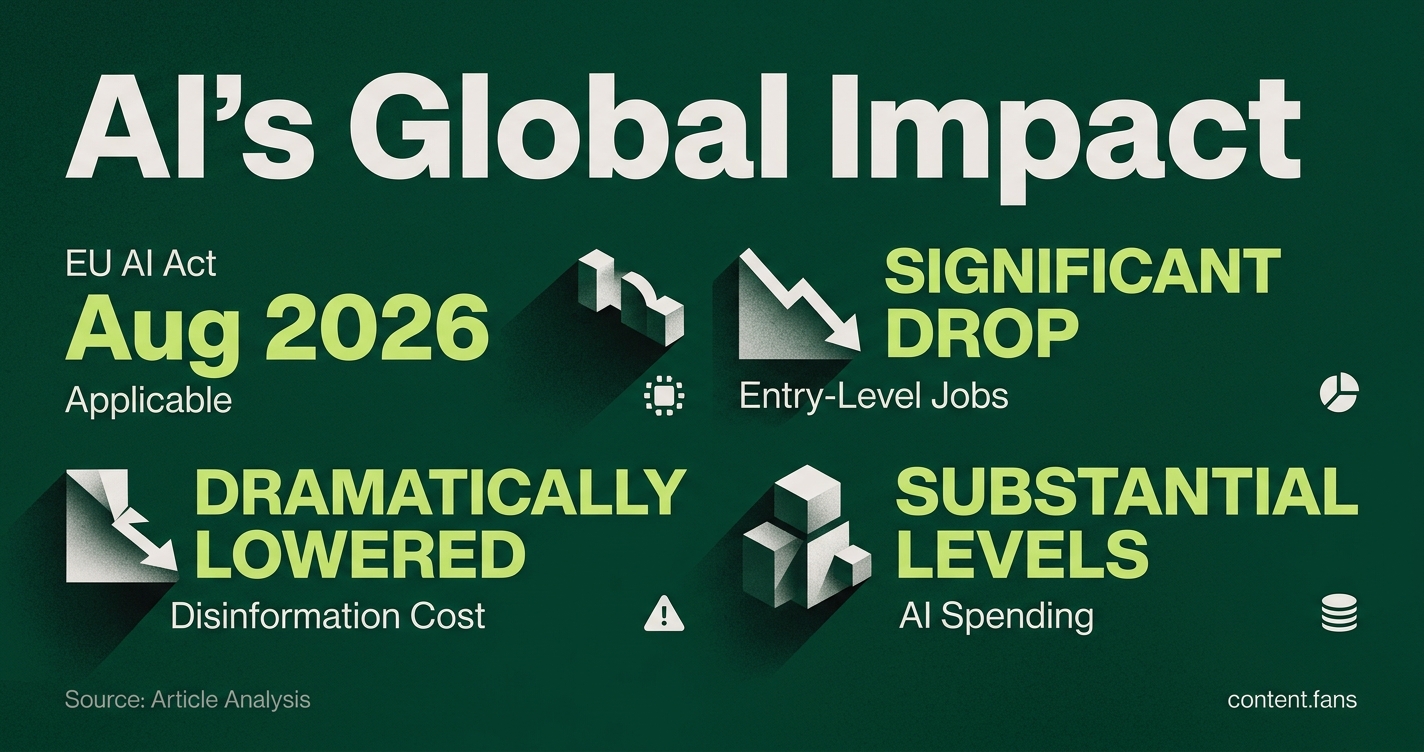
Artificial intelligence has moved from a theoretical concept to a practical force embedded in daily operations. Its influence is seen in massive business investments, the rapid development of global regulations, a changing job market, and the very structure of the digital information we consume.
Global governments are now responding to these visible problems. The European Union's AI Act, fully applicable by August 2026, establishes a legal framework with strict obligations for "high-risk" systems. In contrast, the United States has pursued a different path with executive orders to create frameworks for federal agencies, aiming to address regulatory gaps.
The Price Tag of Ubiquity
The sheer scale of investment highlights the technology's momentum. Industry projections suggest global AI spending will reach substantial levels in the coming years. This capital surge carries significant economic risk, with experts cautioning that market volatility is likely, regardless of whether the investment boom proves sustainable. This spending is fueling massive infrastructure projects, including vast data-center construction, and concentrating economic activity around key technology providers.
Labor Markets in Transition
AI's impact on employment is becoming clearer, primarily affecting entry-level positions rather than causing mass unemployment. Industry reports indicate a significant drop in job-finding rates for young workers in highly exposed fields like programming. While aggregate unemployment has not spiked, research from Goldman Sachs and the Law & Economics Center points to a significant shift. AI is automating a substantial portion of work tasks and compressing career ladders by eliminating entry-level duties. Analysts suggest that the primary challenges are now hiring friction and the need for large-scale reskilling, which may define economic outcomes more than the productivity gains themselves.
Disinformation: Cheaper, Faster, Harder to Trace
Generative AI models have dramatically lowered the cost and complexity of creating disinformation. Security researchers tracking recent election cycles identify several key tactics powered by this technology, including deepfake impersonations, automated spam campaigns, and AI-driven sockpuppet accounts that amplify divisive content. This has created a technological arms race, as platforms simultaneously deploy AI-powered detection tools to counter these threats. However, measuring the true impact of this synthetic content remains difficult, as campaigns often blend human and machine-generated material, and platform moderation policies are in constant flux.
Governance Experiments Worldwide
The push for AI governance has gone global, with many nations adopting risk-based legal frameworks similar to the EU's. A growing number of jurisdictions, including Brazil, Vietnam, and Kazakhstan, have developed enforceable AI rules. China has implemented its own comprehensive regulatory stack focused on algorithm registration, content control, and data localization. This global patchwork of laws, with numerous distinct policy initiatives being tracked by research organizations, requires multinational companies to focus on core compliance tasks like model documentation, data transparency, and establishing human oversight to prepare for audits.
How has AI moved from speculative concern to an unavoidable, practical reality?
AI is no longer a future threat; it is embedded in everyday operations, policy debates, and even physical infrastructure. In a series of Atlantic analyses, Matteo Wong observes that the technology has jumped from conference-room hypotheticals to immediate ethical and economic dilemmas. Global spending on AI is projected to reach substantial levels, while the electricity appetite of new data centers is reshaping regional power grids. The bottom line: businesses, regulators, and citizens must now respond to harms that already exist, not risks that may never arrive.
Which policy regimes have gone furthest in converting AI principles into enforceable rules?
The European Union now operates the world's first comprehensive AI statute. The EU AI Act entered into force on 1 August 2024 and will be fully applicable by 2 August 2026. It imposes strict, risk-based obligations on developers and deployers, with penalties tied to global turnover.
Elsewhere, the picture is fragmented: the United States relies on executive orders, agency guidance, and sector-specific enforcement. The U.S. AI governance landscape is fragmented. China's AI governance is also layered and rule-based, with algorithm registration and security review requirements for public-facing services. Research organizations are tracking a growing number of distinct regulations across many countries, confirming that binding AI governance is spreading faster than any prior tech-regulatory wave.
What measurable impact is AI having on labor markets right now?
The first statistically significant signal is a slowdown in entry-level hiring, not mass layoffs. Industry studies indicate that workers in highly exposed occupations (software, customer support, financial analysis) have experienced significant drops in job-finding rates compared with previous baselines. Research organizations estimate that a substantial number of positions are technically exposed to automation, but project relatively modest increases in unemployment if adoption proceeds gradually. Current analysis sees no aggregate disruption yet, highlighting that the present impact is reallocation at the margin, not displacement at scale.
How is AI changing the disinformation landscape?
Generative AI has made large-scale deception cheaper, faster, and harder to attribute. Industry warnings that "AI is slowly degrading the internet" reflect concerns about synthetic text, deepfake audio, and multilingual botnets that can be created inexpensively and targeted at niche audiences. Detection tools are improving in parallel, creating a classic cat-and-mouse escalation. While policy researchers stress that impact is still difficult to quantify, the capability expansion is undeniable - and upcoming electoral cycles will be significant tests.
What immediate steps should an organization take to stay compliant and competitive?
- Map every AI use case against risk tiers defined in the EU AI Act - prohibited, high-risk, limited-risk, minimal-risk - and assign clear ownership.
- Build transparency documentation now: model cards, data provenance logs, and human-oversight records are already required for GPAI models in Europe and are under review in multiple U.S. agencies.
- Track local rules continuously: jurisdictions such as Brazil, Korea, and Kazakhstan have copied the EU's risk-based language, but deadlines and penalties vary.
- Audit labor exposure: using available frameworks, identify roles where AI is likely to narrow entry-level pipelines and invest in targeted reskilling.
- Monitor AI-generated content touching your brand: adopt real-time detection services and prepare incident-response playbooks before the next synthetic-media spike.
Adopting these moves today will put boards and compliance teams ahead of upcoming enforcement waves.