
AI tools cut pull request review times to under 24 hours
Serge Bulaev
Recent benchmarks suggest that using AI tools may help keep pull request (PR) review times under 24 hours, which appears to be linked to higher contributor engagement. A hybrid workflow is recommended, where AI scans PRs for issues and maintainers make the final decisions. Queue-based bots like GitHub Actions and Mergify can help manage many PRs by merging them one at a time after checks pass. Tracking key metrics such as time to first review and percentage of PRs merged within 24 hours may help teams spot problems early. Projects that use these practices reportedly see fewer merge conflicts and less manual work for maintainers.

Using AI tools to cut pull request review times to under 24 hours is crucial for busy maintainers facing relentless PR queues that can stall development. Recent data shows that achieving a sub-24-hour PR lifecycle boosts contributor engagement, a target many open source projects currently miss (GitKraken benchmarks). This guide details a proven, metrics-driven approach where AI handles repetitive tasks, empowering maintainers to focus on critical decisions.
Hybrid review workflow: define the robot's lane
A hybrid workflow uses AI to perform initial PR scans for common issues like security vulnerabilities, code defects, and insufficient test coverage. The AI provides an annotated report, allowing human maintainers to bypass routine checks and focus immediately on architectural integrity and complex logic, accelerating the final approval.
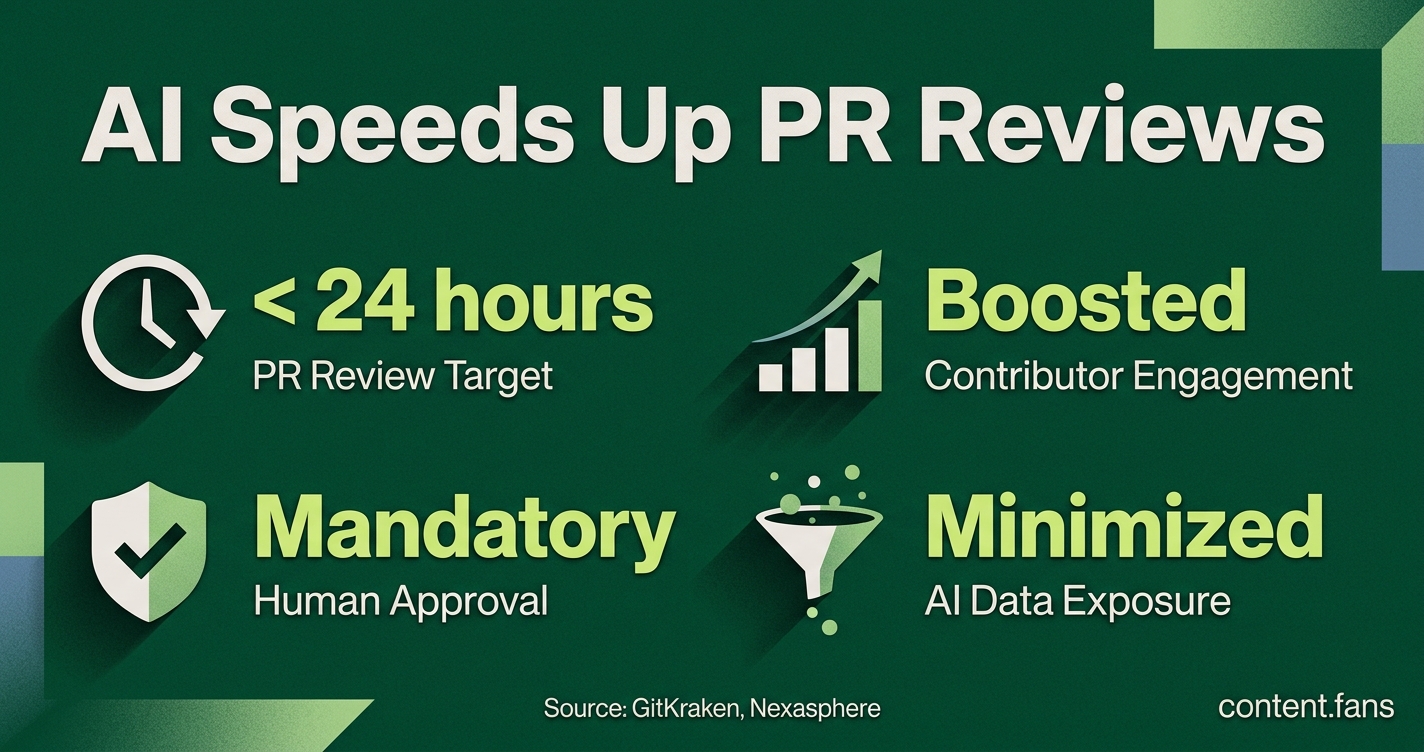
Leading practices recommend a hybrid workflow where AI automates first-pass reviews, flagging defects, security flaws, and test coverage gaps before a maintainer provides final architectural sign-off (hybrid workflow primer). To minimize noise, start with a single repository and a focused ruleset. Only expand the AI's scope after validating its effectiveness by tracking dismissal rates to ensure its feedback remains valuable.
Key guardrails for a secure and efficient hybrid model include:
- Minimize data exposure: Send only the code diff, title, and necessary file paths to external AI services.
- Clarify AI feedback: Label AI-generated comments as informational, reserving blocking status for high-severity issues.
- Maintain human oversight: Mandate at least one human approval for merging any PR, especially if an AI-generated flag is present.
Tools that tame pull request floods
To manage high PR volume, use queue-based automation tools like GitHub Actions or Mergify. These bots create an orderly merge queue, processing PRs sequentially after all automated checks pass. This approach is demonstrated in workflows that automate rebasing, testing, and merging, effectively creating a status-check gated auto-merge system (workflow example). Combined with branch protection rules, this ensures the main branch remains stable and frees reviewers from fixing broken builds.
Implement a least-privilege permission model to minimize risk:
| Actor | Allowed actions |
|---|---|
| External contributor | Open PR, respond to review |
| AI reviewer bot | Comment, label, request changes |
| Merge bot | Merge when required checks and 1 maintainer approval are present |
Metrics every maintainer should watch
Slow response times are directly linked to lower contributor retention. To maintain a healthy development pipeline, continuously monitor these key performance indicators (KPIs), preferably on a public dashboard:
- Time to First Review: How quickly a human reviews a new PR.
- AI Comment Dismissal Rate: The percentage of AI suggestions that are ignored or rejected.
- Reviewer Queue Length: The number of open PRs assigned to each maintainer.
- 24-Hour Merge Rate: The percentage of PRs successfully merged within the benchmark window.
Regularly analyzing this data helps identify bottlenecks, refine AI configurations, and improve contributor onboarding.
Contributor gating without friction
Implement frictionless gates to protect code quality without discouraging contributors:
- Enforce CI Checks: Automatically require all continuous integration checks to pass before a merge, preventing broken code from entering the main branch.
- Protect Sensitive Code: Use label-based allowlists to restrict changes in critical directories to trusted contributors.
- Set Clear Expectations: Add a note about AI tool usage in your
CONTRIBUTING.mdfile to ensure transparency.
Teams adopting these practices report significant reductions in merge conflicts and manual rework, as the merge queue automates rebasing and validation.
Post-merge automation as the final relief valve
After a PR is successfully merged, automation can handle final cleanup tasks to reduce maintainer workload. Configure bots to automatically delete the source branch, update changelogs, and backport critical fixes. This keeps the repository clean and developers focused on new work. Remember to continue monitoring your key metrics; if merge latency or AI dismissal rates increase, it's a sign to reassess and refine the AI's role before further expansion.