
AI systems demand smarter humans, pushing rationality training mainstream
Serge Bulaev
As AI systems change quickly, some writers suggest that people need to become better at thinking clearly and updating their beliefs. They say rationality training, like probabilistic reasoning and understanding feedback, may help people keep up with new AI tools. Evidence of demand for this training appears in new programs and online courses. Governments and companies may be struggling to adapt as fast as AI changes, so they are trying new methods from the rationality community. This suggests rationality training might be moving from a small interest to something many people may need.

The rapid rise of AI demands smarter humans, making rationality training essential for keeping pace with technological change. Advocates argue we must upgrade our mental software to navigate this new landscape, echoing Eliezer Yudkowsky's call to master the "art of rationality."
Why rationality training surfaced again
The resurgence of rationality training is driven by accelerating AI development cycles. As AI evolves in months instead of years, individuals and institutions can no longer rely on slow, traditional adaptation. This pressure demands faster, more robust methods for thinking, decision-making, and updating beliefs under uncertainty.
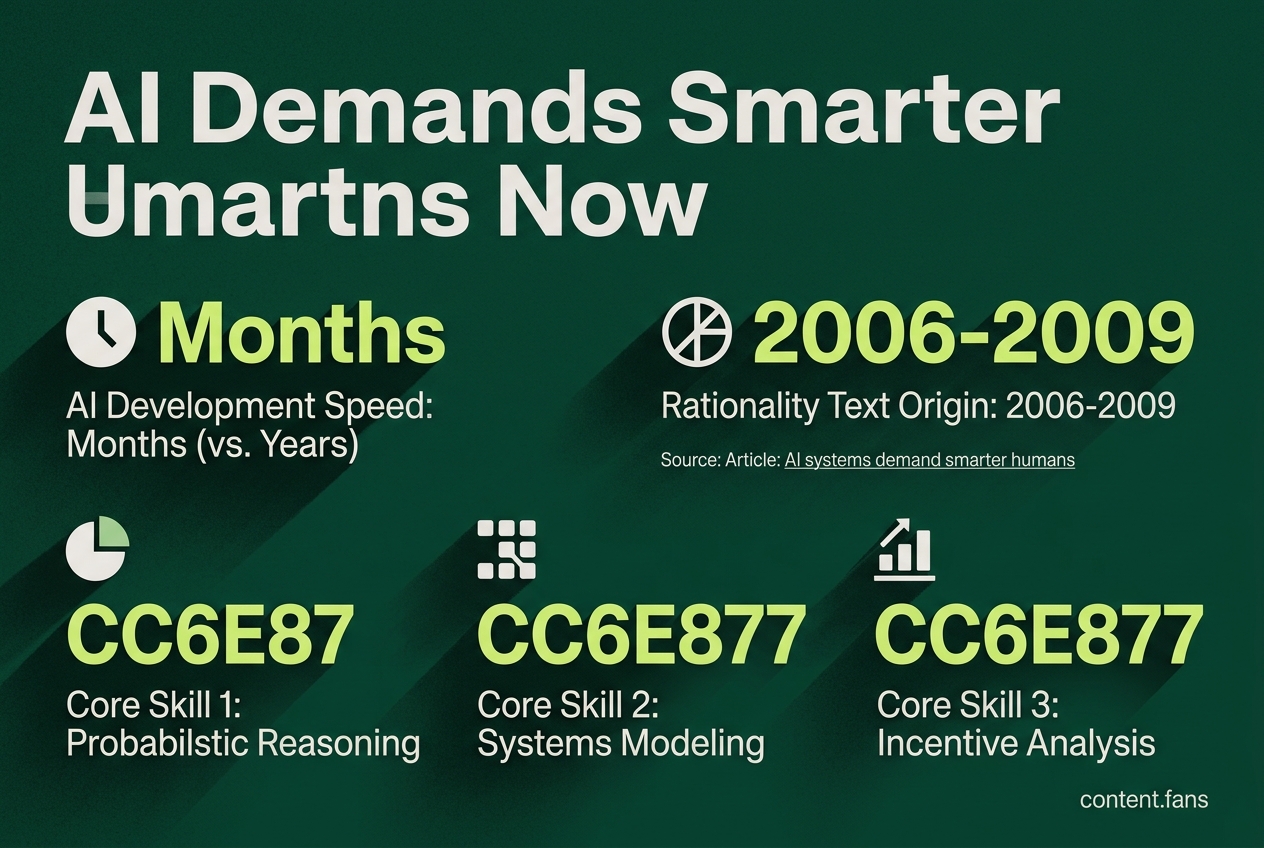
The intellectual groundwork for this movement was laid years ago. Eliezer Yudkowsky's foundational text, Rationality: A-Z, originated as a series of online posts between 2006 and 2009. While trainers still adapt these original materials and the expanded Rationality: From AI to Zombies books, modern thinkers like Zvi Mowshowitz argue the need is more acute today. The reason is simple: speed. AI development cycles have collapsed from years to months, a pace that outstrips conventional regulatory and business adaptation. According to industry reports, this forces a pivot from static rules to dynamic learning models, underscoring the urgency for improved human cognition.
Core competencies for the AI era
To thrive alongside AI, rationality advocates emphasize honing three core cognitive skills:
- Probabilistic Reasoning: Accurately gauging and updating beliefs based on evidence.
- Systems Modeling: Tracing causal links to anticipate second- and third-order effects.
- Incentive and Feedback Analysis: Understanding how systems and people respond to rewards and data.
The demand for these skills is no longer theoretical. It's evident in the growing number of specialized programs and the proliferation of Bayesian modeling courses on educational platforms. Furthermore, some educational and cognitive modeling systems use Bayesian networks for personalization, but the evidence here is limited to specific studies and implementations rather than systematic reviews of cognitive training platforms.
Where institutions struggle to keep up
This cognitive gap is particularly acute in institutions. Lawmakers are in a perpetual race against AI's rapid deployment, as seen with the EU's fast-tracked AI Act and various U.S. state-level impact assessments. As Forbes notes, AI's influence bleeds across data governance, intellectual property, and national security, creating complex challenges faster than traditional legislation can address them. Consequently, many regulators are now adopting AI-driven forecasting tools, signaling a critical need to distribute advanced reasoning skills throughout entire government agencies, not just within specialized analyst teams.
Practical takeaways already visible
In response, forward-thinking organizations are adopting practical methods directly from the rationality community. Tools like calibration checklists, 'premortem' analyses to anticipate failure, and structured debiasing drills are becoming common. Corporate workshops now frequently involve facilitated probability estimates and spreadsheet models to track belief updates over time. These techniques are also shaping formal processes, with decision memos increasingly requiring explicit confidence intervals for all forecasts.
The trend is clear: rationality training is transitioning from a niche intellectual pursuit to a core operational prerequisite for navigating the AI era. While AI systems iterate relentlessly, humans can - and must - learn to shorten their own mental update cycles.