
AI Redefines Key Skills for Education and Workforces
Serge Bulaev
AI is making routine tasks faster and cheaper, so skills like writing basic text or code may not show real mastery anymore. Experts suggest that jobs and education should focus more on judgment, problem framing, and working with AI, as these are harder to automate. In schools, students may be valued more for their ability to explain and check AI work, and teachers still need better training on using AI well. In healthcare and workplaces, people still need to make important decisions and use judgment, even when AI helps with tasks. Overall, the shift appears to put more importance on human skills that machines cannot easily replace.

As generative AI makes routine tasks faster and cheaper, AI redefines key skills for modern careers and education. This rise of "cheap competence," where polished text or basic code no longer signals mastery, requires employers and schools to elevate context-specific judgment, careful problem-framing, and collaboration with AI as newly scarce resources. The World Economic Forum emphasizes that while AI handles clerical work, "high quality, human led pedagogy" remains essential (AI is revolutionizing education 4.0).
Shifting Value in the AI-Powered Classroom
The integration of AI into professional and academic life places a new premium on uniquely human abilities. Skills such as critical judgment, ethical reasoning, and the ability to frame complex problems are becoming more valuable as AI automates routine tasks, shifting focus from task execution to strategic oversight.
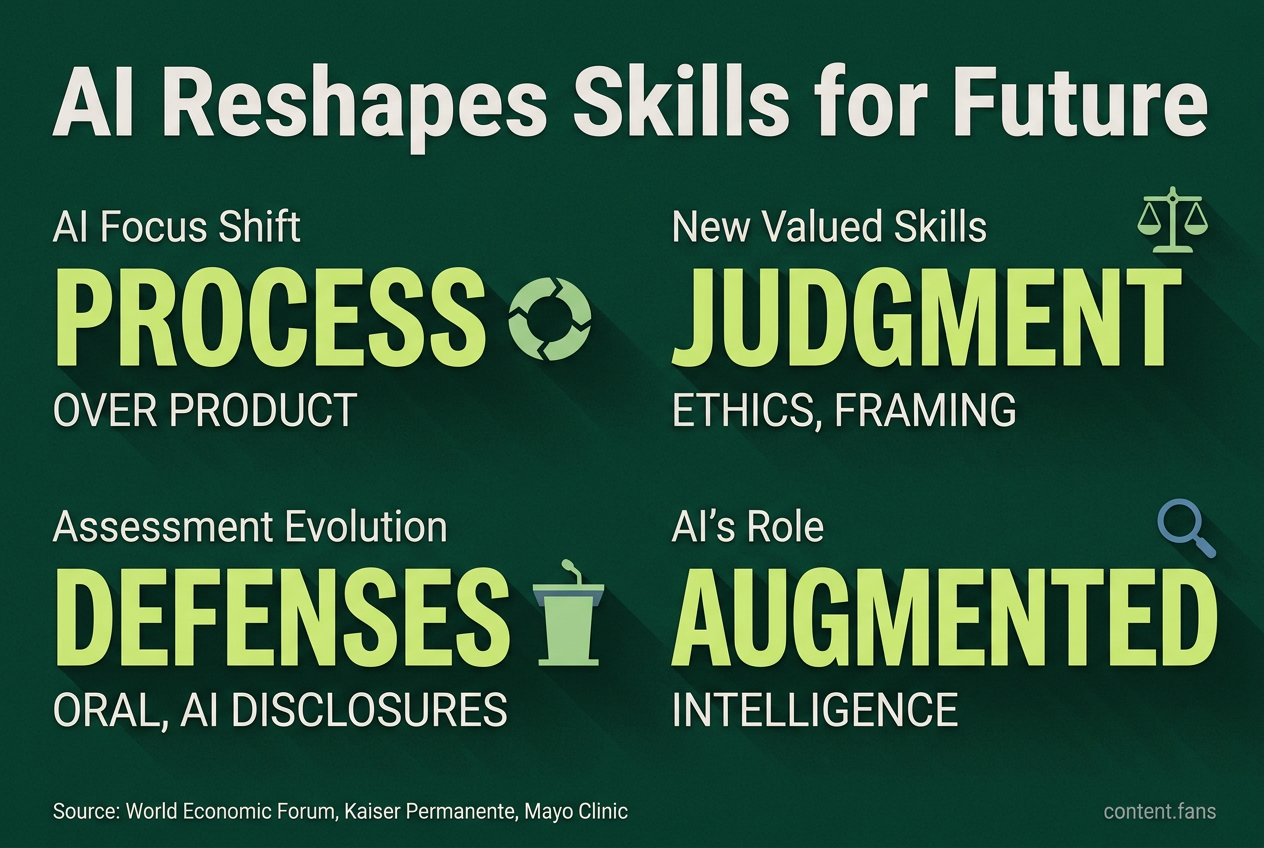
In education, the focus is shifting from the final product to the process. According to education reform discussions, value now lies in what students can explain, evaluate, and create instead of which tools they use. Consequently, assessments are evolving to include oral defenses, version history reviews, and AI prompt disclosures to evaluate skills that AI cannot replicate.
This shift prioritizes durable, automation-resistant abilities:
- judgment and source checking
- reasoning transparency
- ethical awareness
- problem framing
- collaboration with AI systems
However, teacher training struggles to keep pace. While the number of K-12 educators receiving no AI-related professional development is decreasing, most training still centers on basic efficiency tools rather than advanced pedagogical integration.
Augmented Intelligence and Judgment in Healthcare
Clinical environments clearly show how AI automation amplifies the need for human interpretation. At Kaiser Permanente, an AI-powered alert flags high-risk patients by reviewing vitals and lab results, but clinical staff retain final authority, using their judgment to consider factors like DNR orders or postoperative anomalies.
Similarly, Mayo Clinic researchers found that providing primary care teams with AI-assisted ECG readings led to significant improvements in new diagnoses for specific heart conditions. This shifted the physician's role from initial pattern detection to the higher-level work of recommending imaging, planning follow-ups, and discussing patient preferences.
Industry reports define this approach as "augmented intelligence," highlighting that AI models are most effective when they surface patterns for a human expert who then decides on the appropriate action.
Strategic Role Redesign in the Modern Firm
Boston Consulting Group advises leaders to integrate AI workforce strategy directly into their competitive strategy, categorizing roles as amplified, rebalanced, or substituted.
- Amplified roles (e.g., complex sales) use AI for data insights but still rely on human judgment.
- Rebalanced roles offload repetitive tasks, freeing employees for strategic work like client counseling.
- For roles facing substitution, BCG recommends planning for talent redeployment.
IBM echoes this, recommending that any AI plan begin with mapping workflows and skills, supported by transparent change management to build trust. Furthering this, Harvard Business Publishing suggests that L&D must proactively anticipate skill gaps, transforming leaders into "sense-makers" who can effectively orchestrate human-machine teams.
These perspectives converge on a unified strategy: begin by redesigning work, then equip the workforce with AI literacy and critical reasoning skills, and establish continuous learning as core infrastructure. The highest value is placed on professionals who can discern when an AI's answer is wrong, reframe the underlying question, and synthesize multiple outputs into a single, situationally-aware decision.
What does "cheap competence" actually mean for workers and students?
"Cheap competence" is the rapid commoditization of routine outputs generated by AI. In schools, an essay, a lab report, or a Python script that once demonstrated mastery can now be produced in seconds. In workplaces, legal drafts, basic code, and customer emails are no longer scarce skills. The market value for repeating a known pattern is collapsing, while the premium is shifting to context-specific judgment - deciding whether the pattern is right for this patient, this client, this regulatory climate.
How are schools and universities redesigning curriculum?
Evidence from recent educational initiatives shows three converging moves:
-
Assessment turns away from the final artifact and toward the process.
Educational pilots are asking students to submit version histories, source critiques, and oral defenses instead of just a finished essay. -
AI literacy becomes a core subject.
Many US states are considering legislation requiring prompt engineering, bias detection, and disclosure norms. -
Problem-framing courses outrank tool-training.
When tools generate answers quickly, the scarce skill is asking the right question and validating the result.
Which human skills are rising in value?
Educational and workforce development discussions generally focus on AI-era skills such as critical thinking, judgment, ethics, and human-centered teaching:
- Contextual reasoning - why this result fits or does not fit here
- Source triage - spotting hallucinations or missing data
- Ethical override - when to ignore an optimal-seeming AI choice
- Human-led instruction - AI tutors spread, yet direct human interaction remains irreplaceable (WEF 2024)
What do real workflow shifts look like in healthcare and engineering?
- Healthcare organizations are deploying AI deterioration alerts that flag high-risk patients, but nurses decide escalation based on comorbidities and family goals.
- Mayo Clinic's AI-ECG catches asymptomatic heart failure with significantly improved accuracy compared to traditional screening, yet final diagnoses depend on clinician judgment after imaging and patient history review.
In both cases, AI removes the detection bottleneck while amplifying the interpretation bottleneck.
How are companies redesigning roles instead of eliminating them?
Consulting frameworks suggest splitting roles into:
- Amplified - high judgment, AI as co-pilot (senior engineers, strategists)
- Rebalanced - routine parts removed, strategic parts grown (project coordinators)
- Substituted - full process reimagination, not mass layoffs - redeploying talent into validation, oversight, and customer experience roles
Industry reports indicate that HR strategies now include dynamic role profiles updated regularly and skill adjacency mapping to move engineers from legacy codebases to AI oversight tasks.
The consistent theme: the winners treat AI as a collaborator and invest the saved hours in higher-order work, not cost-cutting alone.