
AI-native workspaces expand beyond tech, reshaping 5 business functions
Serge Bulaev
AI-native, code-focused workspaces like Codex and Claude Code are spreading into business areas beyond technology. They may change how tasks are done in marketing, finance, legal, HR, and operations by automating routine work and shifting what skills are needed. Most reports suggest these tools are more likely to reshape jobs and require new skills, rather than cause large job losses. Adoption of these AI tools appears to be growing, but many companies are still in early stages, and there are open questions about how quickly and widely these changes will spread. The evidence suggests that AI-driven workspaces are expanding steadily but unevenly across different sectors.

AI-native workspaces, once confined to software development, are now expanding beyond the tech sector and reshaping core business functions. These code-centric environments, such as Codex and Claude-style platforms, are changing how teams in marketing, finance, legal, and operations handle software-driven tasks. The shift is redefining work by automating routine tasks, creating demand for new skills focused on strategy and oversight rather than causing wholesale job elimination.
How Codex or Claude Code-style environments reshape nontechnical work
These AI-driven environments reshape nontechnical work by automating routine, rules-based tasks like drafting copy or reconciling ledgers. This allows human experts to focus on higher-value activities such as providing business context, crafting strategic prompts, validating AI outputs, and ensuring cross-functional coordination and final judgment.
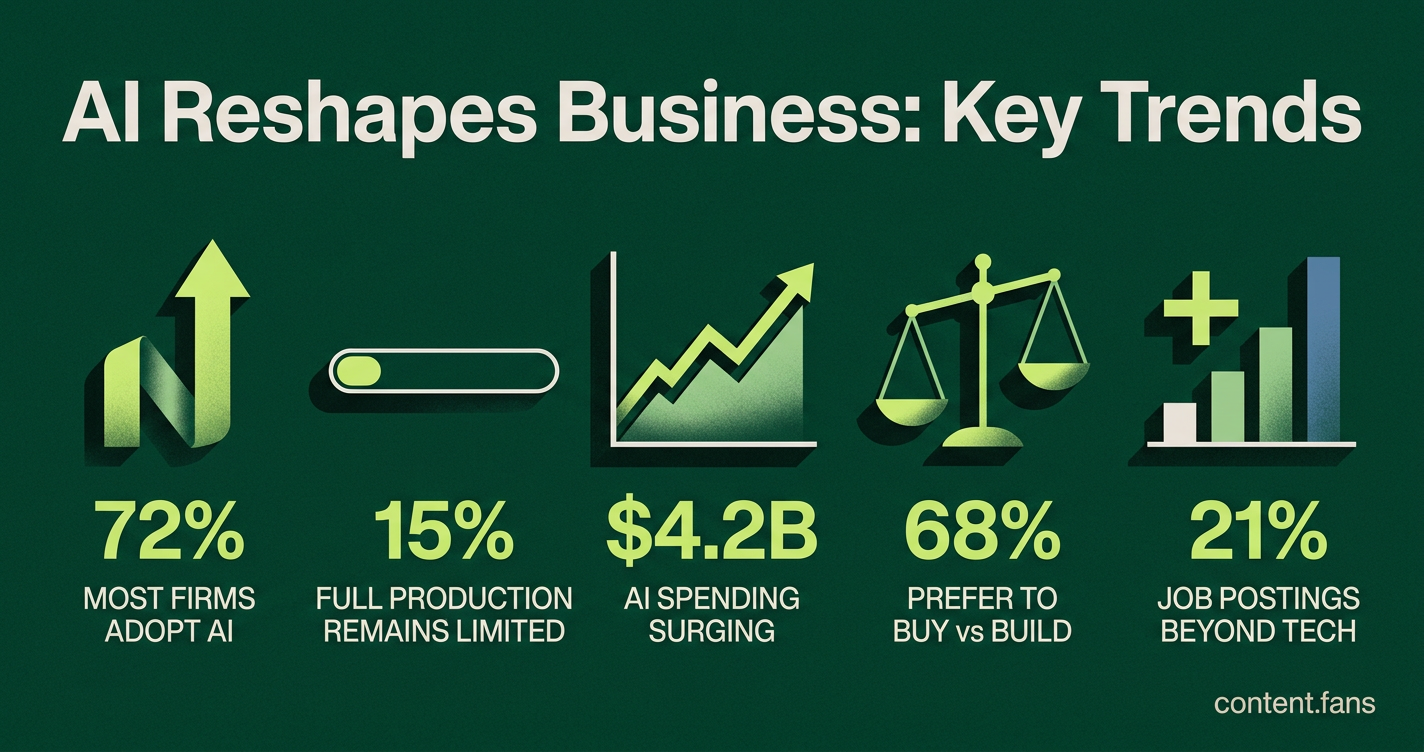
For example, generative tools already draft marketing copy, reconcile ledgers, and schedule meetings, leaving humans to provide essential context and judgment, according to industry reports. Underscoring this trend, a growing number of AI job postings are now outside the tech sector, signaling a clear demand for domain experts skilled in prompting and validating these systems.
These findings point to three significant patterns:
- Routine, rules-based work is increasingly automated via version-controlled AI scripts.
- Skills in oversight, prompt engineering, and cross-functional coordination become critical.
- Traditional entry-level career paths may shrink as AI automates beginner tasks.
Enterprise uptake and spending
Enterprise spending on generative AI is surging, with industry reports showing significant growth in recent years. This growth is supported by a strong preference for containerized, cloud-native deployments, which many IT leaders consider the preferred approach for AI implementations. While adoption is broad - industry reports indicate that most firms use AI in some capacity - only a portion have progressed beyond pilot programs.
This data indicates that while experimentation is nearly universal, full production rollouts are often stalled by security, governance, and integration challenges. Consequently, organizations are increasingly buying versus building. Industry analysis shows a significant shift toward purchased solutions rather than internally developed AI systems.
Skills, training, and collaboration inside AI-native, code-centric workspaces
Collaboration models are evolving as AI agents become active participants in development cycles, from specification to testing, an observation noted by Andreessen Horowitz. Industry reports suggest that professional value is shifting from "implementation to verification." This means both technical and non-technical staff now spend more time defining success criteria, writing effective prompts, and auditing AI-generated results.
In response, teams are starting to treat prompts and design choices as formal, documented artifacts. This practice facilitates asynchronous workflows, where AI agents execute tasks independently and humans review progress at key checkpoints. However, interviews from the Digital Education Council warn of a potential downside: the automation of simple tasks may shrink traditional onboarding paths for junior staff, who previously built skills on such work.
Department-level impact snapshot
| Function | Typical AI-assisted outcome | Reported exposure |
|---|---|---|
| Marketing | Auto-generated copy and segmentation | High but balanced by creative review |
| Finance | Faster anomaly detection and reconciliations | High for rote tasks |
| Legal | Draft contract language and triage | Moderate |
| HR and Ops | Automated scheduling and reporting | High |
| Business analysis | Low-code prototypes via prompts | Rising |
Open questions for the future
The long-term scope of this transformation remains debated. While industry reports show rapid investment, consulting studies suggest that only a minority of firms have redesigned core workflows. This gap highlights both significant room for growth and underlying organizational friction. The evidence points toward a steady but uneven expansion of AI-native workspaces, rather than an overnight revolution.
What exactly is an "AI-native, code-centric workspace"?
These are interactive, prompt-driven environments such as OpenAI Codex and Claude Code in which code artifacts, documentation and even prompts themselves become executable, versioned assets. Unlike conventional SaaS dashboards, every action is reproducible and can be delegated to either humans or AI agents.
Which non-technical roles are already moving into these environments?
Marketing, finance, legal, HR and operations teams are the five functions most affected. Industry reports indicate that many organizations regularly use AI in at least one business function, yet only a significant portion have moved past pilots. The result is task displacement, not job deletion: content generation, contract drafting, reconciliation and scheduling are automated, while human effort shifts to strategy, validation and cross-team coordination.
How fast is enterprise adoption happening?
Enterprise spending on generative AI is growing rapidly, with code completion tools capturing significant market share. The buy-not-build trend is accelerating: organizations are increasingly purchasing AI solutions rather than building them internally, showing that ready-to-use AI coding layers are winning.
What new skills will non- developers need?
Surveys show that AI fluency, critical thinking, data storytelling and adaptability are outweighing traditional coding skills. As a growing number of AI jobs are now outside tech, employers value people who can specify problems, orchestrate agents and review outputs more than those who can hand-write every line of code.
Will junior roles disappear?
Junior developers and routine clerical positions face significant exposure as AI agents increasingly handle boilerplate tasks. Yet industry forecasts predict growth in "citizen developer" roles where business domain experts prototype internal tools without deep programming knowledge.