
AI model labs expand into products, enterprise tools, and security software
Serge Bulaev
AI model labs are shifting from just offering models to also creating products, enterprise tools, and security software. Analysts say this change may be driven by falling prices and the need to stand out, as well as new rules like the EU AI Act. Companies such as OpenAI and Anthropic now offer both APIs and full platforms, which can blur the line between model providers and application platforms. For customers, this means choosing between platforms often depends on the whole ecosystem, not just model quality, and may lead to new kinds of lock-in. Security features are now being built directly into AI platforms, which might help customers but could limit opportunities for specialist security vendors.

The strategic expansion of AI model labs into products, enterprise tools, and security software is a defining industry trend, as leading firms pivot from pure model providers to integrated platform operators. This shift moves the competitive focus from raw benchmark scores to system performance within enterprise environments. An overview of the current landscape shows providers like OpenAI and Anthropic blurring the line between model vendor and application platform (AI stack description). This transition toward productization, with firms like Microsoft acting as an "enterprise distribution layer" for frontier models (DataNorth market article), is driven by key economic and regulatory pressures.
Why model labs move up the stack
This strategic pivot is driven by intense pricing pressure on model APIs and the need for differentiation. By building products, labs can capture more value, create stickier customer relationships, and gather essential usage data to improve future models, all while embedding necessary governance and compliance controls.
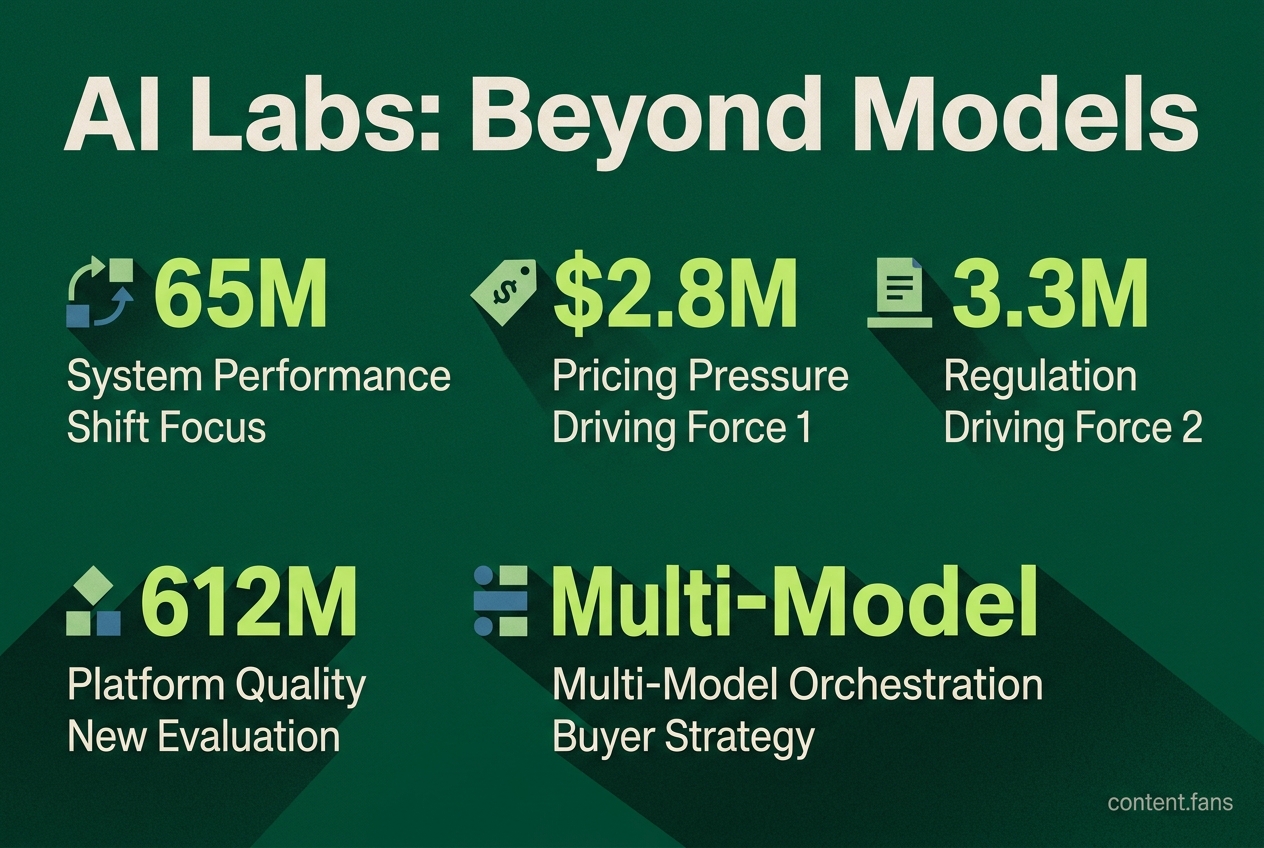
The twin forces of commoditization and regulation are accelerating this shift. A dramatic fall in price-per-token is eroding the margins of standalone API services. In response, labs are building products like coding assistants and security analytics to capture more value and collect telemetry for future training cycles. Simultaneously, regulatory frameworks like the EU AI Act summary mandate comprehensive documentation, testing, and reporting, encouraging vertically integrated platforms that bundle these governance controls.
What this means for enterprise customers
For enterprise buyers, the evaluation criteria are shifting from raw model accuracy to the quality of the entire platform. According to market analysis, customers now assess the complete ecosystem, including SDKs, administrative controls, latency, and data residency policies (Gartner Peer Insights). This creates a new risk of vendor lock-in at the platform level, tied to integrated identity, billing, and workflow management systems.
In response, enterprises are adopting multi-model orchestration strategies, routing routine tasks to cheaper open-source models while reserving premium proprietary models for high-stakes problems. To maintain flexibility, sophisticated buyers use structured vendor scorecards that prioritize security, integration depth, and total cost of ownership alongside model performance.
Key defensive measures for buyers include:
- Define measurable business KPIs before any demo
- Demand explicit data residency and retention terms
- Verify integration through real API reviews, not slideware
- Require exportable audit logs and clear exit rights
Implications for partners and integrators
This platform-centric push presents both opportunities and risks for third-party partners. While generic wrapper applications and thin resellers face displacement, integration specialists become more critical for connecting AI platforms to complex enterprise systems like ERPs and regulated workflows.
Services firms can find new growth in providing specialized fine-tuning and domain adaptation. However, their business models remain dependent on the provider's platform rules, such as billing tiers and API rate limits. To mitigate risk, partners can leverage open ecosystems; the EU AI Act, for instance, imposes lighter obligations on many open-source models, allowing integrators to build more vendor-agnostic solutions.
Security software enters the bundle
To meet enterprise security and compliance demands, AI providers are increasingly bundling security features directly into their platforms. Offerings now frequently include adversarial testing dashboards, policy enforcement engines, and incident response tools. While this integration simplifies security management for customers by reducing the number of tools to manage, it directly encroaches on the market for specialized third-party AI security vendors, narrowing their opportunities.
The competitive landscape is widening significantly, with battles fought not just over models but also over platforms and packaged applications, all under the shadow of tightening regulations. Industry observers expect this convergence to continue, leading to a more integrated but less cleanly divided AI stack.
What is driving AI model providers to launch their own end-user products and enterprise platforms?
A clear shift from "model-only" to "model-plus-product" business models is unfolding across the industry.
- The landscape shows that OpenAI, Anthropic, Microsoft, Google, and Amazon now blur the line between API vendor and application platform.
- A significant number of enterprises in production are already routing multiple foundation models in parallel, so vendors that control the entire stack can lock-in value at the platform layer instead of competing on per-token price alone.
How does this trend change what enterprises should look for in a vendor?
Procurement teams are moving from asking "which model is best?" to "which platform ecosystem can we standardize on?"
- A weighted scorecard is now recommended that grades vendors on business outcome fit, data-security posture, integration readiness and governance controls [see the enterprise vendor evaluation framework].
- Platform-based SLAs, audit-log export and clear exit clauses have become non-negotiable contractual safeguards to avoid lock-in when providers also sell competing applications.
What risks do integration partners face when model providers become product builders?
Disintermediation risk is real.
- When the same company supplies the model, the runtime and the end-user application, generic wrapper solutions lose differentiation.
- Partners that once added value through simple integrations must instead focus on industry-specific deployment, compliance tooling and managed services, as noted in both Gartner Peer Insights coverage and the Sema4.ai Enterprise AI Platform Guide.
Are open or multi-model strategies still viable for buyers?
Absolutely.
- Market analysis shows that enterprises are deliberately routing simpler tasks to lower-cost open-source models while reserving premium proprietary models for high-value workloads.
- This multi-model orchestration reduces dependence on any single provider and keeps pressure on pricing, which is why platforms that offer neutrality and portability are gaining traction.
What practical checklist should an enterprise buyer use today?
A concise four-step process works across industries:
1. Define the business problem and KPIs - never start with the model.
2. Run an identical scenario on each short-listed platform; score against the same enterprise scorecard.
3. Verify contractual safeguards - data ownership, exit rights, exportable audit logs and AI-specific liability terms.
4. Speak to production customers in your vertical; ask about real timelines, cost overruns and post-pilot support quality.