
AI Governance Shifts: Product Teams Adopt 4-Axis Decision Matrix
Serge Bulaev
Product teams are now using a four-axis decision matrix to decide when to automate, ask for human review, or block AI recommendations. The axes include user impact, safety risk, brand sensitivity, and model confidence, and each is scored to guide actions. Automated approvals may be used for low-risk situations, while higher scores mean more human oversight. Ongoing monitoring and regular audits are required, and models may be retired if they fail too many checks. This process may help teams manage AI risks and follow new rules, while keeping customer impact in mind.

A major shift in AI governance has product teams adopting a four-axis decision matrix to manage AI-driven recommendations. This structured approach moves beyond theoretical policies to an operational checklist for balancing automated decisions with human oversight. As AI becomes more integrated into products, frameworks like these are becoming essential. More generally, recent governance guidance emphasizes runtime oversight, continuous monitoring, and AI lifecycle accountability rather than one-time approval. This model aligns with standards like the NIST AI Risk Management Framework and ISO/IEC 42001 by providing clear, auditable decision paths.
How the 4-Axis Decision Matrix Works
This decision matrix evaluates AI recommendations across four key dimensions: user impact, safety risk, brand sensitivity, and model confidence. Each axis receives a score, and the composite result determines the required action - ranging from full automation for low-risk outputs to mandatory human review for high-risk scenarios.
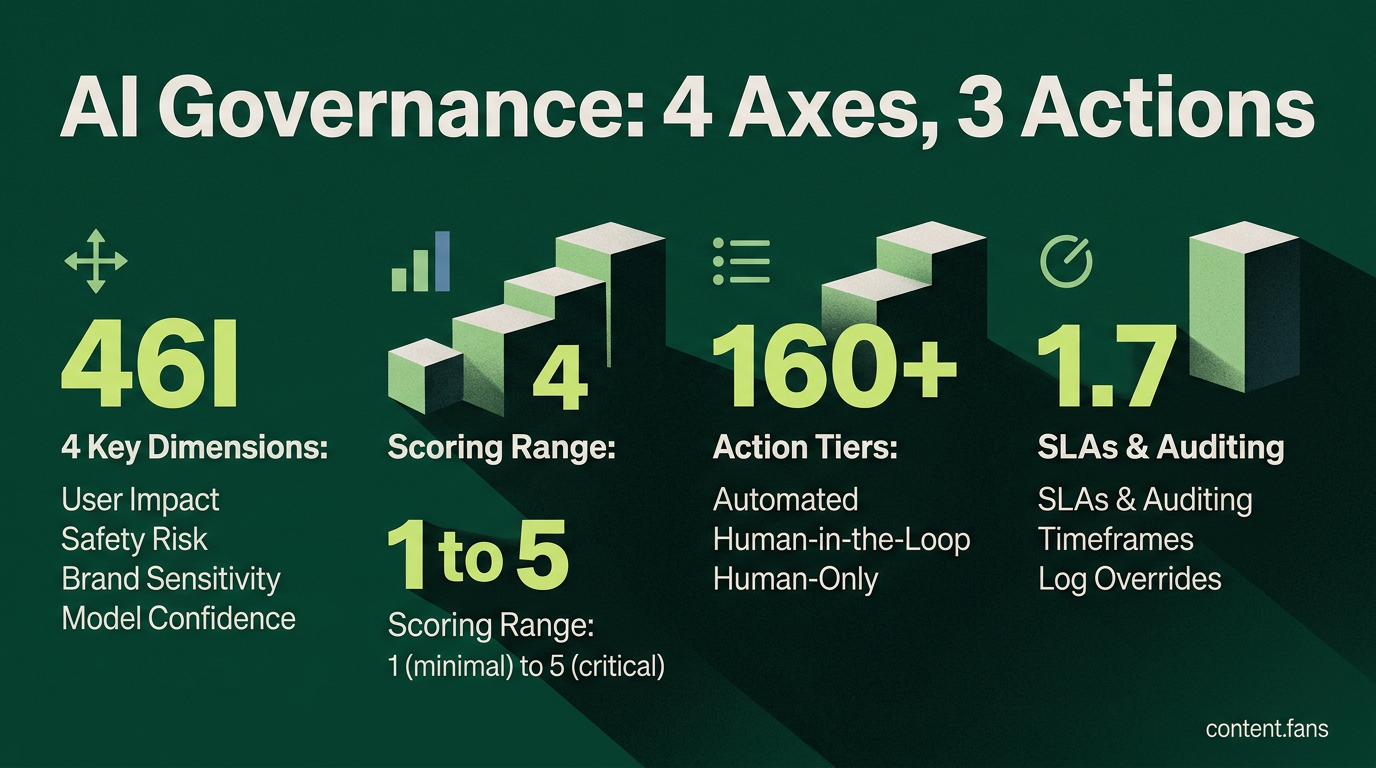
The framework treats each axis as a scored dimension, typically from 1 (minimal) to 5 (critical). Organizations establish their own thresholds where low composite scores allow for full automation, medium scores trigger a "human-in-the-loop" review, and high scores escalate to a human-only workflow. This tiered system helps focus expert review on the most critical AI outputs. The matrix directly implements key controls for building trustworthy AI. An Atlan enterprise guide outlines six layers of control for AI systems - policy, inventory, risk classification, documentation, monitoring, and retirement. The four-axis model operationalizes risk classification, monitoring, and retirement triggers based on clear thresholds:
- Automated: Marketing copy suggestions with high confidence and low drift
- Human-in-the-Loop: Onboarding eligibility hints with moderate confidence levels
- Human-Only: Safety instructions or financial advice with lower confidence thresholds
Each decision lane is tied to service level agreements (SLAs), such as requiring reviewers to clear medium-risk items within specified timeframes and log all overrides for auditing purposes, supporting compliance with regulations like the EU AI Act.
From Launch-Time Policy to Live Monitoring
The industry is shifting from static policy documents to dynamic, monitoring-based governance. Continuous dashboards are essential for tracking metrics like calibration error, Brier score, and human override rates. If an override rate increases beyond established thresholds within a defined timeframe, an automated trigger can disable the AI component pending a formal risk review. This same level of scrutiny applies to vendor-supplied models, with contracts now mandating training data lineage, change notices, and audit rights to ensure accountability.
Using Model Confidence as a Handoff Trigger
Model confidence is the primary operational signal for routing cases between automated and human-led workflows. Teams monitor real-time confidence distribution shifts and the Population Stability Index (PSI). When PSI exceeds organizational thresholds or the model's confidence clusters near decision boundaries, the system automatically flags medium-impact cases for human review. Calibration metrics also serve as an early warning system; a reported rise in expected calibration error preceded a spike in human overrides at one firm, showing that calibration drift can alert teams to issues before customers are impacted.
Auditing and Retiring Models to Maintain Quality
To prevent model degradation, quarterly audits compare a model's real-world performance against its initial risk assessment. If a model's brand sensitivity score increases due to a new market launch, it is rescored and potentially moved to a stricter review lane. Retirement criteria are defined upfront: any model version that fails two consecutive audits or remains disabled for over 30 days is sunsetted. Its inventory slot is then marked as available for a new, retrained model.
By translating abstract concepts like brand safety into quantitative scores, the four-axis framework embeds governance directly into product operations. This creates a durable, repeatable process that ensures customer impact remains the central focus while satisfying regulatory demands and adapting to internal changes.
What practical dimensions does the 4-Axis Decision Matrix actually measure?
The matrix turns four fuzzy concepts into hard, repeatable criteria: user impact, safety risk, brand sensitivity, and AI confidence. Each axis is scored low, medium, or high and the combination determines whether the recommendation is automated, human-verified, or human-only.
- User impact captures how much the user's time, money, or well-being can shift based on the AI output.
- Safety risk captures physical or mental harm potential.
- Brand sensitivity captures reputational exposure if the output misfires.
- AI confidence is taken straight from the model's own calibration metrics (e.g., Expected Calibration Error or Brier score).
The intersection of the four scores is then mapped into a simple green-yellow-red heat map that every PM, designer, or engineer can read without a separate ethics course.
How exactly does "AI confidence" become the trigger for human intervention?
Teams watch confidence distributions in real time instead of a single point estimate.
- If ECE rises above established thresholds or PSI drift crosses organizational limits, the workflow automatically routes the case to human review.
- For generative tasks, an extra groundedness check (is the output actually supported by source data?) acts as a second line of defense.
Industry reports suggest that companies with threshold-based escalation experience significant reductions in post-release incidents compared with those that relied only on accuracy dashboards.
What concrete playbooks exist for the three risk buckets?
| Risk Band | Decision Path | Playbook Elements |
|---|---|---|
| Low | Automated | SLA - 24h autopsy of false positives only |
| Medium | Human-verified | 2-step approval checklist, logged override reasons, 5-minute time-box |
| High | Human-only | Mandatory challenge-and-response, rollback plan pre-loaded, model is disabled automatically if reviewer fails to respond within 30 min |
Every playbook ships as a copy-and-paste template with fill-in-the-blank fields: who approves, how long they have, and the exact metric that will re-open the decision.
Where can I see this working in the wild?
- According to industry reports, financial institutions are piloting AI fraud alert systems through similar matrices. Cards rated with medium safety and high brand sensitivity go to analysts who can override, retrain, and update rules in one screen. Many organizations report maintaining stable escalation rates while reducing false-positive costs.
- A medical-robotics pilot cited in European Journal of Computer Science and IT labels any recommendation affecting patient dosing as high-impact + high-safety, forcing a human-only gate before actuation. The study logged zero severe dosing errors in six months despite increased throughput.
How do we keep the matrix from going stale after launch?
Governance runs as a lifecycle loop rather than a one-time checklist.
- Inventory every model and assign a named owner.
- Measure drift, calibration, and business KPIs weekly.
- Review thresholds at least quarterly or immediately after any minor model update.
- Retire any system whose PSI drift exceeds established thresholds for consecutive windows or whose human override rate exceeds organizational limits.
Industry guidance suggests that teams tying retirement rules to objective drift thresholds retire or retrain significantly more stale models than teams relying on calendar reviews alone.