
AI Costs Soar: Enterprises Scrutinize Every GPU Hour
Serge Bulaev
AI costs may be rising quickly for companies, with some firms facing tens of millions of dollars in monthly bills. Some reports suggest that spending on AI hardware and cloud services is increasing much faster than companies can plan for. Many organizations now watch every GPU hour closely and are trying different ways to control costs, like using smaller models and sharing hardware. Studies indicate that using on-premises hardware might become cheaper than the cloud at a certain point, but companies still need flexible options for different workloads. Overall, success may depend on careful planning, choosing the right technology, and closely tracking costs.

Enterprises are now scrutinizing every GPU hour as spiraling AI costs collide with corporate balance sheets. With generative AI rewriting spending patterns faster than budget cycles can adapt, the tension between AI enthusiasm and fiscal reality is growing. As a result, finance teams now review every GPU hour with the scrutiny once reserved for headcount, making AI cost forecasting a critical part of corporate planning.
Why the bills balloon
AI expenses are escalating due to a combination of usage-based cloud pricing models that charge per token and data transfer, and massive enterprise investment in on-premise AI servers. This rapid hardware acquisition often outpaces a company's ability to optimize its use, leading to inefficient spending.
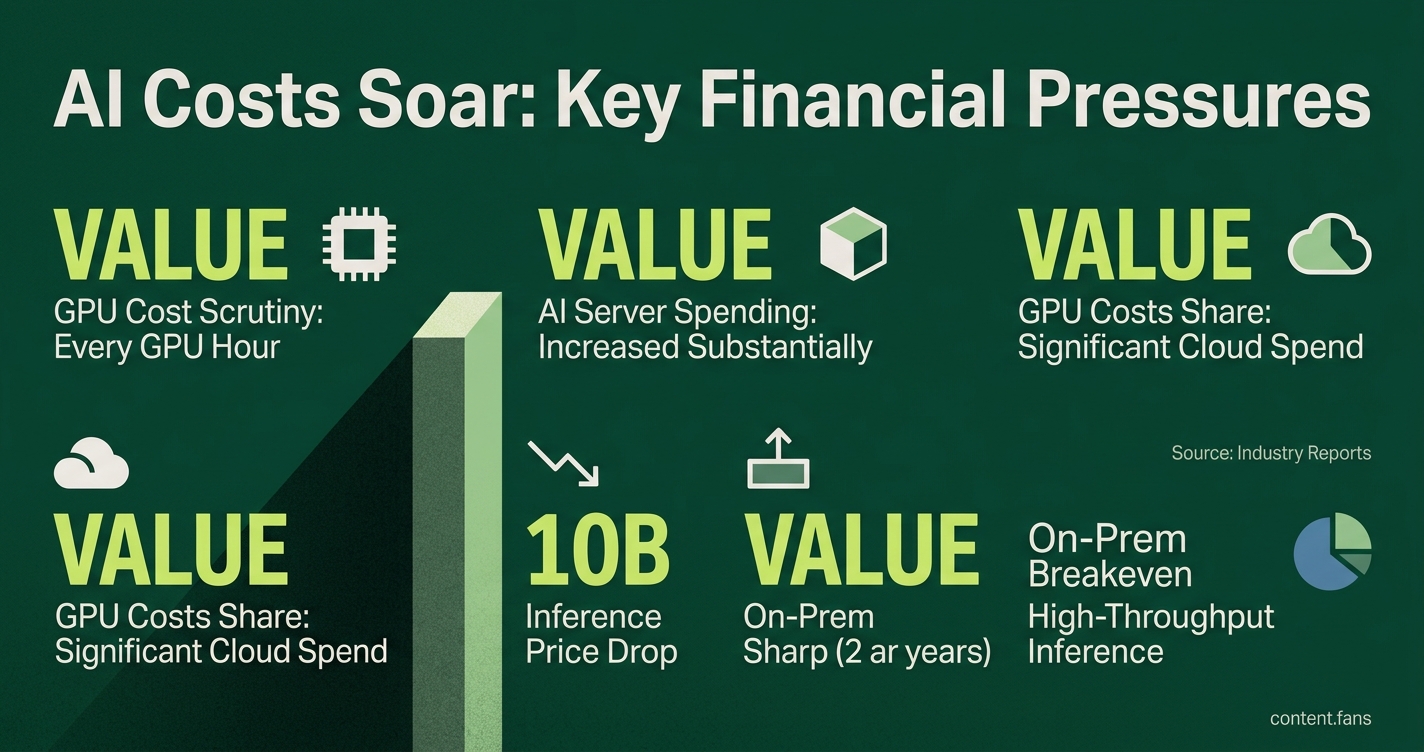
According to industry reports, some firms face substantial monthly AI invoices, even after a sharp drop in inference prices over the last two years. For companies with production AI, GPU-related costs now account for a significant portion of total cloud spend. This financial pressure is amplified by hardware demand. Industry data shows global AI server spending has increased substantially in recent years. This frantic purchasing by both hyperscalers and enterprises indicates that capacity is being acquired faster than it can be optimized.
Playbook for containing AI infrastructure costs
To manage these expenses during budget cycles, analysts recommend several proven strategies:
- Perform a Total Cost of Ownership (TCO) analysis before choosing between cloud, on-premises, or edge deployments. Industry reports indicate that many companies neglect this crucial step.
- Implement a hybrid deployment model. Use the cloud for experimental or bursty workloads while running steady, predictable inference tasks on-premises. This approach can significantly improve workload-to-cost alignment.
- Right-size and compress models using techniques like quantization and pruning. These methods can substantially reduce compute requirements.
- Increase GPU utilization with techniques like continuous batching and GPU sharing, which can dramatically improve efficiency in production environments.
- Establish strong FinOps governance. Experts recommend setting real-time alerts when spending reaches a significant portion of the monthly budget to prevent unexpected overages.
Emerging economic thresholds
A clear economic threshold is emerging for on-premises hardware. Studies show that when cloud service costs exceed a significant portion of the price of running equivalent in-house systems, ownership becomes more economical. Industry reports suggest that on-premises deployments can achieve favorable breakeven points for high-throughput inference, delivering substantial cost advantages over premium API services.
However, flexibility remains a key factor. The cloud is ideal for pilot projects and unpredictable workloads, while edge computing can lower latency for real-time, customer-facing applications. This mixed strategy, or "hybrid economics," allows organizations to dynamically rebalance workloads based on evolving volume and predictability.
Data, energy, and contract knobs
Beyond compute, hidden AI costs include data storage duplication, network egress fees, and high energy consumption. To mitigate energy costs, enterprises can follow the lead of hyperscalers by shifting non-urgent training jobs to periods of high renewable energy availability, as noted by Brookings. On the contractual side, experts advise negotiating fixed-rate agreements with annual caps to hedge against cost inflation.
Ultimately, generative AI is fundamentally reshaping enterprise procurement, IT architecture, and financial governance. Success hinges on a disciplined approach: measuring unit economics from the start, strategically selecting deployment tiers for each workload, and enforcing rigorous FinOps. This allows firms to sustain innovation without jeopardizing their financial stability.
Why are enterprises suddenly enforcing strict GPU-hour budgets?
GPU budgets have tightened because AI workloads are now among the fastest-growing cost line-items in many companies. According to industry reports, average cloud spending has risen substantially, with AI and generative AI identified as key drivers. CFOs are responding with hard caps: Meta has begun throttling internal token use, AT&T is rationing inference calls, and Broadcom is piloting departmental chargeback so every GPU hour shows up on a P&L. The result is a shift from "GPU availability" to unit-cost KPIs such as cost per inference, cost per training run, and cost per workflow.
How can I decide between cloud AI services and buying my own hardware?
The choice is driven by cost thresholds rather than utilization alone. Industry analysis suggests ownership becomes rational when cloud costs reach a significant portion of equivalent on-prem hardware costs. Industry reports indicate that for sustained high-throughput inference, on-premises clusters can achieve favorable economics compared with frontier Model-as-a-Service APIs. Use cloud for bursty experimentation or uncertain demand; buy GPUs when the workload is steady and utilization is high.
What technical levers can we pull to cut AI spend right now?
Industry best practices recommend a short list of high-impact moves:
- Model routing and cascades - send simple queries to smaller models and escalate only when necessary. This can deliver substantial savings on inference.
- Quantization and pruning - reduce memory use and enable larger models on cheaper GPUs. These techniques can significantly reduce compute requirements.
- Continuous batching and GPU sharing - raise throughput substantially and push utilization to much higher levels.
- Spot-instance training with checkpointing - significantly cheaper for non-production jobs.
All of these levers require FinOps governance to work. Real-time dashboards, budget alerts at significant portions of monthly limits, and cross-team chargeback are quickly becoming standard.
How are cloud providers changing their pricing models?
Providers are abandoning flat-rate pricing and moving to granular, usage-based billing. Token charges, per-request fees, and GPU-minute meters now dominate. Industry surveys show that separate line items for storage, data egress, vector databases, and training runtime can make a single production workload appear on multiple different invoices. The upside is closer alignment between cost and actual use; the downside is harder budget forecasting and increased vendor lock-in.
What should my 6- to 12-month AI cost roadmap look like?
Stage timelines distilled from industry analysis:
0-3 months
- Map every active workload by latency, criticality, and cost per outcome.
- Set real-time budget alerts at significant portions of monthly spend.
3-6 months
- Introduce hybrid deployment: cloud for training and testing, on-prem or colocation for steady inference.
- Begin model routing and spot-instance training for non-production jobs.
6-12 months
- Renegotiate provider contracts with fixed-rate annual caps.
- Implement team-level chargeback and retire duplicate workloads.
By the end of the year the board should see two new metrics: cost per business outcome and a quarterly rebalancing plan that moves workloads between cloud, on-prem, and edge based on live TCO data.