
AI companies, employers set habits that shape future AI use
Serge Bulaev
Researchers warn that the ways AI companies and employers set up and use AI now may shape what people see as normal in the future. Many schools and workplaces are quickly adopting AI without much planning, which could lead to habits that are hard to change later. Experts suggest that early choices, like default settings and how humans stay involved, appear to affect how well people learn and use AI responsibly. Some studies suggest that when students are required to check and reflect on AI answers, their thinking skills might improve. The next few years may be important for setting healthy habits around AI use, but there is uncertainty about how fast culture and rules will adapt.

The habits surrounding AI use are being set right now by AI companies and employers, establishing defaults that will define our future interaction with this technology. As schools and businesses rush to adopt AI, researchers warn that the initial configurations and policies being chosen today are quietly training people on what to expect from automated systems, creating routines that may be difficult to reverse. The next few years represent a critical window to establish healthy, human-centered norms for AI integration.
Why Early AI Defaults Are So Critical
Early AI defaults in classrooms and workplaces are critical because they establish behavioral norms that become difficult to change. These initial settings quietly train students and employees on what is considered "normal" use, shaping long-term habits and expectations around automation, verification, and human oversight.
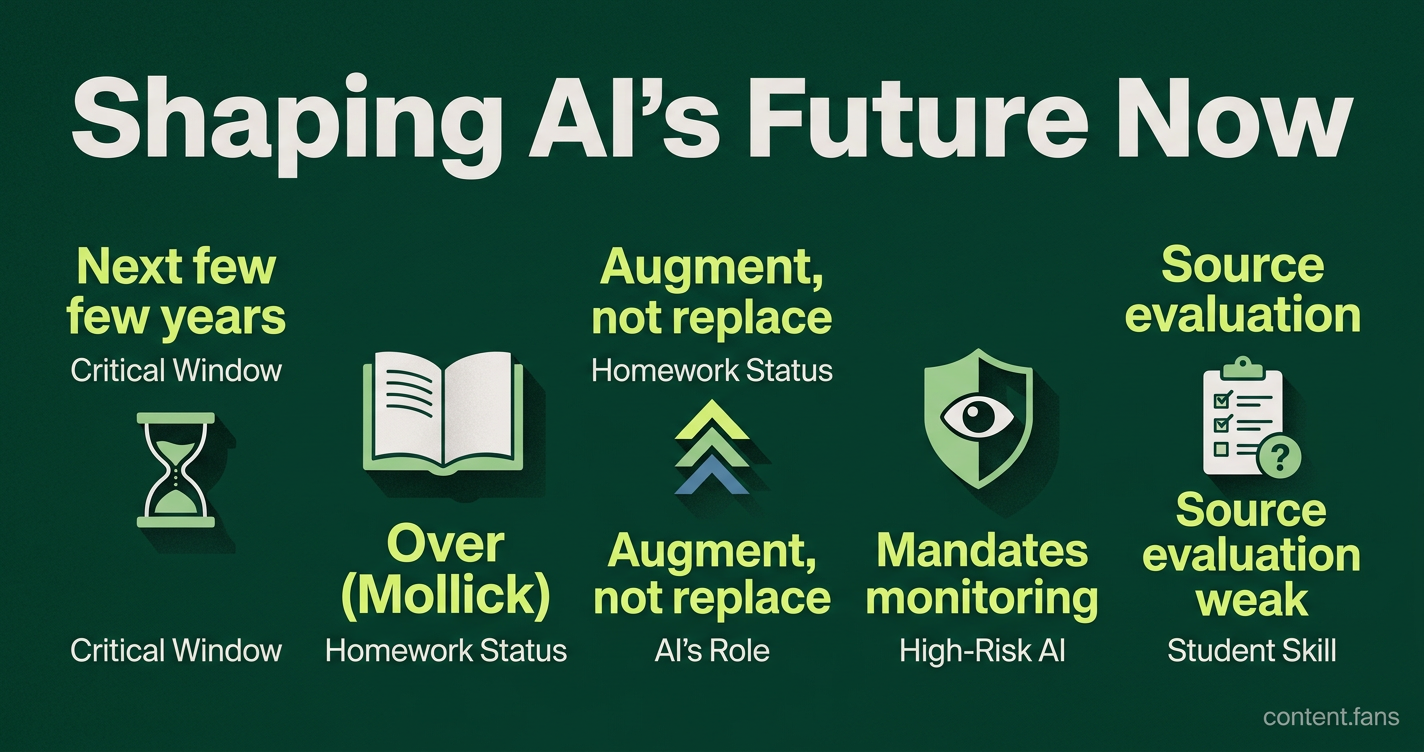
Many institutions are deploying AI tools rapidly but without a clear strategy. Wharton professor Ethan Mollick argues that because AI can solve most standard assignments, "homework is over" (One Useful Thing, Knowledge at Wharton), and that AI-driven cheating will be widespread. Reacting with outright bans or using AI detectors often encourages an arms race instead of promoting reflective and responsible use. In contrast, experts from Brookings and the U.S. Department of Education advise frameworks that prioritize keeping a "human in the loop" and building comprehensive AI literacy.
The Immediate Impact of AI on Education and Work
Current trends show that AI is already reshaping routines in both classrooms and offices. In education, three major shifts are apparent:
- Redesigned Assessments: Teachers are moving away from routine assignments that are easily solved by chatbots, focusing instead on open-ended projects and oral exams.
- Mixed Skill Development: While students using AI tutors often improve their revision skills, their ability to evaluate sources remains weak unless they receive specific guidance.
- Erosion of Inquiry: Early exposure to AI as a simple answer-provider may reduce students' motivation to develop strong questioning skills.
In the workplace, software defaults are creating similar patterns. To counter this, policy is catching up. A brief from the World Economic Forum states that AI tools for hiring or credit should "augment, not replace, human judgment." The EU AI Act now mandates monitoring for high-risk systems, while surveys of HR leaders show that governance policies, bias audits, and explicit human oversight rules are becoming standard practice.
5 Strategies for Building Healthier AI Habits
Experts propose several practical adjustments that organizations can implement to foster more responsible AI use:
- Require a Verification Step: Design assignments and tasks where users must compare AI-generated output against primary sources and document any discrepancies.
- Provide Opt-Out Alternatives: Always offer a non-AI path for completing tasks, ensuring users maintain agency and control.
- Default to Transparency: Configure AI tools to automatically display data sources, confidence scores, and revision histories without requiring extra clicks from the user.
- Schedule Regular Bias Audits: Implement a framework for testing AI systems for demographic performance bias before launch and at regular intervals thereafter.
- Embed AI Literacy into Onboarding: Prioritize training workers on responsible AI use, as skill gaps - not technology - are often the biggest barrier to adoption.
The Narrowing Window for Setting Balanced AI Norms
While regulators are acting, cultural habits may be forming even faster. If educational platforms leave auto-complete on by default, students may learn that drafting is an optional skill. If workplace software defaults to using hidden algorithmic rankings, managers may begin to treat AI suggestions as objective facts. This indicates that the crucial period for establishing balanced, transparent, and human-centered AI norms is now, and it may be closing as these initial habits become permanent.
Why are today's AI defaults so hard to change later?
Defaults create powerful habits. When AI platforms and workplace policies make speed and automation feel normal, these behaviors become deeply embedded. As the World Economic Forum warns, once a generation of students and workers internalizes these patterns, attempting to re-introduce slower, more reflective practices will face significant resistance. With AI-assisted cheating already widespread and hard to detect, the expectation of instant, automated answers is quickly becoming the new baseline.
How can schools integrate AI without eroding critical thinking?
The key is to redesign assignments around verification and reflection. Following guidance from the U.S. Department of Education, educators should ensure AI is used as a "thought partner," not a shortcut. This involves requiring students to check AI-generated sources, explain their edits, and engage in tasks that deepen cognitive skills. Keeping a human - the teacher - in the loop is essential. Studies show that programs following this model can boost critical-thinking metrics by up to 72%.
What does a responsible workplace AI policy include?
A robust policy is built on three pillars: principle-based governance, human oversight, and continuous employee training. Key elements now being adopted to align with frameworks like the EU AI Act include:
- Clear Use Cases: Defining which decisions require human sign-off.
- Mandatory Bias Audits: Scheduling fairness tests before deployment and periodically after.
- Full Transparency: Informing employees when and why AI is being used.
- AI Literacy Training: Reskilling the workforce to manage and interact with AI responsibly.
Which human skills are most valuable in the age of AI?
As AI handles routine tasks, uniquely human skills like agency, ethical judgment, and complex communication are surging in demand. According to analyses from Deloitte and the World Economic Forum, the fastest-growing skill gaps are in critical thinking and adaptability. When AI provides the answers, the greatest value shifts to the human ability to ask the right questions, navigate ambiguity, and frame the problem correctly.
How can designers build more responsible AI products?
Product teams can embed "reflection by design" by prioritizing explainability over frictionless automation. Instead of having AI auto-execute tasks, effective design patterns introduce "pause moments." This can be achieved by:
- Requiring User Confirmation: Forcing a deliberate click before an AI action is finalized.
- Surfacing Explainability: Showing why the model produced a certain result and inviting the user to edit or reject it.
- Displaying Fairness Dashboards: Visualizing bias indicators so decision-makers can intervene.
Studies show these features boost user trust and reduce errors.