
AI clones split creator economy, generating legal and platform challenges
Serge Bulaev
The creator economy may be divided by the rise of AI clones, with some influencers licensing official digital twins while others find unauthorized copies of their voices or faces online. Legal battles over consent and control of digital likenesses are growing, and courts in different countries have begun to treat voice and image as protected traits. The value of digital twins appears to be increasing as brands pay high prices for approved avatars, and agencies are updating contracts to include digital performance fees. New services are emerging to detect illegal clones and help manage digital identities, and stricter platform rules about consent and disclosure may shape how digital identities are valued in the future.
The creator economy is facing a major split from AI clones, generating legal and platform challenges that pit creators using authorized digital twins against those finding illicit copies of themselves online. This division is forcing new conversations about consent, control, and the value of digital identity.
This new landscape hinges on consent, control, and monetization. The methods that successfully prove a verified digital twin can generate measurable ROI will likely set the standard for how talent, advertisers, and courts value digital identity in the future.
Authorized twins draw real budgets
An AI clone, or digital twin, is a synthetic replica of a person's voice, image, or likeness created using artificial intelligence. The legality of these clones hinges on consent. Authorized twins are licensed by the creator, while unauthorized clones are created and used without permission, leading to legal action.
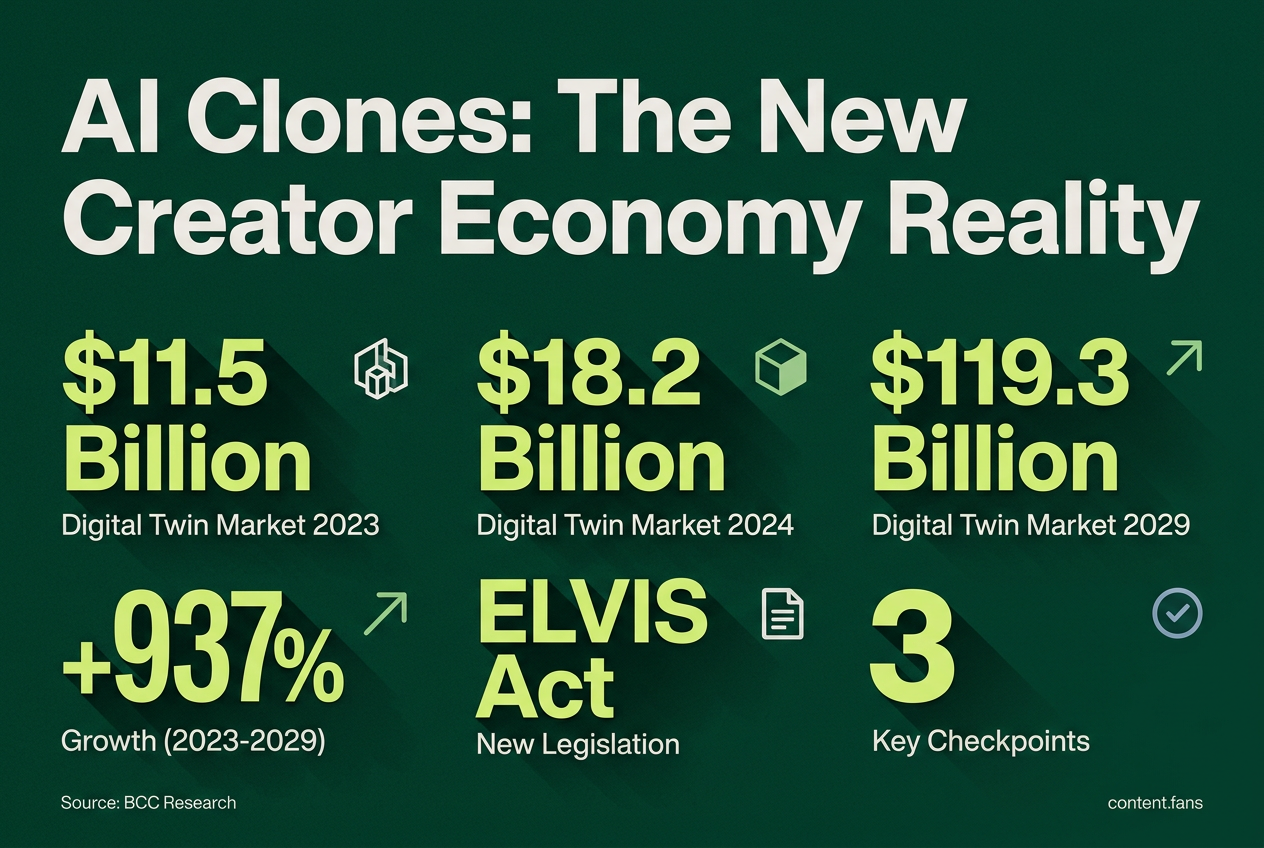
The market for authorized digital twins is attracting significant investment. According to BCC Research, the global digital twin market was valued at $11.5 billion in 2023 and is projected to reach $18.2 billion in 2024, growing to $119.3 billion by 2029. Brand managers are leveraging this growth to justify six-figure deals for approved influencer avatars capable of handling everything from fan Q&As to multi-language ad campaigns.
Reflecting this trend, talent agencies are now updating contracts to include escalating "digital performance" fees with each renewal. This practice points toward an emerging royalty standard for AI-generated appearances, much like the residual payments common in film and television.
Courts focus on voice cloning
Unauthorized AI clones have triggered a surge in right-of-publicity lawsuits, with courts globally establishing new precedents. In India, recent court rulings have classified a singer's voice and likeness as protectable traits, halting their unapproved use. The Delhi High Court followed suit in Jackie Shroff v. The Peppy Store, blocking an AI chatbot that copied the actor's voice.
Similarly, in the United States, cases involving AI voice cloning are proceeding on state-level publicity and privacy claims, suggesting these statutes are more effective than federal copyright law for voice-clone disputes. Tennessee's ELVIS Act (2024) is legislation that protects musical artists from unauthorized use of their digital voice replicas, requiring explicit consent.
Platforms tighten disclosure rules
As platforms tighten their policies, brands and talent managers must now incorporate three critical checkpoints into all agreements for AI-driven campaigns:
- Consent: Secure written consent that explicitly covers voice, likeness, and any future AI model retraining.
- Labeling: Ensure all synthetic content is clearly labeled as such across every platform and geographic region.
- Auditing: Maintain a detailed audit trail documenting the creation process and usage of the digital twin.
New service layers emerge
This division between authorized and unauthorized clones has created a new ecosystem of services. Key niches include verification companies that hunt for illicit clones, specialized legal firms that issue rapid takedowns, and SaaS platforms that embed C2PA metadata for content authentication. Industry experts predict that the tools which successfully standardize digital provenance will become the new "blue check" for AI avatars, commanding trust and premium value.
What counts as an unauthorized AI clone, and where have courts already drawn the line?
Courts in India and the United States have started to treat voice, name, image and likeness misuse as a personality-rights violation even when the AI output is technically new.
- In India, the Bombay High Court has granted interim relief to singers against companies that cloned their voices without consent, calling it a direct breach of publicity and personality rights.
- In the U.S., a New York federal court has let state-law claims proceed in cases involving AI voice cloning, where defendants cloned podcasters' voices for commercial stock libraries.
Bottom line: using recognizable vocal or visual traits without written permission is increasingly actionable.
How big is the market for licensed digital twins, and why should creators care?
Current market estimates vary widely by publisher, but available research places the digital twin market around USD 4.9 billion in 2021 to USD 50.2 billion by 2026 (BCC Research) and USD 35.82 billion in 2025 to USD 49.47 billion in 2026 (Grand View Research).
Creators who move early can position themselves as IP licensors rather than defendants - a shift that monetizes their likeness instead of fighting over it.
Which creator platforms already require disclosure or consent for AI replicas?
Major platforms are increasingly implementing "label + consent" rules:
- YouTube: requires creators to flag realistic synthetic content and will honor privacy takedowns for AI depictions made without consent.
- TikTok & Meta: auto-label AI-made posts via C2PA metadata and prohibit voice or face clones used for impersonation.
- Spotify, Apple Music: demand written permission before distributing tracks that mimic a real artist's voice.
In short, if you do not disclose or lack consent, expect takedowns or demonetization.
What new service layers are emerging around digital-twin licensing?
The split between authorized and unauthorized use has created three fast-growing niches:
- Licensing marketplaces - platforms that broker deals between creators and brands who want to "hire" the digital twin for meetings or campaigns.
- Verification & watermarking - startups offering cryptographic provenance so fans can tell an official twin from a rogue clone.
- Takedown & legal-support services - firms specializing in personality-rights injunctions and DMCA-plus removals that go beyond classic copyright claims.
Early adopters are packaging all three into "360° digital-twin management" retainers for top creators.
How should talent managers and brands rewrite contracts now?
Update every talent agreement to cover "synthetic performer rights":
- Grant of rights: spell out whether the client can license, sell or retire their digital twin.
- Consent language: follow established legal templates - explicit written permission with a reasonably specific description of each planned AI use.
- Revenue splits: carve out AI-generated activations as a separate royalty bucket to avoid disputes when the twin books a brand deal the human never attended.
- Platform compliance: add clauses requiring disclosure tags and metadata watermarking on all AI content to stay ahead of platform policy updates.
Updating today avoids courtrooms tomorrow.