
AI chip deals convert variable spend into fixed cost for buyers
Serge Bulaev
AI chip deals may turn what used to be unpredictable, variable spending into a fixed cost for buyers. Even though the unit price for running AI models (inference) has dropped sharply, total spending keeps rising because use is growing even faster. Some sources suggest that inference now accounts for most of the lifetime cost of running AI, and using chips efficiently becomes crucial for profits. Long-term chip contracts might help buyers by securing supply but can also create financial risks if actual usage falls short. The overall impact on companies depends on whether they can keep their chip usage high enough to justify the fixed costs.

AI chip deals convert variable spend into fixed cost for buyers, a fundamental shift in compute economics. While per-unit inference costs are plummeting, soaring demand means total spending continues to rise. These long-term contracts secure vital supply but introduce major financial risks, making efficient hardware utilization the new benchmark for profitability.
The New Economics of AI: Plunging Unit Costs, Rising Total Spend
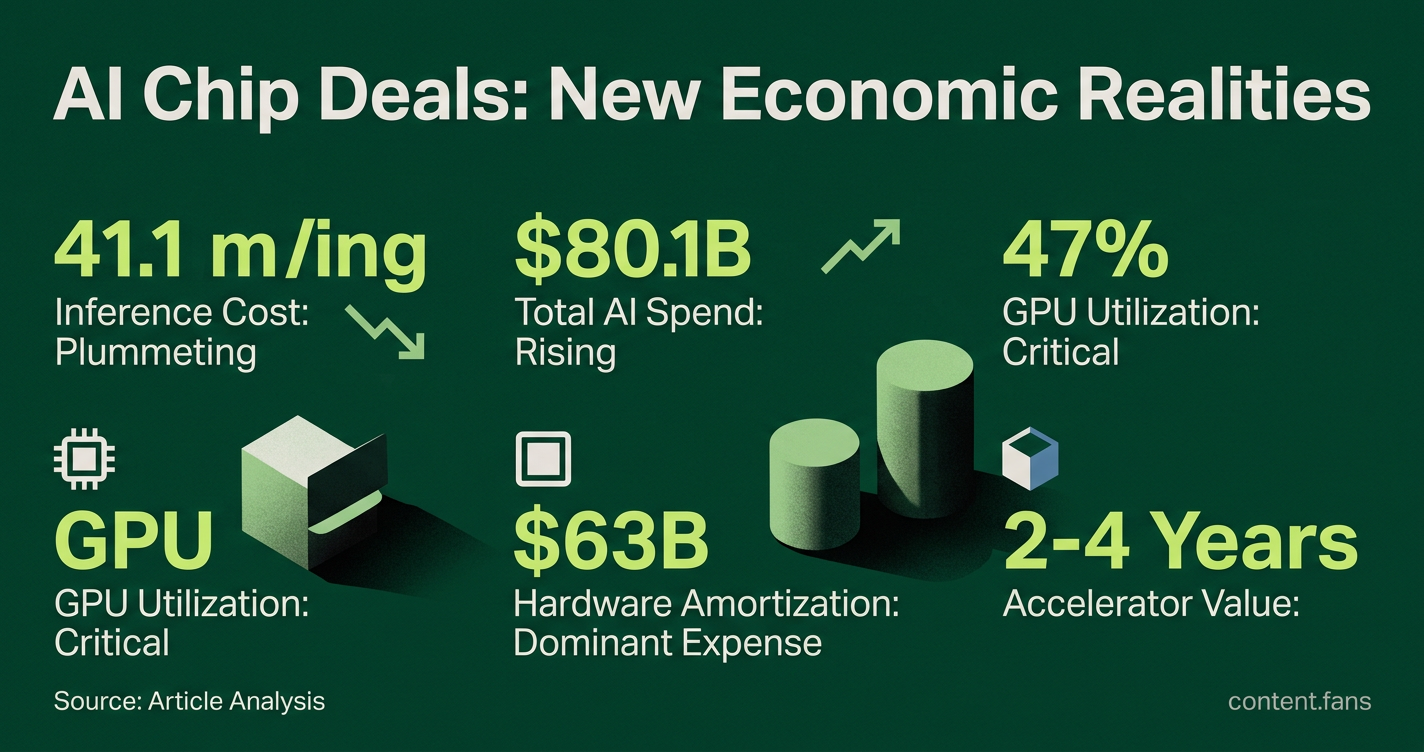
Corporate boards and investors are grappling with a core paradox: why does total AI compute spending keep climbing even as the unit cost of inference collapses? The answer lies in the split between training (a fixed, one-time cost) and inference (a recurring, variable cost). While the price to process a query has dropped dramatically according to industry reports, inference token volume is growing even faster. Consequently, inference now represents a significant portion of an AI model's lifecycle compute cost, making the management of these expenses a critical factor for margins.
Long-term AI chip contracts transform unpredictable, usage-based compute expenses into large, fixed capital commitments. By pre-purchasing hardware, companies secure scarce supply but also accept the risk of underutilization. If demand falters or technology advances, they are still locked into fixed payments, creating significant balance-sheet pressure.
The High Cost of Training and Self-Hosted Inference
The scale of investment is staggering. Training frontier models requires substantial investment, with subsequent serving costs reaching significant annual amounts according to industry estimates. Hardware amortization is the dominant expense. For companies self-hosting their models, GPU utilization is the single most important factor for profitability. Industry analysis suggests that below certain sustained utilization thresholds, renting capacity via cloud APIs is often more economical. Compounding this challenge is rapid economic obsolescence, with analysts debating whether accelerators retain value for two or four years. Cerno Capital notes that extending server depreciation schedules could substantially reduce expenses, but intense workloads may shorten the hardware's physical lifespan.
How Multi-Year Chip Contracts Create Balance-Sheet Risk
Chip suppliers like Broadcom and Samsung point to large, multi-year contracts as evidence of durable AI demand. Major suppliers report substantial projected growth in AI revenue based on long-term deals. For buyers, however, these deals introduce significant risk. Financial analysts warn that complex agreements involving equity and credit can obscure true demand and hide leverage. If utilization fails to meet projections, locked-in capacity can severely pressure margins.
Scenario modeling reveals extreme margin sensitivity to utilization:
- High Utilization: Industry reports suggest that strong utilization rates can deliver healthy gross margins.
- Moderate Utilization: With lower utilization, margins can collapse significantly.
- Low Utilization: Further price cuts could push models into unprofitability relatively quickly.
Because depreciation is time-based while revenue is consumption-based, periods of low utilization have an outsized negative impact. This forces analysts to scrutinize deferred obligations from chip commitments just as closely as realized revenue.
Investor Takeaways: From Growth Hype to Utilization Metrics
Investor focus is shifting. Valuations now depend less on headline AI growth and more on tangible proof that companies can fill their pre-purchased capacity. Key metrics like inferenced tokens per deployed GPU are becoming the new standard for measuring operating leverage. Contracts that front-load hardware purchases without immediate workloads are increasingly viewed as a sign of hidden leverage, not durable earnings. The consensus is clear: while long-term chip deals secure scarce inventory, they transform a variable operating expense into a massive fixed cost. In a market where token prices continue to fall, high utilization is the only reliable defense for margins and valuation.
How do long-term chip deals change an AI company's cost structure?
Multi-year GPU or ASIC agreements convert variable, pay-as-you-go spending into a fixed capital commitment. Instead of renting capacity priced per token or per hour, a model provider locks in a set number of chips and agrees to fixed quarterly payments. The upside is guaranteed supply in a tight market; the downside is that even if token demand falls or new hardware becomes available, the cash outflow remains the same. This increases operating leverage: every extra token beyond the pre-bought capacity is pure margin, but any shortfall in demand magnifies unit costs.
What financial risks should investors watch when firms sign billion-dollar GPU agreements?
Investors face three main red flags:
- Revenue inflation risk - Contracts may count future deliveries in today's backlog, exaggerating near-term growth.
- Concentration risk - A single supplier or chip architecture can become a single point of failure.
- Hidden leverage - Some deals involve vendor financing or equity swaps, so reported cash positions may overstate liquidity. Financial analysts have warned that these structures can obscure true customer demand and inflate valuations.
How fast are AI accelerator depreciation schedules shortening compared to traditional servers?
Traditional enterprise servers typically have longer depreciation schedules, but industry practice shows hyperscalers now model AI GPUs on shorter lifespans. The driver is economic obsolescence: each new card delivers significantly more throughput per watt, making last-gen hardware uncompetitive even if it still works. Analysts estimate that extending GPU depreciation schedules could substantially cut annual depreciation expenses, but warn that high utilization can shorten physical life through faster silicon ageing.
What utilization level makes self-hosted inference cheaper than cloud APIs?
Industry benchmarks indicate there is a break-even utilization threshold below which the fixed costs of ownership (depreciation, power, colocation, operations) outweigh the benefits of self-hosting compared to cloud API pricing. At high concurrency, self-hosted hardware can achieve lower per-token costs, but only if the hardware stays busy with batched requests most hours of the day.
How sensitive are margins to changes in token pricing and hardware utilization?
Unit economics are highly elastic:
- Price sensitivity - Per-token API prices have fallen dramatically in recent years, so any new contract signed at current rates can become uncompetitive within months.
- Utilization sensitivity - Below optimal GPU utilization levels, cost per token can increase substantially; above higher thresholds, each incremental percentage point in utilization can meaningfully reduce per-token costs. Therefore scenario modeling must stress-test both falling prices and fluctuating demand to avoid margin surprises.