
AI and stablecoins dismantle approval hierarchies, transforming professional services
Serge Bulaev
AI and stablecoins may be breaking down old approval systems in professional services. Many tasks that once needed banks, lawyers, or accountants can now be done using new technology, but only some firms have fully put these tools into everyday use. AI appears to make legal and banking work faster and might lower the need for some workers, while stablecoins seem to make moving money cheaper and easier. These changes could bring new risks, such as security issues and unclear responsibility if things go wrong. Even as more skills can be automated, people still have to manage, supervise, and deal with the results.

The rapid ascent of AI and stablecoins is dismantling approval hierarchies, fundamentally transforming professional services into a "permissionless economy." Where individuals once needed constant validation from banks, law firms, or accountants, today's crypto and AI tools allow them to incorporate, trade, and move capital independently. This shift is most pronounced where knowledge work and code intersect.
Which tasks are AI and automation transforming first?
Generative AI models now draft legal research, summarize contracts, and prepare audit worksheets in minutes, compressing routine tasks that once took days. While many professional services firms report growing AI adoption, implementation varies significantly across the industry, according to data aggregated by The Thinking Inc.. The impact is already measurable:
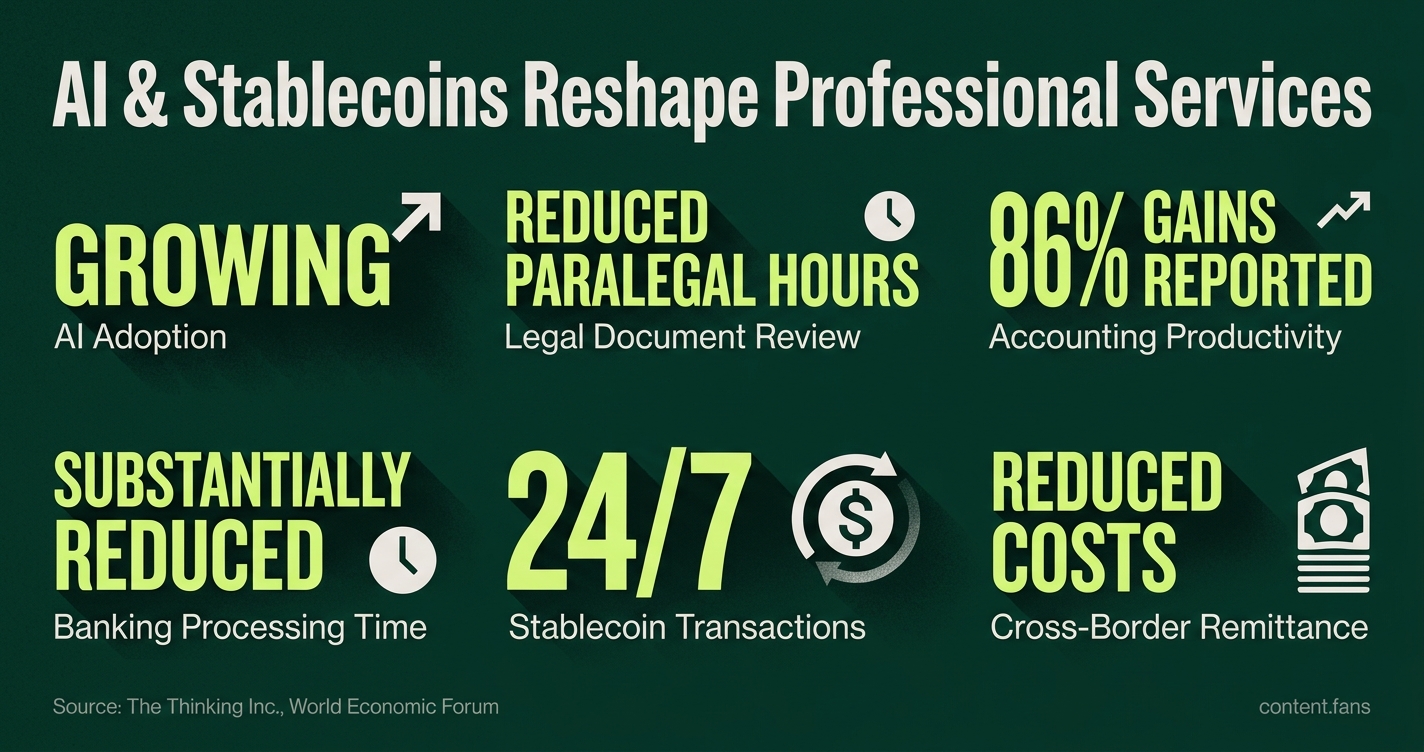
- Legal: Firms using AI for document review report significant reductions in paralegal hours.
- Accounting: Many organizations report productivity gains from AI in bookkeeping and reconciliation.
- Banking: Back-office processing time for tasks like credit reviews is substantially reduced.
AI primarily automates repetitive, data-heavy work across legal, accounting, and banking sectors. Key examples include document review, first-pass contract drafting, bookkeeping, and initial audit sampling. Consequently, human roles are shifting toward supervision, strategic advice, and managing exceptions, challenging traditional time-based billing models.
How stablecoins are building a parallel financial system
Permissionless finance demonstrates a parallel dynamic. Stablecoins have processed substantial transaction volumes in recent years, with transactions operating 24/7 outside traditional banking hours. According to a World Economic Forum executive summary, blockchain technology has the potential to significantly reduce cross-border remittance costs. Decentralized finance (DeFi) protocols like Aave and Morpho further this trend, allowing users to borrow against assets via smart contracts, replacing the need for credit officers.
The modern toolkit for a permissionless operator
A solo operator can now assemble a powerful stack to bypass traditional gatekeepers. Here is a starter kit you can deploy without asking for permission:
| Function | Permissionless Tool | What it provides |
|---|---|---|
| Business banking | Stablecoin wallet (Ledger, Coinbase Wallet) | Self-custody, instant global payments |
| Legal templates | AI first-draft generators (Harvey, Lexion) | Contracts, NDAs, T&Cs in minutes |
| Accounting & audit trail | AI bookkeeping layer (Numeric, Puzzle) | Auto-categorized transactions, chain-ready reports |
| Cross-border payroll | USDC/DAI payouts via Superfluid or Request Network | Pay contractors at reduced traditional remittance cost |
| Governance & cap-table | Tokenized DAO (Gnosis Safe, Aragon) | Shareholder votes without lawyers |
Crucially, these tools export data in standard formats, ensuring you can still engage a traditional lawyer or accountant for high-level review when needed.
How traditional firms and new structures are adapting
With AI adoption showing strong returns on investment for early adopters, traditional firms are being forced to adapt. According to Deloitte research, ROI from AI integration can surpass 300% within three years. Industry observers note that leading brands are responding in several key ways:
- Productizing Services: Packaging routine work like basic contract reviews into flat-rate AI-driven products.
- Moving Upstream: Shifting partner focus toward high-stakes advisory, complex negotiation, and relationship management.
- Downsizing Junior Roles: Increasing attrition in junior cohorts as firms realize they need fewer associates for entry-level tasks.
This is creating smaller, higher-margin teams focused on judgment and reputational cover - elements AI cannot yet provide. In parallel, new organizational models are emerging that mirror these permissionless ideals. Companies like Haier delegate authority to micro-teams, reflecting the governance of Decentralized Autonomous Organizations (DAOs) where token holders vote on proposals instead of boards.
Key risks of the permissionless economy and how to hedge them
While powerful, a fully permissionless approach is not without its dangers. The primary risks include:
- Regulatory Uncertainty: Gaps in KYC/AML compliance can lead to frozen funds on centralized exchanges. Hedge: Maintain a traditional banking channel for regulated transactions like payroll taxes.
- Smart-Contract Exploits: DeFi protocols reportedly lost about $795 million in the first four months of 2026, with losses largely driven by compromised keys, bridges, and operational failures. Hedge: Use insured protocols and limit exposure to any single platform.
- Governance Vacuum: If a DAO votes against your interests, there is no central authority to appeal to. Hedge: Embed arbitration clauses in code (e.g., Kleros) and retain multi-signature veto power for critical decisions.
- Liquidity Runs: Transparent public ledgers make bank-run scenarios visible in real-time. Hedge: Keep 30-60 days of operating expenses in off-chain USD reserves.
A hybrid model - running most operations on permissionless rails for speed and cost while keeping a portion in regulated systems - offers a prudent path forward.
Economic signals to watch
Looking ahead, several economic signals will track the momentum of this transformation. Watch for the rise of "AI capacity pricing," where firms bill for autonomous agents as if they were junior staff. Generative AI adoption in professional services continues to grow rapidly across the industry. In parallel, real-time indicators like stablecoin transaction volume and DeFi's total value locked (TVL) will measure the traction of permissionless finance.
Each of these metrics points to a gradual inversion of the approval pyramid. Skills once gated by graduate degrees and compliance departments are now being simulated and automated. However, ultimate accountability still rests with the humans who must supervise the code, manage strategic risk, and interpret the final outcomes.