
AI Agent Identity Becomes New Enterprise Security Control Plane
Serge Bulaev
AI agent identity is becoming a key part of enterprise security, acting as a single place to manage and monitor what people, machines, and AI agents can do. Experts say identity may be the best way to control access and respond quickly to problems, since agents might bypass old security boundaries with valid credentials. Research suggests new security designs focus on short-lived identities, constant policy checks, and strong audit trails. Some experts warn the control system itself could be a target, so it should be well-protected. Many companies already use AI agents, and more may adopt unified identity controls to keep risks small and easy to manage.

Managing AI agent identity through a unified control plane for identity, data, and AI agents has rapidly evolved from concept to a core reference architecture. Security teams are adopting this model to contain the blast radius of security incidents, ensuring they are small, visible, and quickly recoverable. This approach centralizes security by tying every human, machine, and AI agent action to a single policy decision point, providing a unified lens for enforcement, auditing, and rapid emergency response.
Why identity sits at the center
An AI agent identity control plane is a centralized security framework for managing permissions for AI agents. It treats each agent as a unique identity, enforcing consistent access policies, creating detailed audit trails, and enabling instant response to threats across the entire enterprise technology stack.
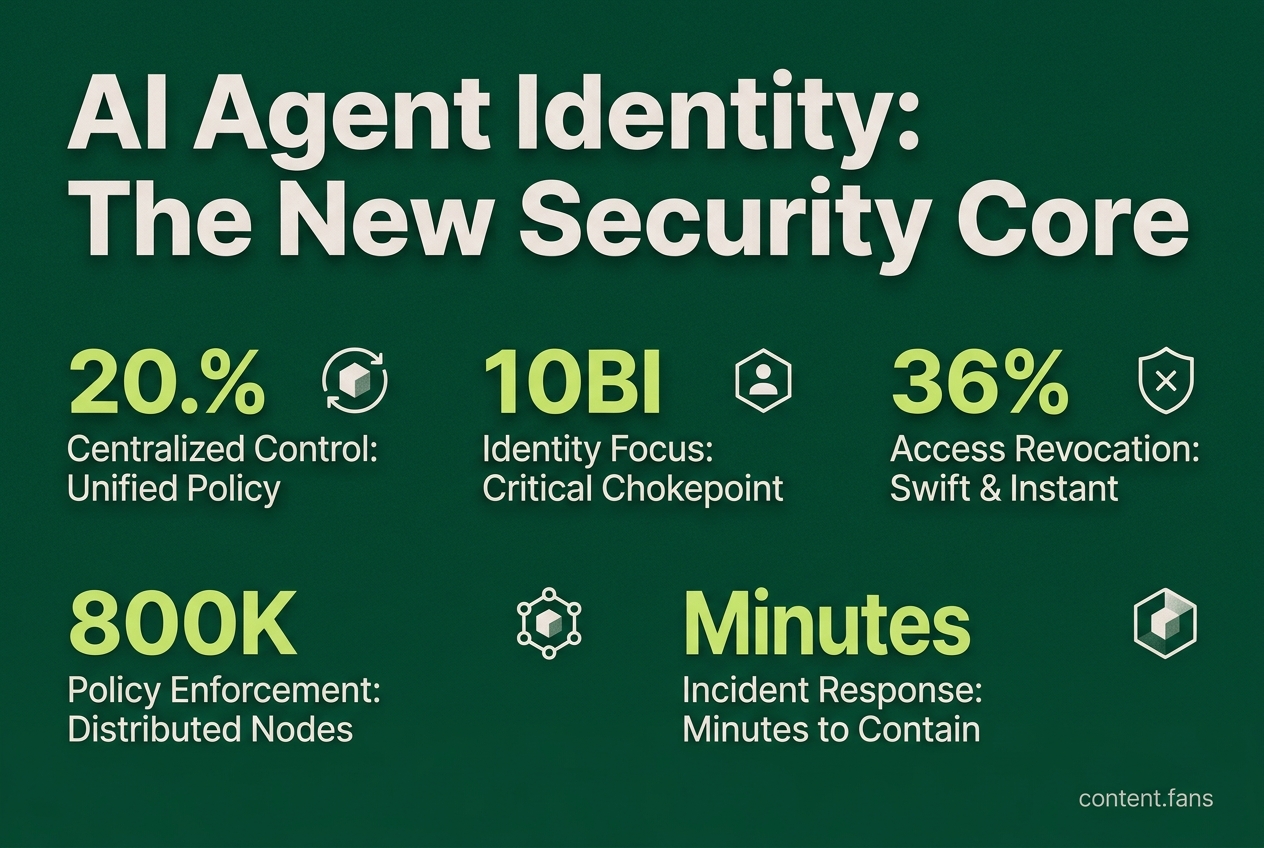
Identity serves as the foundational starting point for every agent's operations. Industry reports highlight that agents can "bypass traditional security boundaries while using valid credentials," which positions the identity layer as the critical chokepoint for governance and accountability. Forrester research reinforces this, stating that effective runtime governance requires an identity that accompanies the agent from development to production. A centralized identity fabric enables just-in-time credentials, swift access revocation, and the consistent application of least-privilege policies across all cloud, SaaS, and on-premise environments.
Core components of this architecture typically include:
- Distinct, short-lived identities for each agent or workload to minimize exposure.
- A runtime policy engine that evaluates every access request against predefined rules.
- Distributed enforcement nodes to ensure asset protection continues even if the central control UI is offline.
- A comprehensive audit pipeline that records the intent, decision logic, and resources accessed for every action.
Design pattern for resilience and speed
In a security incident, response teams require a single point of control to revoke access, assess the blast radius, and initiate remediation. Industry research notes that enterprises are adopting a "Trust and Control architecture" where identity, policy, and logs converge, enabling containment actions within minutes. The most effective pattern combines centralized control with distributed enforcement. This means policy updates originate from a central plane but are cached locally at gateways, service meshes, or host agents, ensuring enforcement continues even if the central console becomes unavailable.
Security architects caution that the control plane itself is a high-value target. Security experts recommend safeguards like dual-administrator controls, air-gapped backups, and continuous policy validation to prevent misconfigurations from expanding an incident's blast radius. True resilience, therefore, depends on building a highly redundant and independently secured control plane.
Emerging adoption signals
Adoption is accelerating rapidly. A CSA survey reports that 82% of organizations have unknown AI agents in their environment, with 65% having experienced security incidents related to AI agents. Furthermore, industry reports suggest that a significant portion of enterprise applications will embed task-specific agents in the coming years. This trend is driving major technology vendors to converge IAM, data security, and agent governance. For instance, Microsoft now manages agents as distinct entities with lifecycle controls, Google Cloud is securing agent access with its Model Context Protocol, and leading identity providers are introducing short-lived credentials for non-human identities.
The industry trajectory is clearly moving toward a single operational boundary for AI security: a unified control plane where agent access is granted, monitored, explained, and revoked. Operating without such a framework is becoming akin to managing incident response without a firewall - technically feasible, but operationally reckless.
What exactly is the "AI Agent Identity Control Plane" and how does it differ from traditional IAM?
The concept is a single orchestration layer that treats every AI agent, bot, or autonomous workload as a first-class identity with its own credentials, policy set, and audit trail. Unlike traditional IAM that focuses on humans and static service accounts, this plane unifies identity resilience, data-protection orchestration, and agent runtime governance in one place. It becomes the chokepoint where every agent action must authenticate, justify its intent, and leave an immutable log.
How does centralizing these functions reduce blast radius during an incident?
When an exploit or misconfiguration is detected, the unified plane can instantly revoke the specific agent identity, quarantine downstream resources, and replay audit logs to reconstruct exactly which data or systems were touched. Industry reports show that companies using this pattern have significantly reduced mean-time-to-contain and reduced affected asset count compared with fragmented controls.
What are the core technical components enterprises should look for?
- Distinct agent identities issued by the corporate IdP but scoped to each workload.
- Runtime policy engine that evaluates every request against least-privilege rules, including just-in-time or ephemeral credentials.
- Observability layer streaming intent, resource, and policy outcome for every call.
- Registry of models and tools with MCP governance points so agents can be inventoried and retired.
- Recovery hooks - cached rules and redundant enforcement nodes that keep the plane alive if the primary control node fails.
Which vendors or ecosystems are making progress in this space?
- Microsoft already positions Azure as the control plane for agent operations, requiring identities, permissions, policy enforcement, and lifecycle management at scale.
- Google Cloud is baking Model Context Protocol (MCP) governance into Vertex AI so agents access cloud data through scoped, auditable channels.
- Deloitte advises regulated clients to adopt cryptographic receipts and immutable logs for every agent transaction, using identity-centric stacks from Okta, IBM, or bespoke PKI.
Open-source momentum is around NIST CAISI drafts and the emerging Agent-to-Agent (A2A) protocol supported by the Cloud Security Alliance.
What are the biggest trade-offs or failure modes to plan for?
- Single point of compromise: if attackers pivot into the control plane itself, they could disable protections globally. Mitigate with strong separation of duties, multi-party approval workflows, and offline policy caches.
- Operational bottleneck: centralized approvals can slow incident response unless high-throughput automation and human-in-the-loop exemptions are pre-designed.
- Policy-drift risk: one mis-applied rule can propagate everywhere. Continuous validation pipelines and canary deployments are essential.