
AI Adoption Faces Bottleneck as Public Trust, Governance Lag
Serge Bulaev
AI progress is moving quickly, but many institutions are slow to adopt it because they are unsure if controls and governance are strong enough. Studies suggest that weak data governance, not technical ability, may be what holds back wider use, especially in areas like finance and public infrastructure. Public trust appears to be limited, and some experts warn that a lack of transparency might stop people from accepting AI. New laws and frameworks, such as the EU AI Act and ISO/IEC 42001, aim to improve oversight, but many organizations still seem to be in early stages of building trust. Evidence suggests adoption might increase most where technical advances are paired with clear records, strong controls, and public involvement.

A significant AI adoption bottleneck is emerging because public trust and institutional governance are failing to keep pace with rapid technical progress. In high-stakes sectors like finance and healthcare, organizations are delaying large-scale deployment, prioritizing transparent controls and auditable systems over raw model performance.
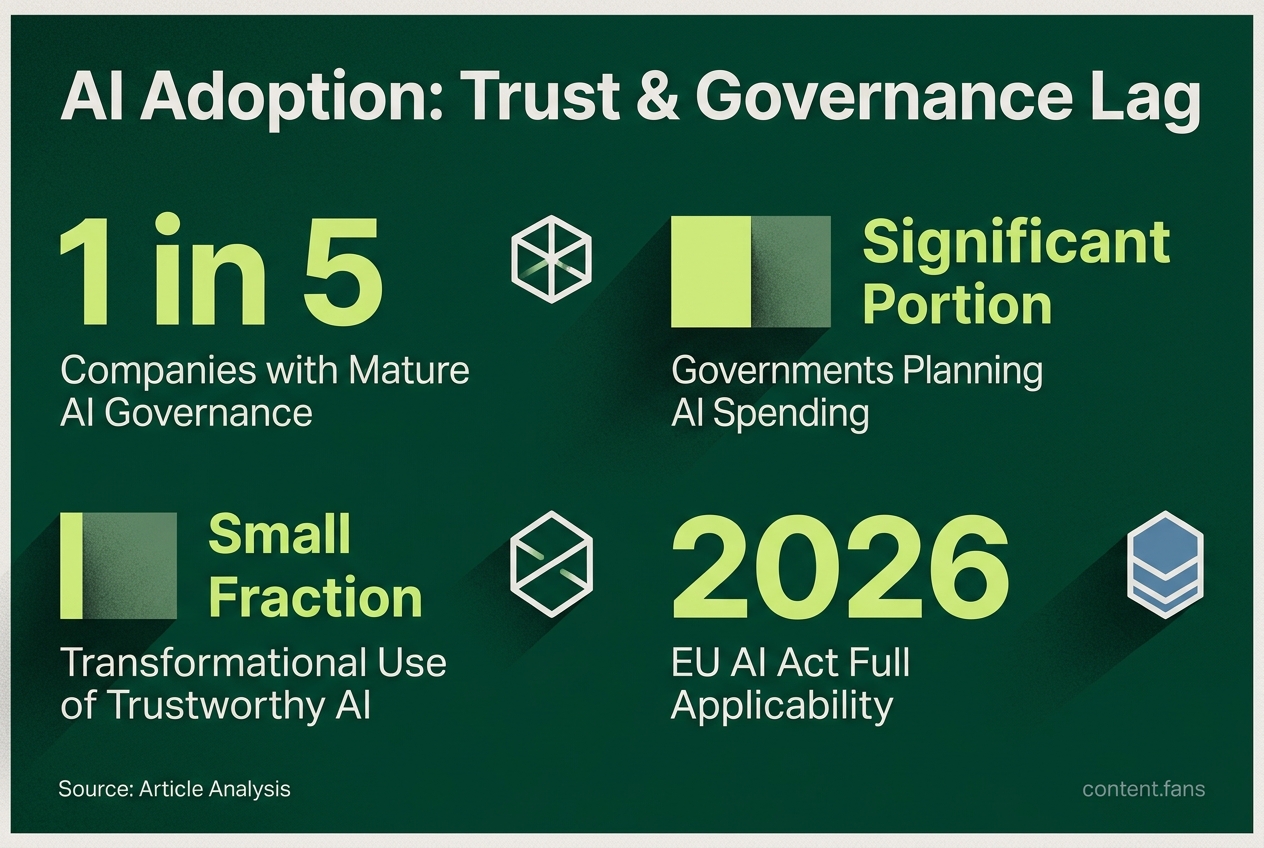
Public sentiment data highlights this disconnect. Industry reports suggest that while a significant portion of governments plan to increase AI spending, only a small fraction report 'transformational' use of trustworthy AI. Many organizations cite weak data governance as the primary inhibitor, confirming that controls - not technology - are limiting scale. Echoing this, the Federation of American Scientists warns that a lack of transparency erodes public trust and "will inhibit the beneficial uses of AI."
Global Governance Frameworks Emerge to Address Risk
Widespread AI adoption is slowed not by technical limitations, but by a lack of institutional readiness. Organizations in sensitive fields require clear evidence of safety, auditability, and regulatory compliance before scaling AI systems. This trust deficit means that governance frameworks have become more critical than algorithmic breakthroughs for deployment.
Several key frameworks are shaping global AI risk management. The EU AI Act establishes tiered obligations for high-risk systems, demanding human oversight and full traceability, as detailed in the MIT AI Risk Landscape update link. The Act is being implemented in phases, with full applicability expected by 2026 and transition periods for many high-risk systems extending into 2027-2028. Complementing this are the voluntary NIST AI Risk Management Framework in the U.S., the certifiable ISO/IEC 42001:2023 standard, and Singapore's practical Model AI Governance Framework.
Sector Analysis: Finance and Infrastructure Face Trust Hurdles
The financial sector clearly illustrates the gap between technical capability and institutional trust. According to a compliance checklist from Fin AI, financial AI agents must maintain an immutable, timestamped audit log of all inputs, actions, and approvals to meet regulatory standards link. With a Deloitte poll showing only one in five companies has a mature AI governance model, many projects are unable to move past the pilot stage without these robust evidence trails.
Critical infrastructure sectors like energy, water, and transportation face similar challenges. The Federation of American Scientists notes that deploying AI without public participation erodes legitimacy and can halt projects. This is compounded by public skepticism; industry studies suggest a significant portion of citizens remain unsure if AI enhances government efficiency, delaying deployments that require community buy-in.
The Anatomy of an Auditable AI System
A consensus is forming around the essential data an auditable AI system must record. To satisfy regulators and build trust, these logs must be immutable. Key components of this audit trail include:
- Session & User Data: Precise identifiers and timestamps for all interactions.
- Decision Provenance: The exact model, prompt, and policy versions used for each decision.
- Data Sources: A record of all retrieved documents or data used to generate an output.
- Authorization Trail: All authorization checks and any manual overrides by human operators.
- State Changes: Before-and-after records for any system data the AI modifies.
ISO/IEC 42001 further mandates that this evidence supports a cycle of continuous improvement through documented monitoring and incident response.
The Path to Scaling AI: Governance Before Growth
Ultimately, success in scaling AI in high-stakes environments depends on packaging technical advances with clear governance. Field evidence shows that adoption accelerates only when institutions have the necessary scaffolding. This includes implementing risk-tiering from the EU AI Act, operational controls from the NIST framework, and the management discipline required by ISO 42001, which together provide the confidence needed to move beyond limited pilot projects.
Why is better technology alone not leading to faster AI adoption in sensitive sectors?
Regulators, executives, and the public now evaluate AI on trust signals first and model performance second.
Recent Deloitte data show that only one in five enterprises have a mature governance model for autonomous agents, even while experimentation budgets keep rising. In short, technical readiness has raced ahead of institutional readiness, leaving a gap where trust, provenance, and clear accountability are demanded before scale-up is granted.
Which global frameworks will shape deployment decisions in the coming years?
The EU AI Act (Regulation 2024/1689) introduces a four-tier risk map that places the heaviest duties on high-risk AI systems used in finance, employment, and public services. The regulation is being implemented in phases through 2028.
Singapore's Model AI Governance Framework and the ISO/IEC 42001:2023 management standard provide practical guidance that auditors and chief risk officers increasingly reference. While China, Saudi Arabia, and the U.S. (via the voluntary NIST AI RMF 1.0) add regional nuance, risk-based classification, transparency, and human oversight are becoming the shared language of global compliance.
How does public trust translate into real-world investment patterns?
Industry reports suggest that a significant portion of government organizations expect AI investment to rise, yet only a small fraction classify their programmes as "transformational and trustworthy."
In finance, Deloitte reports that trust deficits raise the cost of capital and slow product roll-outs because a single explainability incident can erase perceived fairness gains. Simply put, boards are now spending more on governance tooling than on net-new model training to keep public and regulatory confidence intact.
What technical artefacts must finance agents store to pass an audit?
A production-grade agent must maintain three tamper-evident layers:
- Decision logging - timestamped transcripts of every prompt, tool call, and human override
- Action traceability - pre- and post-state snapshots for any record the agent updates (payments, addresses, risk scores)
- Policy/data provenance - exact model version, prompt template, retrieved document IDs, and governing rule set active at the moment of decision
These records align with both the EU AI Act's traceability mandate and U.S. SR 11-7 model-risk expectations, giving auditors an end-to-end reconstruction of why a specific outcome was produced.
What practical checklist should teams use before scaling AI?
| Control | Evidence Required |
|---|---|
| System inventory | Register of each AI use case, owner, affected parties |
| Risk classification | Documented tier (minimal, limited, high, unacceptable) |
| Human oversight path | Defined escalation triggers and override protocol |
| Immutable audit trail | Logging backend with role-based read rights |
| Policy versioning | Link each decision to the active governance rule set |
| Continuous monitoring | Metrics dashboard for drift, bias, and operational incidents |
| Vendor governance | Contracts and evidence trails for upstream model providers |
Institutions that can demonstrate these artefacts are already moving from pilots to full-scale deployment, while those that cannot are facing voluntary slowdowns demanded by boards and regulators alike.