
Agentic CDPs drive retail innovation in 2026, but hurdles remain
Serge Bulaev
Agentic CDPs use AI agents to manage customer data and act in real time, which may help retailers make faster decisions with less manual work. Early reports from 2026 suggest these systems can improve things like inventory and personalized offers, but only about 10-20 percent of large retailers have fully adopted them so far. Most retailers are still testing or planning, and experts point out problems like limited data visibility, weak oversight, security risks, and technology that may not fit well. The market may split between using these tools as part of larger data systems or focusing on making them more autonomous. Success may depend on how retailers deal with issues around governance, security, and data access.

Agentic CDPs are driving retail innovation by using AI agents to act on unified customer data in real time. Early adopters in 2026 report faster decision-making and reduced manual work, but significant adoption hurdles remain. This article explores the technology, early results, and key challenges.
From storage to autonomous execution
An agentic CDP represents the next evolution of customer data platforms, shifting from data storage to autonomous action. These systems embed AI agents that can independently analyze customer behavior, select the best engagement strategy, and execute campaigns without requiring direct human intervention for each decision.
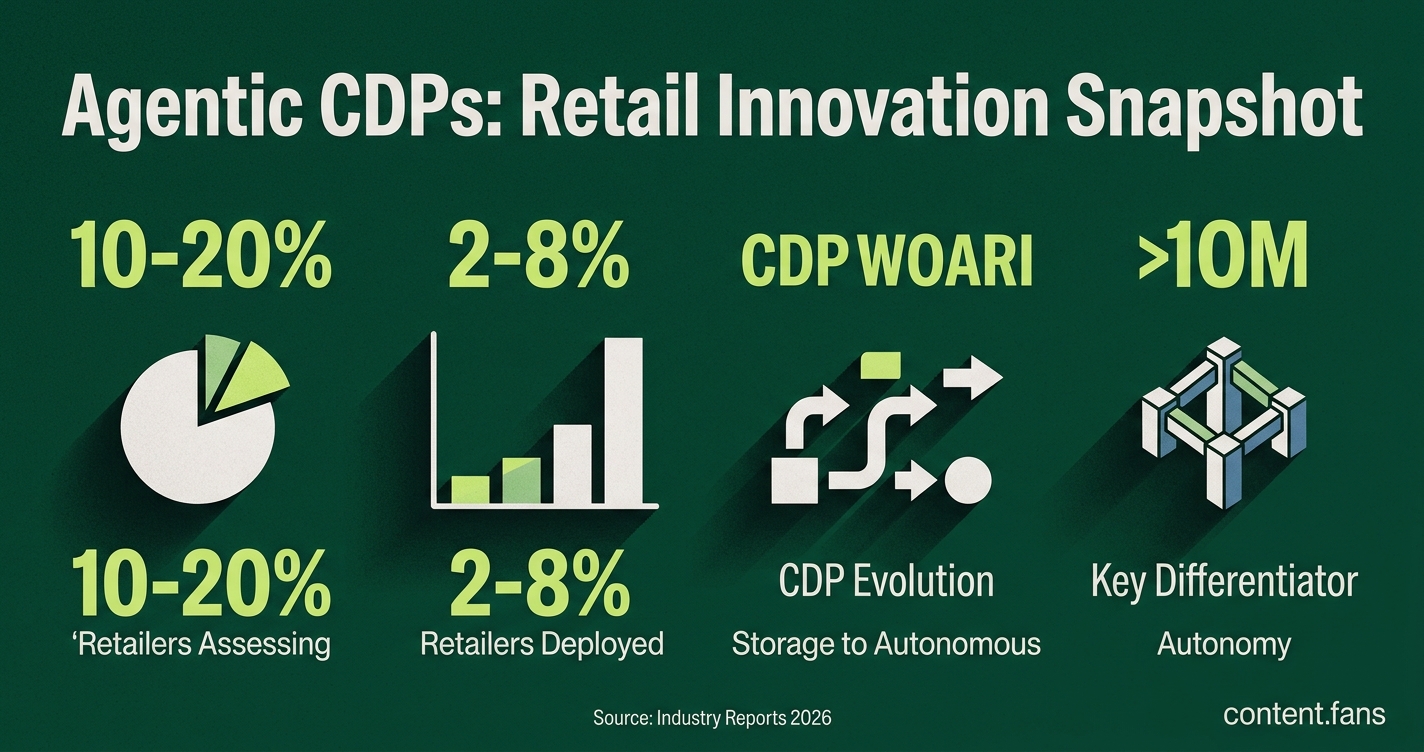
Industry analysts define agentic CDPs as an emerging stage in the platform's evolution, moving beyond traditional packaged and composable models. The key differentiator is autonomy: embedded AI agents monitor customer behavior, select appropriate channels and messages, and execute workflows without human approval. The Databricks CustomerLake launch highlights this by unifying customer context, AI, and execution in a single environment, eliminating data transfers to separate tools. This shift signals that the CDP is becoming core enterprise infrastructure.
Early retail results
While field evidence is still emerging, it is highly instructive. Industry reports indicate that approximately 10-20% of retailers are assessing agentic AI, with only 2-8% having deployed agents along the value chain by mid-2026. Notable developments include:
- Walmart: Has implemented AI for inventory and personalization, though specific claims about extensive "Stores of the Future" deployments using specialized AI agents for cashierless shopping remain unverified in available sources.
- Leading retailers: Several major retailers are piloting agentic systems for both front- and back-office tasks with unified data foundations, though comprehensive continental deployments are still in early stages.
- Various US retailers: Multiple retailers are testing AI decisioning systems to increase in-store visits and customer lifetime value, with some reporting significant improvements in early pilots.
- European retailers: Some retailers are experimenting with agentic AI for building retail media audiences and syndicating them across multiple ad channels.
These examples demonstrate that immediate performance gains are possible when AI agents have direct access to clean, real-time data. However, the majority of the market remains in pilot or planning phases, indicating a cautious approach to full-scale deployment.
Barriers that keep adoption cautious
Despite the potential, experts identify four significant hurdles slowing widespread adoption:
- Enhanced Data Visibility: AI agents capture behavioral data from the initial discovery and consideration phases, enabling better personalization before cart interaction, though this requires sophisticated data infrastructure.
- Weak Governance: According to industry analysis, immature governance models and siloed data systems increase the risk of automation errors and compliance violations.
- Increased Security Risks: With AI agents handling payments, security concerns are paramount. Industry reports suggest financial institutions anticipate a rise in fraud attempts targeting these automated systems.
- Infrastructure Mismatch: Existing commerce infrastructure is often not optimized for AI. Research indicates agent-driven traffic can convert comparably or even higher than human traffic when machine-readable catalogs and APIs are properly implemented, but many retailers lack this infrastructure.
Looking ahead, industry analysis suggests a market evolution toward two strategies: embedding CDP capabilities within larger data platforms or prioritizing specialized autonomous engagement tools. The ultimate success of agentic CDPs will depend on how effectively retailers can address the critical challenges of governance, security, and data infrastructure.
What exactly is an agentic CDP and how is it different from the CDPs we used a year ago?
An agentic CDP represents an emerging evolution of customer data platforms that are being developed and tested in 2026. Instead of acting as passive data warehouses, these systems now operate like dedicated associates for every shopper. While traditional CDPs required teams to build segments and approve campaigns, agentic versions deploy AI agents that observe behavior in real time, decide on the best channel, and trigger messages without human approval. Databricks CustomerLake is already shipping this architecture, combining governed customer context, AI models, and execution inside one environment so data never has to be duplicated across separate tools.
Which retailers are already using agentic CDPs and what results are they seeing?
Early adopters span geographies and verticals:
- Walmart has implemented AI systems for inventory management and personalization, though comprehensive "Stores of the Future" deployments are still being evaluated and tested.
- Major European retailers are piloting AI systems across multiple locations, driving efficiencies in both front-end campaigns and back-office replenishment.
- Leading national retailers are connecting CDPs to AI decisioning layers, letting agents pick timing and frequency autonomously, with some reporting significant performance improvements in early tests.
- UK retailers are testing unified audience systems with AI optimization across touchpoints, with promising early results in web engagement and email performance.
These cases show agentic AI does not merely recommend - it executes.
How much of the retail market has moved to this new model?
As of mid-2026:
- A growing number of enterprise retail applications are incorporating agentic AI workflows in pilot phases.
- Approximately 10-20% of retailers are assessing agentic AI, with only 2-8% having deployed agents along the value chain.
- Industry analysts predict significant growth in CDP deployments embedded within broader data platforms rather than stand-alone marketing tools over the coming years.
What is holding retailers back from wider adoption?
The main hurdles are data infrastructure, governance, and security gaps:
- Infrastructure Requirements: Agentic workflows need sophisticated, streaming data infrastructure. Legacy systems or inadequate APIs can cause automation errors and limit effectiveness.
- Governance & Real-Time Data: Unified, real-time data governance is essential. Legacy silos increase compliance risk and reduce automation accuracy.
- Security & Fraud: Financial institutions expect increased security challenges with agent-driven systems, while consumer trust still hinges on transparent, unbiased recommendations.
- Technical Integration: Current storefronts often need significant updates to work effectively with agent traffic, requiring machine-readable catalogs and APIs optimized for autonomous systems.
What should retailers do now to be ready for 2027?
- Make catalogs machine-readable with standardized schema and real-time inventory feeds so agents can execute multi-item transactions effectively.
- Establish a governed "customer lake" that merges identity, consent, and behavioral data in one place - a pattern already outlined by Databricks CustomerLake.
- Introduce trust signals (clear return policies, verified stock levels) that agents can surface to shoppers instantly.
- Run controlled pilots that pair a CDP with an AI decisioning layer for a single use-case (e.g., cart-abandon rescue) before scaling to full customer journeys.
Retailers that solve these steps today will be positioned to turn 2027's agent-mediated commerce traffic into revenue; those that wait risk losing competitive advantage to retailers whose data infrastructure is already agent-ready.