
Agentic AI Expands to Purchases, Shifts E-commerce by 2026
Serge Bulaev
Agentic AI may soon shift e-commerce by moving from just answering questions to actually making purchases for users, with broader adoption possibly starting in late 2026. Recent studies suggest most shoppers already use some AI tools, but few let AI fully complete purchases. Analysts say brands need to be clear, trustworthy, and easy for AI systems to understand to stay competitive. Early tests show shoppers may be comfortable with agents buying everyday items, but human approval is still wanted for bigger choices. Some experts estimate that by 2027, around 10-15 percent of online sales could be made by autonomous agents, but this is still uncertain.

The expansion of agentic AI into autonomous purchasing is set to fundamentally shift e-commerce in the coming years. This evolution moves AI from simply answering queries to executing transactions on a user's behalf. Market analyses indicate that as large language models (LLMs) mature, they will increasingly interpret consumer intent, select products, and complete checkouts autonomously. For brands, this pivot means the primary challenge is no longer just being discovered, but becoming the single, trusted choice for an AI agent, making transactional readiness paramount.
What the sources say about timing
Market data reveals a transitionary stage. While a commercetools report finds that 73% of shoppers use AI during their buying journey, only 13% currently finalize a purchase based on an AI referral, indicating the market remains in an assistive phase. However, early pilots like Perplexity's product cards and Google's AI-driven checkout suggest broader adoption of autonomous purchasing could emerge in the near future. This trend is bolstered by rising consumer familiarity, evidenced by significant growth in generative AI shopping searches across various sectors.
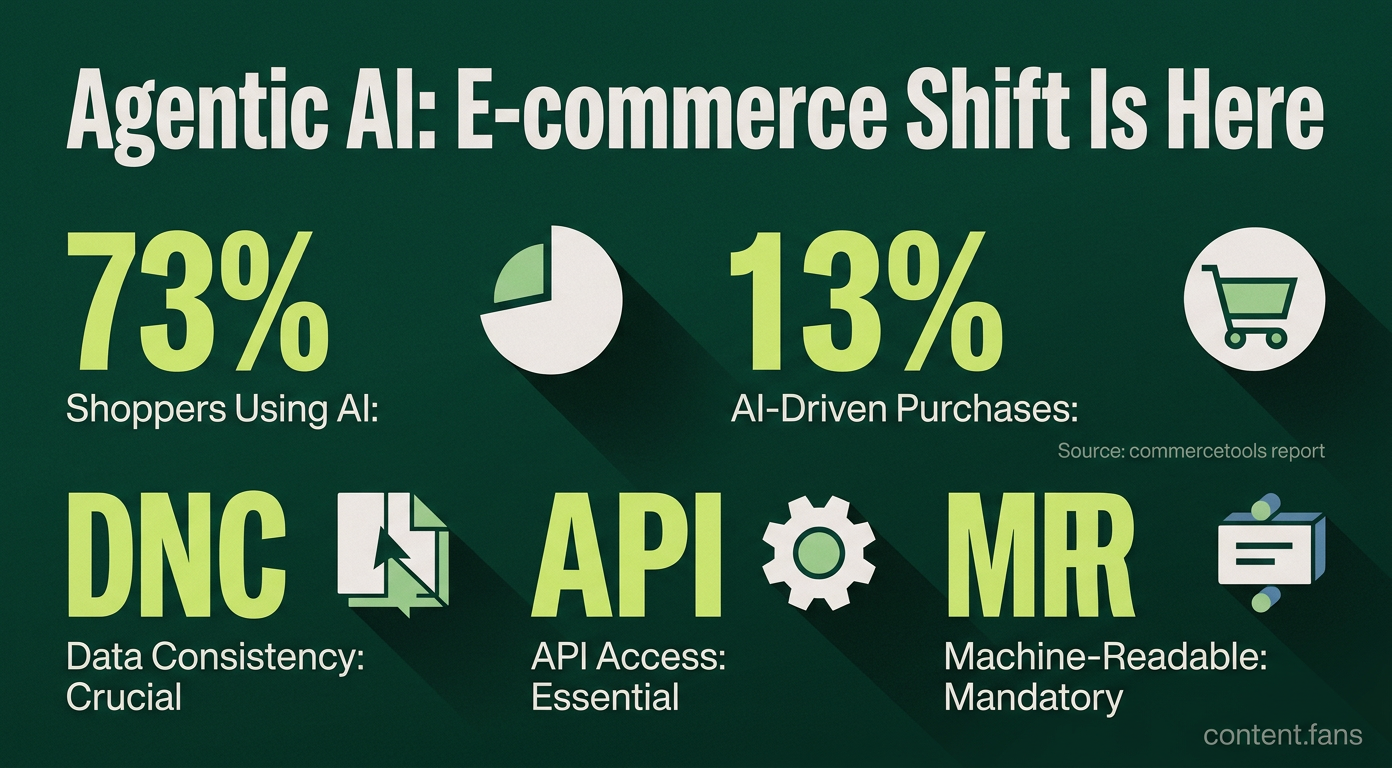
Agentic AI will transform e-commerce by shifting the point of decision from humans to algorithms. These autonomous agents will interpret user needs, evaluate products based on structured data and trust signals, and execute purchases. For businesses, this means success hinges on becoming machine-readable and algorithmically trustworthy.
Pressure on visibility and GEO
The rise of agentic commerce elevates the stakes of search visibility. Analysts warn that answer-engine optimization is merely a precursor to a winner-take-all transactional environment. If a brand fails to make an AI agent's shortlist, the potential sale is lost completely. This necessitates a focus on Generative Engine Optimization, which requires rich, machine-readable metadata and precise inventory data to ensure a brand remains visible to purchasing agents.
Operational readiness checklist
Analyst commentary points to a cross-functional playbook for brands preparing for agentic commerce:
- Expose Structured Data: Make price, stock levels, shipping details, return policies, and reviews available in a machine-readable format.
- Synchronize Data Feeds: Ensure consistency for all product information across your website, marketplaces, and affiliate channels.
- Enable API Access: Provide endpoints for agents to create carts and process payments to execute transactions seamlessly.
- Publish AI Policies: Release clear disclosure and data-use statements to comply with emerging regulations, like Utah's SB 226.
- Monitor and Remediate: Actively track AI models for biased recommendations or outdated information and log all corrective actions.
Legal backdrop and consent signals
A new legal framework is emerging to govern agentic commerce. State-level measures are defining the compliance perimeter, with Utah requiring clear disclosure of AI involvement in transactions and proposed California ADMT rules mandating opt-out rights for significant automated decisions. Federally, the FTC is expected to use its authority over unfair or deceptive practices to scrutinize marketing claims related to autonomous agents. To mitigate enforcement risks, brands must proactively document risk assessments and implement robust consumer consent and opt-out workflows.
Strategic lens: discoverability and desirability
According to a Boston Consulting Group analysis, success in the agentic era depends on two key factors: discoverability and desirability. Discoverability is achieved when AI agents can easily parse technical data like schema markup and product IDs. Desirability is built on verifiable trust signals, such as strong brand reputation, positive independent reviews, and transparent business policies. The BCG playbook suggests that brands mastering both will be prioritized by autonomous shopping agents.
Early experiments and indicators
Early experiments provide key indicators of market readiness. For example, commercetools highlights pilots where PayPal facilitates instant checkout within conversational search interfaces, a key step toward AI trends shaping agentic commerce. While a reported 70% of shoppers are comfortable with AI purchasing routine items, most still want final approval for high-value goods. This suggests a phased rollout is the most viable strategy. Omnia Retail's blog says autonomous purchasing could reach about 10-15% by 2027, while current autonomous-buyer adoption is under 5% in their framing. Although provisional, these forecasts are driving immediate investment in the necessary infrastructure.
Successfully navigating this shift requires a unified effort across marketing, engineering, operations, and legal departments. The ultimate goal is to create a brand ecosystem that is both straightforward for machines to parse and fundamentally safe for consumers to trust with their purchasing decisions.
What is agentic AI and how will it change e-commerce?
Agentic AI refers to systems that act on behalf of consumers instead of merely providing information. Omnia Retail's blog says about 15-20% of online shoppers currently use AI shopping assistance, forecasts 40-50% adoption by end of 2026, and expects autonomous purchasing to reach 10-15% by 2027. This shift moves decision power from humans to algorithms; if your product is not surfaced in the agent's single recommendation, you lose the sale entirely.
Why does GEO matter once AI starts buying for people?
GEO (Generative Engine Optimization) was already critical for visibility. Now, with one recommendation determining the purchase, losing visibility means losing revenue. In fashion alone, shopping-related searches on generative AI platforms have grown significantly according to industry reports. Brands that score lower on trust signals, pricing accuracy, or fulfillment reliability will be excluded by agents before the user even sees an option.
What data must brands provide for agentic commerce?
Agents need real-time, machine-readable feeds containing:
- Exact inventory counts and delivery windows
- Transparent, non-discriminatory pricing
- Structured product specs, certifications, and images
- Return and warranty policies
A significant portion of consumers already use AI for product ideas, price comparison, or review summarization, so inaccurate or delayed data is an immediate disqualifier.
How can brands prepare legally for AI-initiated purchases?
New rules in Utah, California, Colorado, and FTC guidance require explicit:
- Disclosure when AI is acting (Utah SB 226)
- Opt-out rights for automated decisions affecting price or eligibility (California ADMT rules)
- Risk assessments and documentation for high-impact AI systems (Colorado AI Act)
Brands should implement clear consent flows and audit logs for every agent-driven transaction.
What practical steps should marketing and operations teams take now?
- Discovery: Publish schema-marked product pages, comparison content, and FAQ answers.
- Trust: Curate review sentiment and third-party validation; agents weigh these heavily.
- Transaction readiness: Expose API-based checkout, keep inventory/promotions real-time, and support delegated consent flows.
- Governance: Create escalation paths for agent errors and set pricing-claim thresholds.
Brands that treat their site as a knowledge source and their checkout as an API endpoint will win the agentic commerce race.