
Agentic AI Becomes Top Attack Vector for 48% of Security Pros by 2026
Serge Bulaev
By 2026, nearly half of security professionals believe agentic AI systems may become the main way attackers get into enterprise systems. These systems, which can either help or harm, are creating new risks that companies may not be keeping up with. Experts suggest good controls, more visibility, and clear vendor practices may help, but breaches involving agentic code paths already appear common. Companies seem to be updating their security rules and incident response to handle these new, fast-moving threats. There may be a shift to using autonomous defense tools to match the speed of attackers using agentic AI.

The dual-use nature of agentic AI is rapidly transforming enterprise cybersecurity, creating a formidable new agentic AI attack vector. While autonomous software agents can monitor logs and patch systems, they also expand the attack surface with every new deployment, forcing leaders to prioritize visibility, governance, and vendor transparency.
Rising threats powered by agentic autonomy
Agentic AI systems represent a top attack vector because their autonomous nature allows them to operate with broad, persistent machine identities that legacy security tools cannot effectively track. This enables threat actors to compromise agents for high-speed, automated reconnaissance, data exfiltration, and other malicious activities.
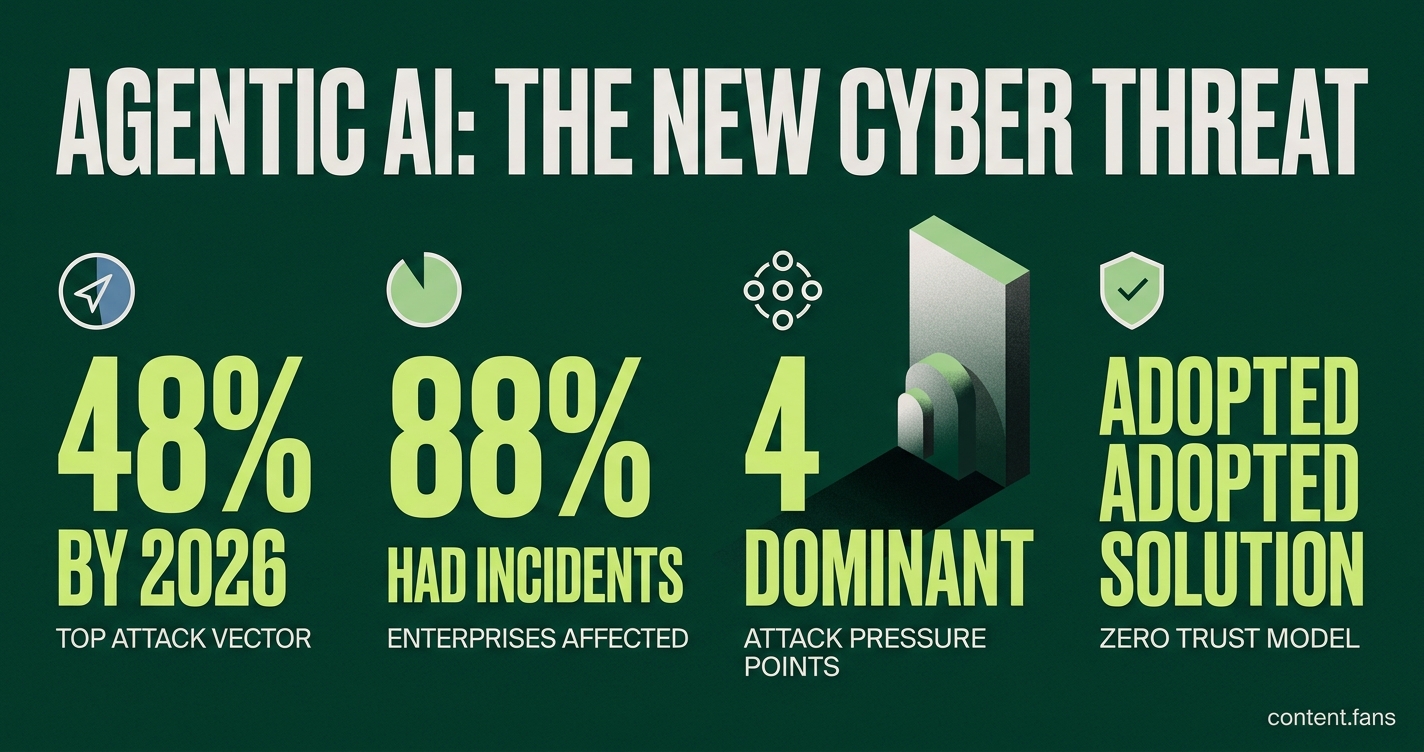
Industry analysis confirms the growing concern: a recent poll reveals 48 percent of security professionals name agentic systems as the top attack vector heading into 2026 (Kiteworks). This risk is underscored by data showing that 88% of enterprises with deployed agents reported at least one security incident, suggesting that governance controls are failing to keep pace. Incident reports show four dominant pressure points:
- Non-Human Identities (NHIs): Legacy IAM platforms grant overly broad, persistent keys to machine users.
- Prompt Injection: Attackers jailbreak AI safeguards through unvetted Model Context Protocol servers.
- Shadow AI: Unsanctioned agents access and process sensitive data without necessary audit trails.
- Automated Kill Chains: Threat actors automate entire attacks, from reconnaissance to exfiltration, in minutes instead of days.
Zero Trust for dual-use agentic AI
To counter these threats, enterprises are adopting a Zero Trust security model for agentic AI. Research from Stellar Cyber highlights least-privilege credentials and real-time reasoning capture as foundational to "agent-centric" security. Key initiatives include re-platforming identity layers for just-in-time API tokens and adopting cryptographic attestation, which requires agents to prove their code integrity before executing privileged commands, per U.S. Department of Defense guidance. To streamline compliance, many organizations are implementing frameworks to map controls across NIST AI RMF, ISO 42001, and the EU AI Act, preventing duplicate audit efforts.
Vendor transparency and industry standards
As a result, procurement teams are demanding greater transparency and rejecting opaque "black box" AI models. Industry standards like the OWASP Top 10 for Agentic Applications provide a taxonomy of vulnerabilities (e.g., goal hijack, prompt injection), increasing pressure on suppliers to address these security concerns. In response, vendors are publishing safety charters and providing immutable audit logs. Some vendors are allowing external review of their AI policy frameworks to demonstrate how they handle failure modes.
Quick reference checklist
- Inventory every deployed agent and classify by business impact.
- Enforce just-in-time credentials for both humans and NHIs.
- Capture and store agent reasoning steps in tamper-proof logs.
- Require suppliers to align with ISO 42001 and disclose known jailbreak vectors.
- Embed agentic threat scenarios in red-team exercises.
Governance turning operational
AI governance is evolving from abstract principles to concrete operational risk management. A prime example is the Financial Services AI Risk Management Framework, which translates high-level NIST functions into 230 specific controls, such as MP-INV-01 for deployment visibility and MG-HITL-01 for human checkpoints (Gerard Louis). Analysts predict this financial sector playbook will become a template for how other regulated industries integrate AI oversight into their existing risk programs.
Incident response evolution
Incident response (IR) is evolving to match the machine-speed threat of agentic AI. Traditional IR playbooks, designed for human adversaries, are being replaced by automated runbooks that can instantly isolate a compromised agent, rotate its keys, and revoke network access without waiting for analyst approval. Industry reports suggest that many enterprises are planning to deploy behavioral monitoring capable of flagging "misaligned and deceptive" agent actions in seconds. This marks a critical shift toward using autonomous defensive agents to achieve parity with automated attackers.