
AeroFarms Rebounds with Palm Ventures as Vertical Farming Shifts Focus
Serge Bulaev
After many bankruptcies in the vertical farming sector from 2023 to 2025, investors became much more careful and focused on costs. AeroFarms was recapitalized by Palm Ventures in June 2026, which suggests that funding may still be possible for companies that show strong business results. The sector now seems to favor farms with proven retailer partnerships, solid financial backers, and improved cost controls. New technologies like AI, better LED lighting, and water recirculation might help farms lower their costs. Success in vertical farming appears to depend less on growing quickly and more on steady, smart business practices.

The rebound of AeroFarms signals a significant shift in the vertical farming industry following widespread bankruptcies in recent years. This move proves capital is available for operators with proven commercial traction. After the failures of several major players, investors now demand disciplined operating economics, strategic partnerships, and firm retailer agreements, moving away from hype-driven funding toward revenue-backed growth.
Why Recent Failures Changed the Playbook
A wave of bankruptcies in recent years forced a strategic reset. High-profile failures were driven by soaring energy costs, heavy capital expenditures, and rising interest rates. As a result, investors pivoted from funding rapid expansion to demanding a clear, sustainable path to profitability.
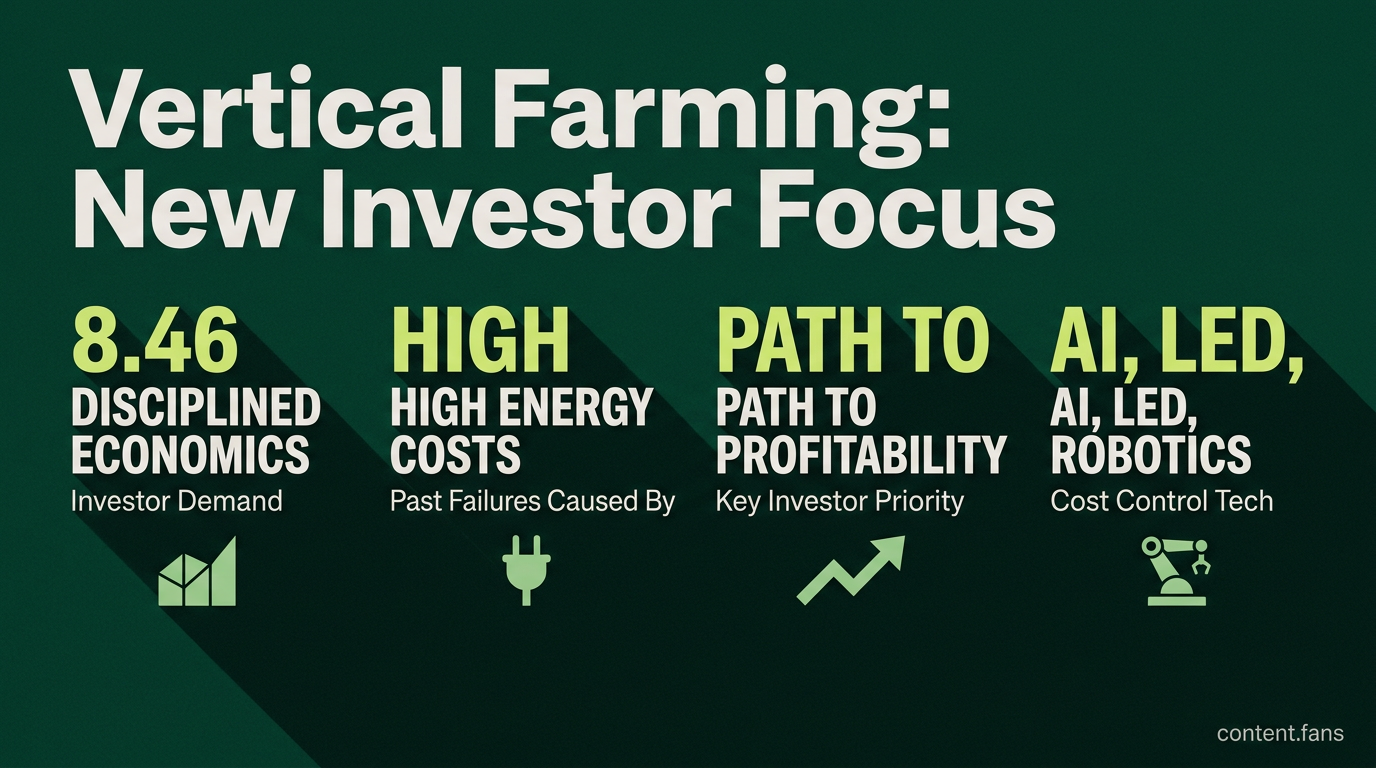
The core pressures were financial and operational. Industry reports indicate that companies faced unsustainable energy costs, heavy capital requirements, and rising interest rates. Compounded by a structural disadvantage in electricity prices, this "scale-first" approach prevented many operators from achieving cost parity with conventional agriculture, ultimately cutting off access to crucial follow-on funding.
What Investors Look For Now
In the post-shakeout landscape, investors prioritize operators that demonstrate a clear path to profitability. Companies securing funding consistently exhibit three key attributes:
- Proven Retailer Demand: Documented offtake agreements, such as retail partnerships with major grocery chains.
- Strategic Backing: Strong institutional or corporate shareholders, including names like SoftBank Vision Fund, McCain Foods, or Ingka Group (Ikea's venture arm).
- Disciplined Unit Economics: Verifiable progress on reducing costs per unit, achieved through advanced automation and efficient energy management.
Key Survivors and Their Strategic Advantages
| Company | Key Retail Partnerships | Recent Funding Signal |
|---|---|---|
| Plenty | Walmart partnerships | Backed by SoftBank Vision Fund |
| 80 Acres Farms | Salad supply partnerships | Significant funding round |
| Infarm | Kroger, Marks & Spencer, Amazon Fresh | Corporate backing |
| AeroFarms | Whole Foods, ShopRite | Recently recapitalized |
Note: Figures are based on publicly reported deals and may include secondary estimates.
Cost-Control Technologies Gaining Traction
Industry analysis points to four critical technologies that are narrowing the cost gap between controlled-environment and field-grown produce:
- AI-Powered Operations: AI-driven climate and crop monitoring systems are proven to lower energy and labor costs significantly in test environments.
- Advanced LED Lighting: High-efficiency LED arrays with spectral tuning can substantially reduce electricity consumption compared to previous-generation lighting.
- Robotic Harvesting: Automation in harvesting reduces manual labor costs while minimizing crop damage, which in turn improves final sell-through rates.
- Closed-Loop Recirculation: Systems that recirculate water and nutrients can significantly reduce water use and may lower operating costs, but the exact savings depend on the application; industry sources support reductions ranging roughly from 70% to 98%.
Industry reports show that farms integrating these tools achieve steadier gross margins, confirming that profitability now hinges more on iterative operational improvements than on rapid expansion.
Outlook: Disciplined Growth Over Hype
The current outlook positions vertical farming as a specialized, capital-intensive sector where success is earned, not assumed. Predictable yields at competitive costs are the new benchmark. The AeroFarms lifeline demonstrates that investment capital remains available, but it is now exclusively directed at operators who can prove a trifecta of success: strong retailer demand, solid institutional backing, and verifiable cost controls. Companies failing to meet this standard risk repeating the industry's recent history of collapse.
Why is AeroFarms considered a survivor after recent industry bankruptcies?
AeroFarms filed for Chapter 11 in June 2023 and emerged from bankruptcy in September 2023 through a restructuring led by existing investors such as Grosvenor Food & AgTech and Doha Venture Capital. After bankruptcy, AeroFarms kept operating and narrowed spending to its Danville farm, while announcing retailer expansions that included Walmart, Stop & Shop, and H Mart, satisfying investor demands for retail traction and cost discipline.
What broader industry failures triggered this investor shift?
Recent years saw significant vertical farm bankruptcies and shutdowns, including high-profile cases such as major industry players that liquidated or filed for bankruptcy despite raising substantial funding. Rising interest rates, energy spikes in many U.S. markets, and the realisation that indoor greens still cost significantly more than conventional produce forced investors to demand proof of unit-level profitability before writing new checks.
Which technologies are cutting operating costs the fastest?
The most promising levers are:
- AI-driven climate control that can significantly reduce energy consumption through predictive lighting and HVAC scheduling
- Next-gen LEDs with spectral tuning delivering substantially higher photon efficiency than earlier fixtures
- Closed-loop fertigation reducing water use and fertiliser spend considerably
- Robotic harvesters cutting labor costs substantially on leafy greens, according to industry pilot data
How are retail partnerships influencing who gets funded?
In the current financing environment, offtake agreements with national grocers have become increasingly important. The clearest winners are:
- Plenty - supplying Walmart stores with produce and backed by SoftBank Vision Fund
- 80 Acres Farms - fresh funding round anchored by retail partnerships
- Infarm - contracts with major retailers including Kroger, Marks & Spencer and Amazon Fresh
Without contracted shelf space and a visible gross-margin roadmap, new rounds are increasingly difficult to close.
What does this mean for new entrants or existing small farms?
Expect a multi-tier market:
- Tier 1: Well-capitalised players with anchor retailers, significant automation, and energy management will continue to raise growth equity
- Tier 2: Smaller or hardware-centric farms without established supply agreements will likely pivot to specialized niches or face acquisition at reduced valuations
Investor checklists now include ambitious cost targets, renewable energy agreements, and substantial offtake clauses before term sheets are issued.