
Accenture, CMU SEI Launch AI Adoption Maturity Model in 2026
Serge Bulaev
Accenture and Carnegie Mellon SEI have launched the AI Adoption Maturity Model in 2026 to help organizations move from experimenting with AI to achieving more predictable results. The model measures progress in eight key areas, such as strategy and data, and may help large companies plan and manage their AI programs better. Early evidence suggests that users found it useful for setting priorities, improving communication, and making budget decisions, but the results are still early and not yet fully proven. Future versions might include more specific guidance for regulated industries. The success of the framework appears to depend on how many companies use it and share the results over time.

The AI Adoption Maturity Model was released by SEI and Accenture on June 8, 2026, representing a new framework to help organizations scale artificial intelligence initiatives. The model provides a clear path for enterprises to move beyond experimental AI projects and achieve predictable, scalable outcomes across the AI lifecycle (Accenture newsroom).
This framework is significant because it translates rigorous academic research into a practical, actionable tool. It offers large organizations concrete benchmarks to effectively plan, budget for, and govern their enterprise-wide AI programs.
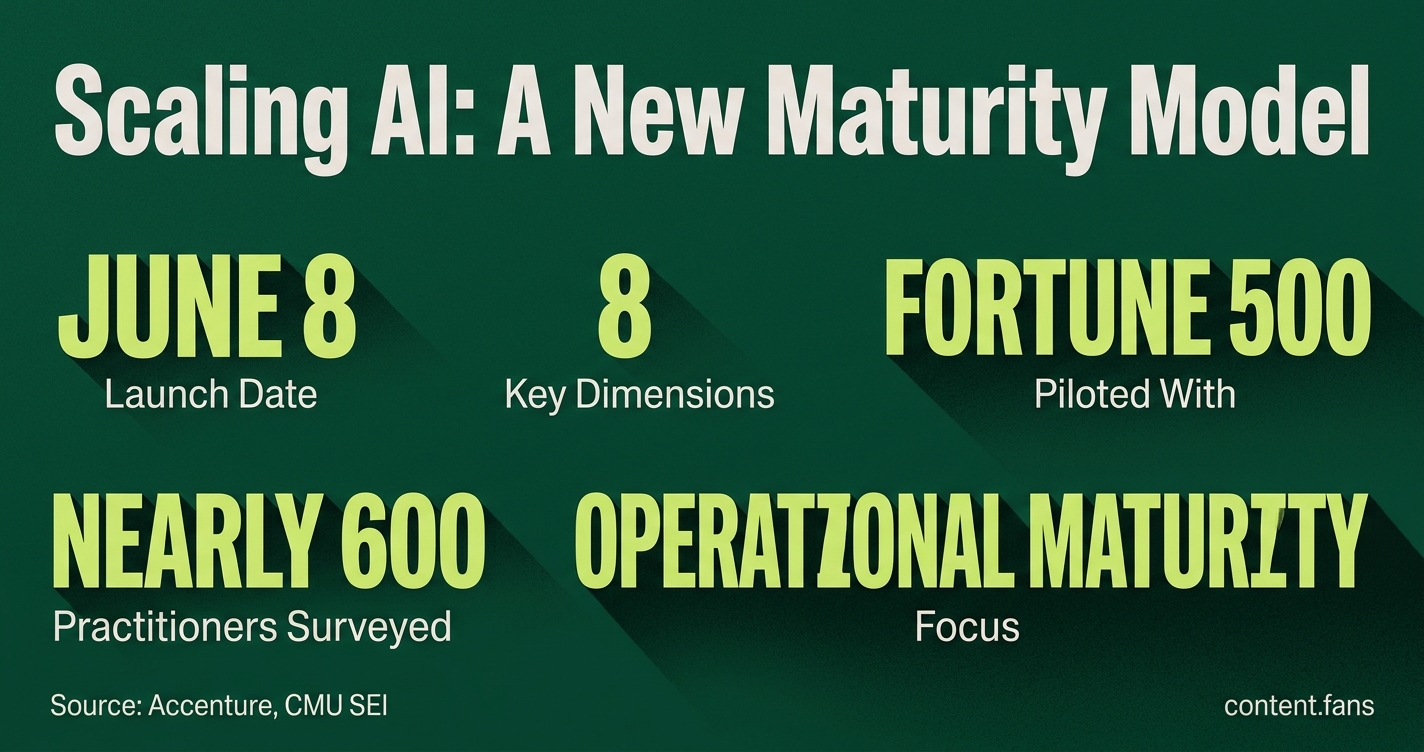
Eight dimensions that define maturity
The AI Adoption Maturity Model is a strategic framework for assessing an organization's AI capabilities across eight key dimensions. It evaluates an enterprise's ability to consistently deliver value from AI, providing a roadmap to advance from ad-hoc experimentation to mature, optimized implementation and predictable business results.
- Organizational strategy
- Workforce and culture
- Workflow re-engineering
- Risk and governance
- Data
- Engineering
- Operations
- Ecosystem
SEI has an AI maturity model overview; the available source evidence does not confirm the exact claim that a 2025 preliminary report states each dimension includes specific practice-level indicators that pinpoint gaps limiting repeatable success (SEI preliminary report). This structure allows leadership to visualize organizational AI readiness through a concise, single-page heatmap rather than sifting through numerous disjointed metrics.
What early evidence tells us
Prior to its public release, the model was piloted with Fortune 500 firms and informed by surveys from nearly 600 practitioners. Early adopters used their baseline scores to consolidate pilots, define three-year roadmaps, and integrate risk reviews earlier in the development lifecycle. The primary goals were to reduce "pilot sprawl" and better align technical efforts with overarching business strategy. Unlike frameworks such as the NIST AI Risk Management Framework (focused on risk) or ISO 42001 (focused on management systems), this model emphasizes operational maturity - embedding AI into daily workflows and tracking value. This practical focus helps organizations translate strategic governance discussions into tangible, funded engineering initiatives.
Reported business effects so far
During pilot phases, organizations reported several immediate business benefits:
- Clearer prioritisation of AI use cases after seeing gaps in data readiness.
- Faster alignment between technology and compliance teams thanks to a shared vocabulary.
- More consistent budget planning tied to stage-gated maturity targets.
- Increased executive confidence when requesting board approval for large-scale deployments.
While these early outcomes are promising, they remain preliminary. Quantified, public ROI case studies are anticipated following the conclusion of the first assessment cycles.
Where the framework may head next
Future iterations of the model may include sector-specific controls for highly regulated industries, according to industry reports. Concurrently, Accenture is empowering clients to self-administer the assessment, enabling internal audit and data offices to monitor progress independently. Ultimately, this collaboration provides a maturity framework that complements existing risk and compliance standards. Its long-term impact will be determined by widespread adoption and the transparent sharing of outcome metrics as organizations advance along their maturity roadmaps.