
50+ SpaceX, xAI Staff Jump to Meta, Thinking Machines
Serge Bulaev
More than fifty SpaceX and xAI employees left for Meta and Thinking Machines in a few months, which may show that the line between space hardware and AI research is fading. Meta reportedly gained at least 11 former xAI staff, and Thinking Machines hired seven, which might help both groups move faster on new projects. SpaceXAI appears to have lost key team members, leaving its core AI work weakened. Reports suggest the moves happened because of tough work demands at SpaceXAI and better pay or job focus elsewhere. Some experts think this trend could slow SpaceXAI's progress and make hybrid aerospace-AI skills more valuable in the future.

A significant talent exodus has seen over 50 SpaceX and xAI staff jump to Meta and Thinking Machines in recent months. This brain drain, covered in a May 2026 TechCrunch report, is reshaping the competitive landscape by transferring critical expertise from Elon Musk's ventures to rival AI labs.
What Meta and Thinking Machines gained
Meta and Thinking Machines gained immediate, high-level expertise in large-scale model training and development. The influx of engineers, already familiar with advanced AI concepts like multimodal world models and coding assistants, allows the receiving companies to accelerate their research and development timelines without lengthy onboarding periods.
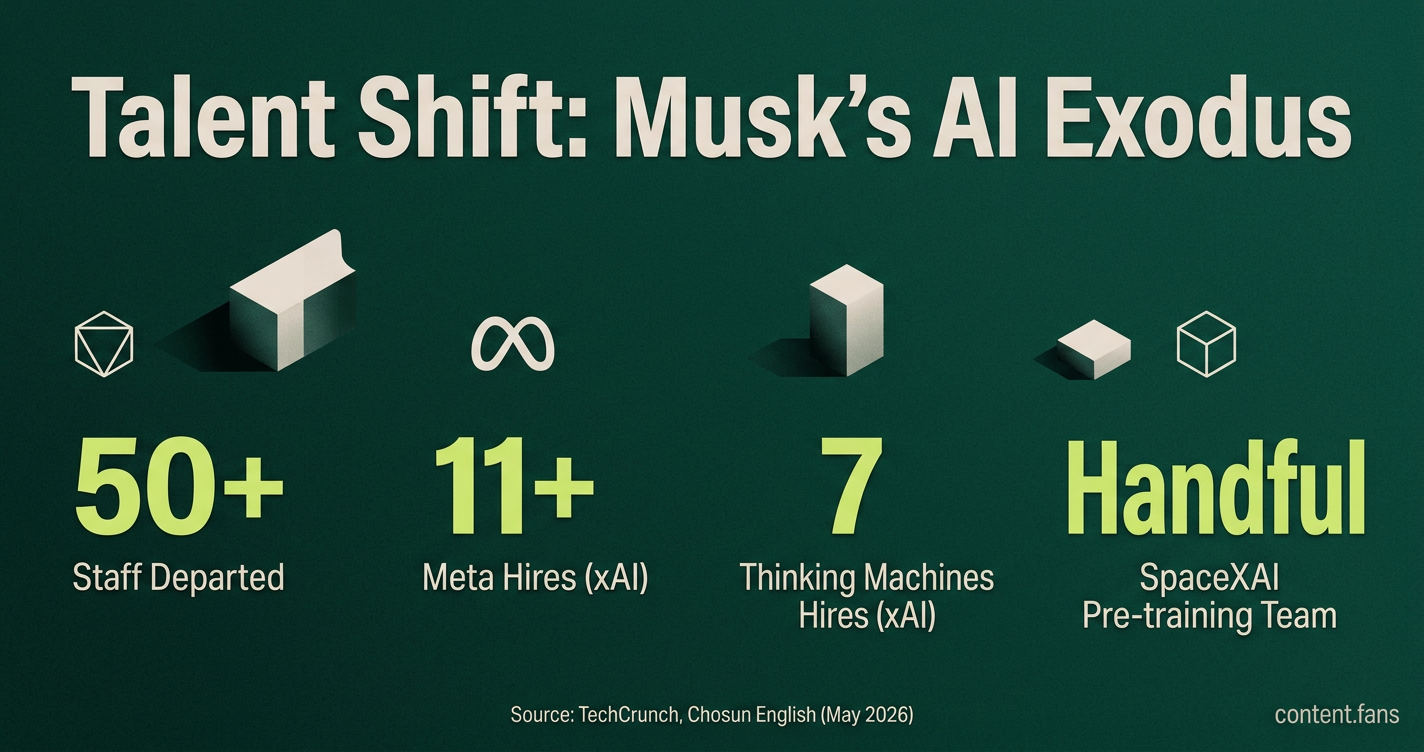
Meta appears to be the primary beneficiary, absorbing at least 11 former xAI researchers and engineers into its AI division since February 2026. These new hires bring proven experience in large-scale pre-training and multimodal world models, significantly shortening Meta's development cycle for new projects. Meanwhile, Thinking Machines Lab, an early-stage venture from former OpenAI CTO Mira Murati, reportedly onboarded seven ex-xAI employees. For a startup, this injection of senior talent can dramatically accelerate product milestones. In stark contrast, SpaceXAI has reportedly lost a critical mass of talent, with one source claiming its pre-training team is now just "a handful of people," jeopardizing progress on key projects.
Why engineers walked out
The departures stem from a combination of push-and-pull factors, according to reporting from both Chosun English and TechCrunch. Insiders point to a challenging work environment at SpaceXAI as a primary "push" factor, citing:
- Demanding seven-day work schedules and intense deadline pressure.
- Frequent corporate restructurings and weekly layoffs following the February merger.
- "Unrealistic model-training deadlines" that one engineer claimed led to cutting corners on the Grok model.
The primary "pull" factors from competitors included more attractive compensation packages with greater equity liquidity and the opportunity to focus purely on AI research, free from hardware delivery pressures. The culture clash between Musk's hardware-focused urgency and the iterative nature of AI research was also cited as a source of friction.
Cross-pollination of space and AI skills
This talent migration highlights the valuable cross-pollination of skills between the aerospace and AI sectors. Many departing employees had honed their expertise at SpaceX by optimizing autonomous systems, managing complex telemetry pipelines, and engineering high-throughput compute environments. These capabilities translate directly to the challenges of training frontier AI models, which involve managing petabyte-scale datasets and fine-tuning low-level system performance. This trend suggests that future talent acquisition in AI will increasingly prioritize candidates with "hybrid" résumés that combine aerospace rigor with software agility.
Implications for the 2026 talent market
According to industry reports, this exodus reinforces several key signals for the 2026 AI talent market:
- Aerospace companies are a prime source for engineers equipped to handle large-scale AI challenges.
- Early-stage AI labs can gain a competitive edge by acquiring pre-assembled, experienced teams.
- Intense work cultures and poor work-life balance create significant attrition risks, especially after employee equity vests.
While precise headcount projections are unavailable, the reported departures alone are larger than the entire engineering staff of some seed-stage AI startups. Analysts warn that if SpaceXAI cannot halt this brain drain, its development timeline for the next version of Grok could face significant delays, ceding a crucial advantage to its rivals.