
5 marketing shifts rewrite playbooks for 2026
Serge Bulaev
Marketing in 2026 may be changing as discovery appears to focus more on trusted sources, AI helpers, and personal conversations instead of website clicks. Studies suggest Google's May 2026 Core Update made brands with their own strong content and authority more visible, while aggregators lost ground. Over 60 percent of Google searches now might not lead to clicks, suggesting people get answers directly on the search page. On LinkedIn, personal profiles seem to get more attention than company pages, so expert voices from real people may matter more. Measuring marketing impact is becoming harder, and experts recommend using several methods to get a better picture of what is working.

Analysis of emerging marketing trends reveals several key marketing shifts that are rewriting playbooks for 2026, as brand discovery moves away from website clicks and toward trusted sources, AI agents, and private conversations. Data from SEO and social platforms confirms that brands now win or lose attention long before a click, fundamentally changing how visibility and measurement are approached.
How recent Google Core Updates reshaped marketing trends
Recent Google Core Updates have significantly shifted rankings by prioritizing primary-source domains and pages rich in unique data. This update approach, termed "disintermediation," led to major visibility gains for direct brands while aggregator and summary sites experienced sharp performance losses across the search landscape.
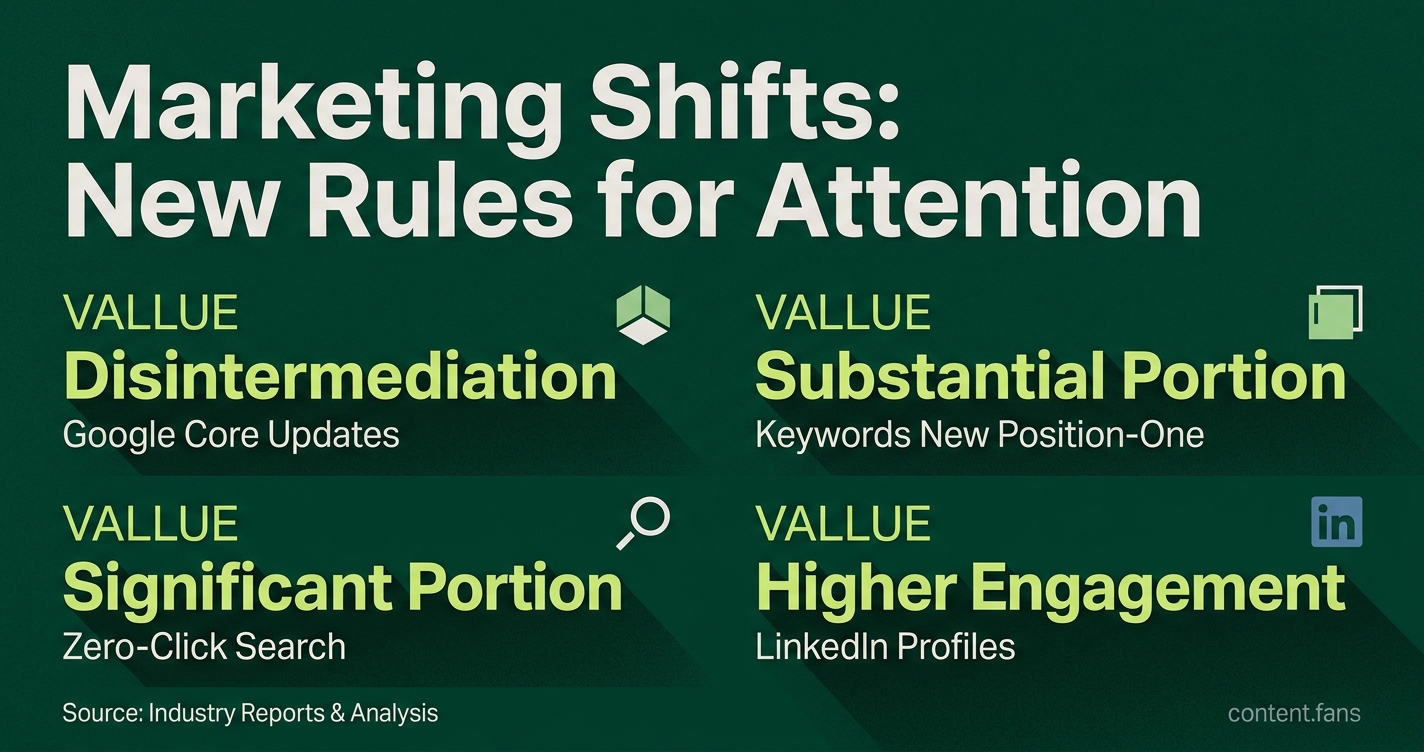
Google's recent Core Updates initiated what industry analysts call a "disintermediation" effect. Studies show that primary data owners and direct brand domains gained significant search share at the expense of aggregators. The update's volatility was notable, with industry reports indicating that a substantial portion of keywords saw new position-one results in the first week alone. Analysts conclude that algorithms now weigh source type and intent fit heavily, compelling brands to build earned authority and first-party content instead of relying on simple optimization.
Agentic advertising inches from concept to workflow
Industry reports suggest the early operationalization of agentic advertising, where autonomous AI agents manage campaigns within set guardrails. An Index Exchange field guide highlights its use in workflow automation and impression-level decisioning via standards like the Agentic RTB Framework. While agents now automate tasks like pausing ads or negotiating deals, adoption is uneven. Tools like Performance Max are considered "agent-like," but fully autonomous, cross-channel ad buying remains in its nascent stages.
Zero-click search continues to grow
Industry reports suggest that a significant portion of Google searches are "zero-click," meaning the user's query is resolved on the results page without an outbound click. This indicates that discovery increasingly occurs within AI Overviews, answer boxes, and widgets, where referral traffic is not generated. While brands cited as authorities in these features can gain downstream influence via branded search, this impact is often invisible to standard attribution models.
LinkedIn shifts reach toward people over pages
On LinkedIn, analytics firms consistently observe personal profiles achieving significantly higher impressions and engagement than official company pages. Practitioners in some B2B sectors report substantial reach gaps. This trend suggests LinkedIn's algorithm prioritizes content from identifiable experts, signaling a critical shift toward employee-led thought leadership and authentic, creator-driven content strategies.
The growing AI attribution gap
Marketing measurement now contends with a growing "AI attribution gap," a term for the discrepancy between platform-reported conversions and true brand influence occurring across untrackable touchpoints like AI chats. To get a complete picture, emerging best practices involve a layered measurement approach:
- First-party data capture using server-side tagging and conversion APIs
- Multi-touch attribution for optimizing within specific channels
- Marketing mix modeling to properly allocate budget across all channels
- Incrementality testing (e.g., geo holdouts) to validate actual lift
- AI visibility tracking to monitor citations and branded search trends
It's crucial to distinguish platform optimization metrics from true business impact, as strong algorithmic reporting can mask modest incremental growth.
Taken together, these shifts portray a marketing landscape where discovery is mediated by algorithms, agents, and personal reputation. Brands positioned for success are those that invest in owning authoritative content, empowering expert voices, and upgrading to sophisticated measurement stacks to accurately see the real impact of their efforts.
How do recent Google Core Updates change what ranks?
The updates appear to reward brands that are the primary source of the answer and reduces visibility for pages that simply summarize or repackage content. Analysts observed that a substantial portion of keywords gained new position-one results in a single week, and a significant portion of query volume saw complete top-result shifts, signaling unusually high volatility. If your site is not the canonical destination for the query intent, it now faces a higher risk of being outranked by the brand that owns the information.
Practical takeaway: strengthen first-hand expertise, secure earned media mentions, and track visibility inside AI Overviews and Discover, not only traditional blue-link rankings. More detail on the observed patterns is available in the seoClarity research.
What exactly is "agentic advertising" and who is exploring it?
Agentic advertising is the deployment of autonomous AI agents that plan, negotiate, and optimize campaigns with limited human oversight. Instead of giving recommendations for humans to approve, the agents execute actions such as:
- activating and pausing ads
- reallocating budget in real time
- selecting audiences and negotiating deals with sell-side agents
According to industry reports, the practice is emerging but concentrated. Major platforms are testing supply-side workflows, and demand-side tools like Meta Advantage+ and Google Performance Max already manage substantial spend via agentic logic. Adoption sits between workflow automation (widespread) and fully autonomous end-to-end buying (still experimental).
A concise field guide for operators is provided by industry research organizations.
How severe is the AI attribution gap, and how can teams close it?
The gap exists because platform dashboards credit trackable clicks, yet buyers increasingly discover brands through AI answer engines, word of mouth, and other dark-funnel moments. According to Funnel.io, even AI-enhanced attribution "operates on observed or modeled click and impression paths and cannot judge performance across channels."
Teams are closing the gap with a four-layer stack:
- First-party data spine - server-side tracking, conversion APIs, unified CRM
- Marketing mix modeling (MMM) - for cross-channel and offline impact
- Incrementality tests - geo-holdouts and audience holdouts to prove cause
- AI visibility measurement - track branded-search lift, share of AI citations, and self-reported attribution
A practical walkthrough is outlined by Dataslayer.
Why are LinkedIn personal profiles now outperforming company pages?
Data shows personal profiles are generating far more reach than company pages, underscoring a broader move toward expertise-led and AI-mediated distribution. Algorithms reward authentic, first-person knowledge, and audiences trust individual voices over institutional broadcasters. The consequence is that thought-leader content posted by a subject-matter expert often surfaces in feeds even when the same message from a brand account is throttled.
Implication: empower internal experts to publish consistently, syndicate high-performing posts back to the corporate page, and measure engagement at the profile level to stay visible.
With zero-click search continuing to grow, what metrics should replace CTR?
When a significant portion of queries end without a click, traditional click-through rate loses meaning. Forward-looking teams now track:
- Share of AI citations inside answer boxes and Discover
- Branded-search lift following an AI overview appearance
- Self-reported attribution in lead-capture forms
- Incremental lift in assisted conversions measured via holdout tests
These indicators capture influence rather than traffic, aligning measurement with the reality that users often convert minutes or days after an answer-only interaction with the brand.