
Zylos AI Report: How LLM Apps Use Layered Error Recovery in 2026
Serge Bulaev
The Zylos AI report suggests that dealing with errors in large language model (LLM) apps often relies on a layered approach, where different types of errors are handled in different ways. Teams may classify problems as transient (temporary), permanent, or semantic (meaning-related), and respond based on this tagging. The report notes that retrying is suitable for transient issues, but not for permanent errors, while semantic mistakes like bad outputs need validation or repair. Recent work also suggests using fallback models, output checks, and collecting error traces to find patterns and improve systems. These steps may help teams spot, classify, and fix many types of errors found in LLM-powered apps.

Managing errors in LLM-powered applications is a critical challenge for engineering teams. From a single hallucination derailing a chatbot to a series of API errors taking a pipeline offline, reliability is paramount. The industry is converging on a best practice: a layered error recovery model that embeds resilience into every layer of the stack by separating transient transport issues from semantic output failures.
Classify first, then react
Layered error recovery for LLM applications involves classifying failures before reacting. Teams categorize errors as transient (e.g., timeouts), permanent (e.g., auth failures), or semantic (e.g., hallucinations). This classification dictates the response: retrying transient issues, failing fast on permanent ones, and using validation or fallbacks for semantic mistakes.
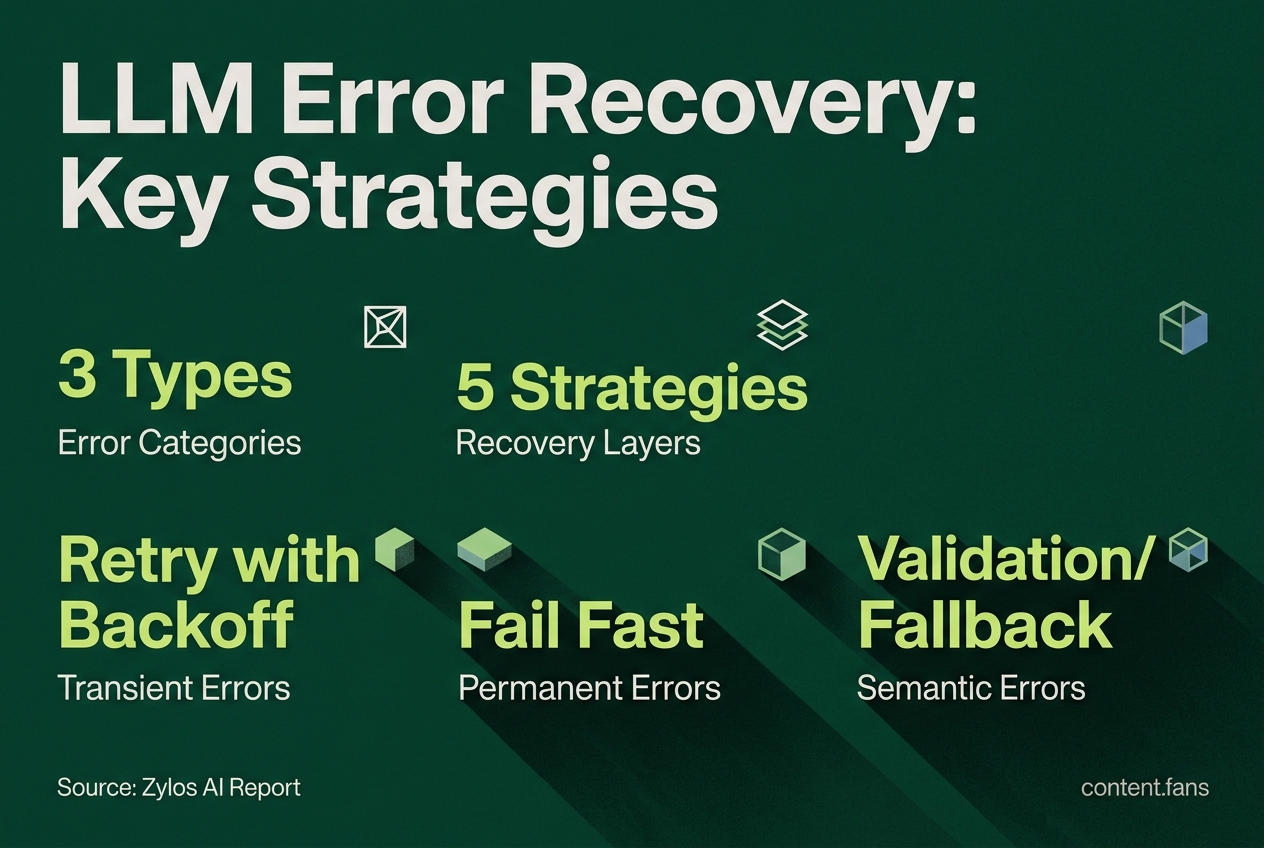
A mature error-handling strategy begins with a clear classification system. Engineering teams advise tagging every failure as transient, permanent, or semantic. Transient issues like timeouts or rate limits are best handled with capped retries using exponential backoff. Permanent errors, such as invalid authentication tokens or 4xx status codes, should fail immediately without retries. Finally, semantic failures - including hallucinations or malformed JSON - demand specialized validation, repair, or fallback logic instead of simple transport-level recovery.
Recovery layers that engineers deploy today
- Retry with backoff for transient transport errors.
- Circuit breakers that enter an open state after N consecutive failures to prevent cascading outages.
- Fallback chains: primary model → backup model → cached response → human escalation.
- Schema or guard-based output validation before handing results to business logic.
- Checkpoint and replay mechanics for multi-step agents.
Fallback chains are rapidly gaining traction, as teams recognize that consistent availability can be more critical than optimal output quality in certain use cases. As DevOps practitioners note, the principle is to "never retry a 401" but "always retry 429s," which highlights the importance of applying distinct rules for each error category.
Semantic validation moves closer to the model
Violations in structured outputs like JSON are among the most frequent semantic defects. Techniques like grammar-constrained decoding and JSON-schema validation significantly reduce these invalid output rates. For tool-using models, additional safeguards are crucial, including argument typing, pre-execution dry-runs, and typed error returns that the agent's planner can interpret.
Agentic systems introduce stateful risks like goal drift or unintended side effects. To combat this, research on structured exception handling proposes checkpoint-rollback-replay loops, which borrow from database recovery techniques to store state, roll back on failure, and replay steps after correction.
Observability turns incidents into test cases
Systematic improvement hinges on robust observability. Experts agree that collecting rich, detailed traces transforms reactive, one-off patches into proactive enhancements. The recommended practice involves automatically collecting failed traces, clustering them by error signature, and converting these clusters into regression tests. This process allows engineering teams to identify and address systemic patterns instead of getting bogged down by isolated incidents, dramatically shortening the time to root cause.
Emerging API features ease detection
LLM providers are introducing API features that simplify error detection and prevention. Native JSON mode, for example, reduces parsing ambiguity for structured data. Prompt prefix caching lowers token consumption on repeated instructions, mitigating context overflow and truncation errors. Furthermore, modern streaming callbacks enable dynamic model swapping; if a primary model's stream stalls, the system can automatically switch to a fallback, integrating seamlessly with the layered recovery strategies.
Practical checklist to start
- Count tokens before every request and trim or summarise to fit the model window.
- Apply per-category retry policies with jitter; never retry permanent errors.
- Guard every structured output with a schema validator.
- Wrap external tool calls in typed validators and return machine-readable error objects.
- Store traces, cluster failures, and add the worst offenders to automated regression suites.
Adopting these practices enables a team to effectively detect, classify, and mitigate the complete spectrum of failures in production LLM systems, from simple transport glitches to complex semantic drift.
How does layered error recovery differ from traditional software error handling?
Traditional software treats errors as binary - success or failure - with standard retry logic for transient issues like network timeouts. LLM applications require a fundamentally different approach because a technically successful API response can still be semantically unusable. The best practice is to classify errors into three categories before deciding recovery: transient transport failures (timeouts, 429s, 5xx), permanent request errors (invalid inputs, auth failures), and semantic failures (hallucinations, malformed JSON, wrong schema). This classification determines whether you retry with exponential backoff, fail fast, or trigger validation and re-prompting workflows. Teams implementing this layered approach see more reliable production systems because they match recovery strategy to failure type rather than applying blanket retry policies.
Why are semantic failures treated as first-class incidents in 2026?
Output quality failures are recognized as equally critical to system reliability as API errors. An LLM can return syntactically valid responses that are still unsafe, ungrounded, or structurally incorrect - what practitioners call "silent failures." The shift toward treating these as first-class incidents means implementing schema conformance and output quality circuit breakers alongside traditional HTTP error handling. Production systems now validate structured outputs against schemas using provider features like JSON mode, run content/quality checks before downstream use, and maintain fallback chains: primary model → backup model → cached response → human handoff. This matters because malformed model outputs that propagate into business workflows can cause more damage than obvious API failures.
What makes agentic workflows require different error handling than simple LLM calls?
Agent systems face stateful rather than stateless failures. When agents use tools, maintain memory, and execute multi-step plans, errors can occur at planning, tool execution, handoff, or side-effect stages - not just at the model output stage. The recommended pattern is durable execution with checkpoints, rollback, and replay rather than simple retry loops. Key practices include: validating every tool argument before the call leaves the agent, returning structured errors (not raw exception traces) so the planner can recover, and scoring tool-call spans with correctness evaluators. Research on agent architectures emphasizes that three rules cover most tool-related defects: type validation, structured error returns, and span-level scoring. Without these, a single tool failure can corrupt agent state and cascade through the workflow.
How are circuit breakers and fallback strategies evolving for LLM applications?
Circuit breakers operate as intelligent dependency protection rather than simple failure counters. After repeated failures, they fail fast for a cooldown period instead of repeatedly calling broken dependencies - typically cycling through three states: closed, open, and half-open. The critical evolution is multi-provider and model-fallback strategies: when primary providers are down or degraded, systems route to alternate models/providers or serve cached/rule-based outputs. This is especially valuable when availability matters more than perfect output quality. Fallback chains are now standard: primary model → smaller backup model → cached/predefined response → human escalation. The pattern acknowledges that different failure modes deserve different degradation paths.
What validation techniques are proving most effective against semantic failures?
The most mature mitigation strategies combine constrained decoding, evidence filtering, and runtime validation layers. For structured outputs, grammar-constrained decoding and schema-constrained fine-tuning prevent invalid structures at generation time rather than fixing them afterward. For knowledge-heavy tasks, retrieval-time evidence filtering forces alignment with source evidence rather than latent association - case studies show adding a semantic layer can improve accuracy significantly across multiple models, with some achieving high grounding rates of required filter values. For code generation and agentic workflows, post-generation semantic validators, I/O tracing, and targeted unit tests catch failures that only appear after execution. The pattern is clear: stack multiple defenses - prompt constraints, constrained decoding, runtime validation, and human review for high-stakes cases - rather than relying on any single layer.