
Anthropic updates Claude Fable 5.1 with 75% cheaper cache fees
Serge Bulaev
Anthropic has released Claude Fable 5.1 and Mythos 5.1, which may help address enterprise concerns about cost and privacy. The update lowers some refusal rates and reduces prompt-cache read fees by 75%, which could cut typical costs by about 25% and help certain workloads even more. Early tests suggest Fable 5.1 performs better on science and coding tasks compared to earlier versions and some competitors. The new models also appear to block fewer harmless requests while keeping security protections. Some early users report benefits, but questions about meeting all data regulations may remain.

Anthropic introduced Claude Fable 5.1 and Claude Mythos 5.1; Fable 5.1 is generally available, while Mythos 5.1 is limited to trusted access programs. The new models feature a 75% reduction in prompt-caching fees, improved benchmark scores in science and coding, and fewer false refusals. Fable 5.1 is available for general use, while the less-restrained Mythos 5.1 is limited to vetted specialists.
Pricing Shift and Agent Economics
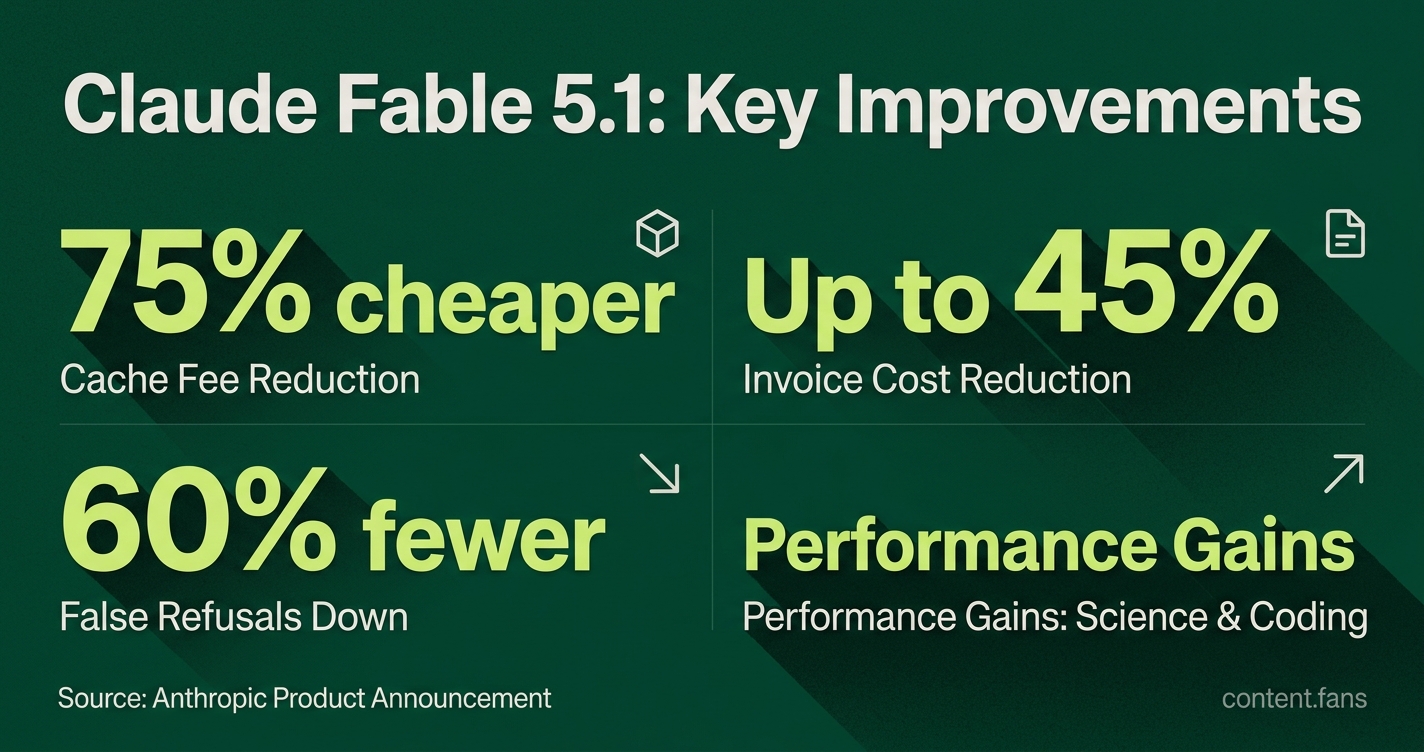
A central feature of the Fable 5.1 update is a major pricing change targeting agentic workflows. Anthropic has slashed prompt-cache read fees by 75%, from $1.00 down to $0.25 per million tokens, as detailed in its product announcement. While base input and output prices are unchanged, this caching discount is projected to lower typical user invoices by 25% and costs for highly agentic systems by up to 45%.
The cost savings are most significant for workloads that repeatedly access cached context, including:
- Long-running autonomous agents
- Retrieval or memory-heavy chatbots
- Multi-step coding assistants that re-read large system prompts
The Claude Fable 5.1 update introduces major cost savings through a 75% reduction in cache fees, making complex AI agents more economical. It also delivers significant performance boosts in scientific and coding tasks, along with a 60% decrease in incorrect safety refusals for a smoother user experience.
Addressing Enterprise Privacy with Frontier Safeguards
To resolve enterprise data privacy and Zero Data Retention (ZDR) concerns, Anthropic announced Enterprise Frontier Safeguards (EFS). This upcoming feature will allow eligible customers to store data in their own cloud infrastructure, providing a privacy equivalent to ZDR. While EFS is scheduled for a phased rollout, approved customers can use Fable 5.1 with ZDR in the interim.
Benchmark Gains
Fable 5.1 shows significant performance improvements in internal benchmarks. According to industry reports, the model demonstrated substantial gains in scientific reasoning tasks, significantly outperforming its predecessor and many competitors. The model also achieved higher scores in coding benchmarks, placing it ahead of many competing models on these specific tasks.
Reduced False Positives in Cyber Safeguards
A key usability improvement in Fable 5.1 is a 60% reduction in false positive safety refusals compared to its predecessor. This allows the model to handle more benign requests without obstruction while maintaining critical safety filters. The more restrictive Mythos 5.1 model is reserved for specialized use cases where stricter oversight is necessary.
Early Enterprise Response
Early adopters have responded positively, noting the new data retention options remove a major barrier to production deployment. For instance, hedge fund Millennium credited Fable 5.1 with identifying the root cause of a rare system crash. However, some compliance teams are still evaluating whether the interim ZDR solution satisfies all regional data transfer regulations.
What to Watch Next
Moving forward, industry observers will be watching the adoption rate of Enterprise Frontier Safeguards to gauge its success in addressing enterprise privacy concerns. Concurrently, the developer community is expected to optimize agentic systems to leverage the new caching economics. Future benchmark results and competitive shifts will ultimately determine the long-term market position of Anthropic's Fable and Mythos models.
What are the key differences between Claude Fable 5.1 and Claude Mythos 5.1?
Anthropic released Claude Fable 5.1 and Claude Mythos 5.1 as two variants of the same underlying model with different safeguard levels. Fable 5.1 is designed for general availability and broader enterprise use, while Mythos 5.1 is reserved for vetted specialist customers who require access with fewer restrictions. Both models share the same core capabilities, but Mythos 5.1 operates under different safety protocols intended for organizations with specialized use cases that have undergone additional vetting.
How much will the new cache pricing reduce costs for AI agent workloads?
Anthropic has cut cache read costs by 75% - from $1.00 to $0.25 per million tokens on Fable 5.1. The company estimates this reduces typical bills by approximately 25% and up to 45% for highly agentic workloads. This pricing structure particularly benefits developers building long-running AI agents that repeatedly reuse context, such as those with persistent memory, multi-step autonomous workflows, or retrieval-heavy orchestration. Headline input and output token prices remain unchanged at $10 and $50 per million tokens respectively, meaning the savings come specifically from cached context reuse rather than base model calls.
What performance improvements does Fable 5.1 show in scientific and coding tasks?
Fable 5.1 demonstrates substantial gains in science and coding benchmarks compared to both its predecessor and competitors. According to industry reports, the model showed significant improvements in scientific reasoning tasks and coding performance, with the science performance showing particularly notable gains compared to its predecessor. Independent testing by Every found Fable 5.1 strong at coding and product-focused outputs, noting it produced usable diagram reproductions where competitors added distracting decorations.
What is Enterprise Frontier Safeguards and how does it affect data retention?
Enterprise Frontier Safeguards (EFS) is Anthropic's new system that gives eligible enterprise customers complete privacy equivalent to zero data retention by storing data in customer-controlled cloud infrastructure rather than Anthropic's systems. This addresses a significant pain point: Fable and Mythos models require 30-day data retention by default for safety monitoring, which conflicts with many enterprises' zero data retention (ZDR) requirements. EFS will roll out in phases, with eligible customers able to use Fable 5.1 with ZDR until EFS becomes available. The feature will be supported across multiple platforms including Claude Code, Claude Enterprise, Amazon Bedrock, and Microsoft Foundry.
What real-world impact has Fable 5.1 already demonstrated?
Beyond benchmarks, Fable 5.1 has shown practical value in production environments. Millennium hedge fund credited Fable 5.1 with finding the cause of a one-in-a-million crash - a concrete example of its analytical capabilities in high-stakes scenarios. Additionally, Anthropic reports that cyber safeguard false alarms dropped by approximately 60%, reducing friction for legitimate use cases while maintaining security. The release explicitly responds to customer feedback on price, data retention, and refusals, suggesting Anthropic is prioritizing enterprise usability alongside raw capability improvements.