
Enterprises Boost AI Cybersecurity Spending 74% Amid New Threats
Serge Bulaev
Enterprises appear to be increasing their AI cybersecurity spending by 74% in response to new AI-enabled threats. Surveys suggest that more companies are making separate budgets for AI-specific defenses, and the share of cyber funds planned for AI solutions may grow sharply by 2026. Spending is shifting from general security tools to measures that address model abuse and identity deception, such as deepfakes and prompt injection. Compliance with standards like NIST AI RMF and ISO/IEC 42001 may be guiding purchases, and budgets for areas like detection, monitoring, and governance are rising. This suggests a long-term change in how companies manage AI risks, with 2026 seen as an important year for this transition.

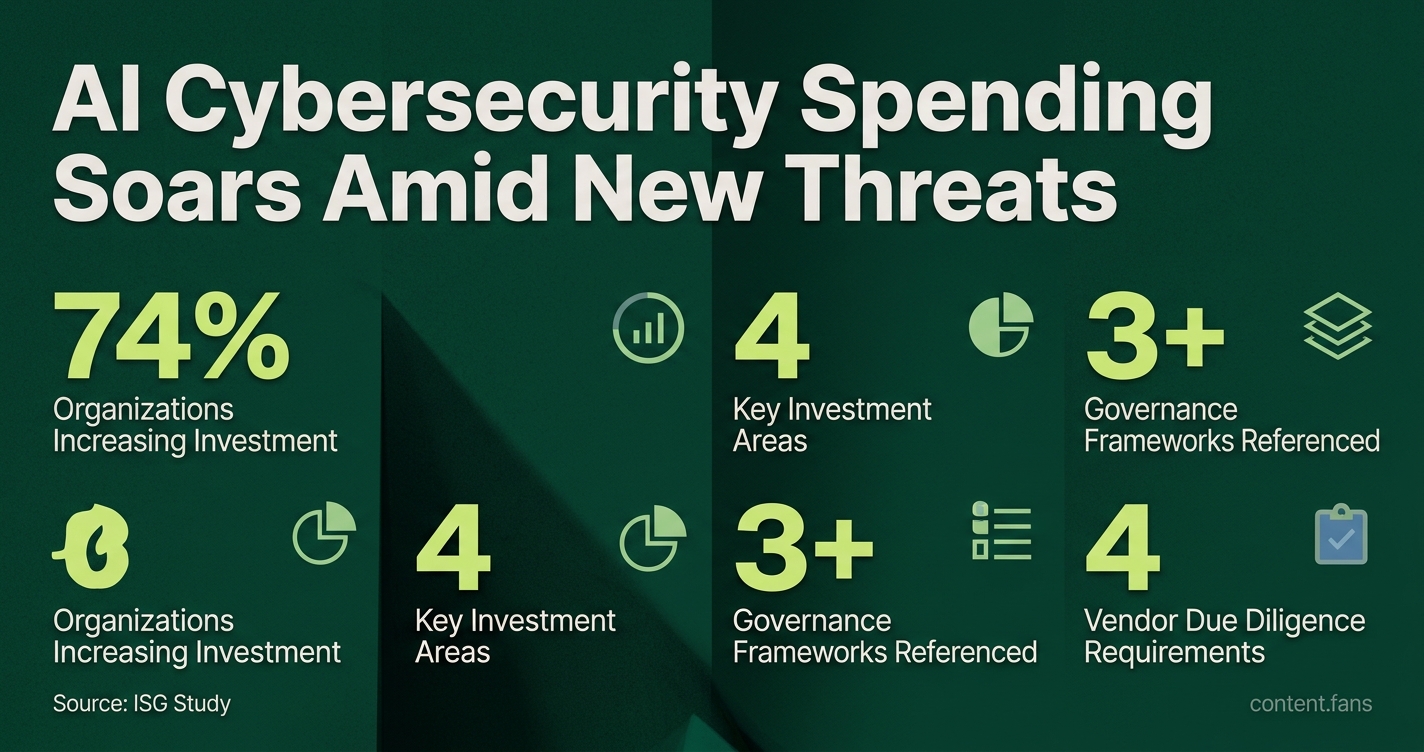
Enterprises are significantly increasing AI cybersecurity spending as leaders confront new, sophisticated AI-enabled threats. Recent surveys show a decisive shift toward dedicated budgets for AI-specific defenses, with one ISG study finding 74 percent of organizations are increasing investment in tools to counter model manipulation and deepfake fraud. This trend points to a long-term structural rebalancing of security budgets, not a temporary spike.
How Are AI Threats Reshaping Cybersecurity Budgets?
Organizations are reallocating funds from general security to AI-specific defenses to counter new, tangible threats. Attacks like deepfake fraud and prompt injection are causing direct financial losses, prompting leaders to establish dedicated budgets for AI risk governance, model monitoring, and advanced threat detection.
Data indicates a clear move toward ring-fenced funding for AI risks. Industry reports suggest that AI-related security now comprises a growing portion of total cyber spending. Furthermore, research indicates that a significant number of organizations maintain dedicated AI security budgets, and studies predict the share of firms allocating substantial portions of their cyber funds to AI will increase significantly within two years.
This new spending is shifting away from traditional perimeter tools and toward specific controls for emerging threats. Key investment areas include:
- Shadow-AI Discovery: Identifying and inventorying unauthorized AI usage.
- Policy Enforcement: Managing model access and usage rules.
- AI Data Protection: Securing content processed by AI systems.
- Targeted Threat Detection: Identifying prompt injection and deepfake attacks.
How Governance Frameworks Are Shaping AI Security Purchases
Corporate boards now demand that new spending aligns with recognized standards, pushing procurement toward evidence-based decisions. Enterprises increasingly reference frameworks like the NIST AI RMF and seek vendor alignment with ISO/IEC 42001. For companies with European operations, the risk tiers of the EU AI Act are also critical, mandating strict documentation and monitoring for high-risk systems.
This has operationalized vendor due diligence. Scorecards now require:
- Documented Governance: Artifacts like model cards and risk classifications.
- Robust Testing Evidence: Proof of bias, robustness, and adversarial safety testing.
- Continuous Monitoring: Capabilities for tracking model drift, compliance, and abuse.
- Defined Incident Response: Clear runbooks for system rollbacks and regulatory notifications.
Industry surveys confirm this trend, noting that buyers now directly ask suppliers about their framework alignment and audit plans for standards like ISO/IEC 42001, prioritizing operational proof over high-level ethics statements.
Which Specific AI Attacks Are Driving Spending?
Two primary attack vectors are consistently cited in budget justifications: prompt injection and deepfake fraud. Security researchers report observing prompt injection attempts in a significant majority of production AI deployments, with substantial estimated global losses. Similarly, surveys indicate that many organizations have encountered deepfake attacks.
High-profile incidents demonstrate the real-world impact. Security disclosures have revealed how prompt injection vulnerabilities in enterprise AI systems could potentially exfiltrate internal data. Similarly, security organizations have documented deepfake voice calls bypassing bank security to authorize fraudulent transfers. These concrete examples are compelling CFOs to approve spending on AI-aware monitoring and stronger identity verification.
Emerging AI Security Budget Allocations
Based on industry reports, a clear pattern of budget allocation is emerging, with a strong focus on preventative and oversight functions. Average spending shares are projected as follows:
| Category | Approximate Share of AI Security Budget |
|---|---|
| Governance and Compliance | 25-30 percent |
| Detection and Monitoring | 25-30 percent |
| Data Protection Controls | 20-25 percent |
| Incident Response and Red-Teaming | 10-15 percent |
| Talent and Training | 10 percent |
Key Operational Changes for Security Teams
This spending shift creates three immediate operational changes for security teams:
- Justifying ROI: CISOs must now demonstrate a measurable reduction in AI-specific risk to secure incremental funding from finance departments.
- Tool Integration: Security operations centers (SOCs) need to integrate new telemetry from AI gateways and deepfake detectors, forcing discussions about tool consolidation and workflow updates.
- Smarter Procurement: Procurement teams are adopting scorecards mapped to NIST AI RMF and ISO/IEC 42001, which helps shorten sales cycles for vendors who provide clear compliance artifacts.
The consensus from industry data is that the coming years represent a pivotal period where cybersecurity spending growth will align directly with AI-driven threat models, while investment in traditional security categories slows.