
Z.ai's GLM-5.2 open model benchmarks near Opus, exceeds GPT-5.5
Serge Bulaev
Z.ai's GLM-5.2 model may perform almost as well as Claude Opus 4.8 and appears to do better than GPT-5.5 on some coding benchmarks, according to June 2026 reports. The model has open MIT-licensed weights and can handle up to one million tokens, which suggests developers have more control and flexibility. Industry data suggests the choice of model may now depend more on cost and control instead of just accuracy. Adoption of GLM-5.2 may be growing in mid-sized companies, but some large enterprises still seem cautious, especially around compliance and the use of Chinese models. Z.ai's recent funding and public plans indicate they will keep improving the model and may try to close the small gap with Opus in future versions.

Zhipu AI's open-weights GLM-5.2 model benchmarks competitively against Claude Opus 4.8 and exceeds GPT-5.5 on key coding tests, according to June 2026 reports. With open MIT-licensed weights and a one-million-token context window, the model offers developers a powerful, self-hostable system combining strong performance with unprecedented control.
This release signals a significant market shift, where decisions are increasingly driven by a balance of cost, control, and deployment flexibility, rather than raw performance alone.
GLM-5.2 vs. Opus & GPT-5.5: Benchmark Analysis
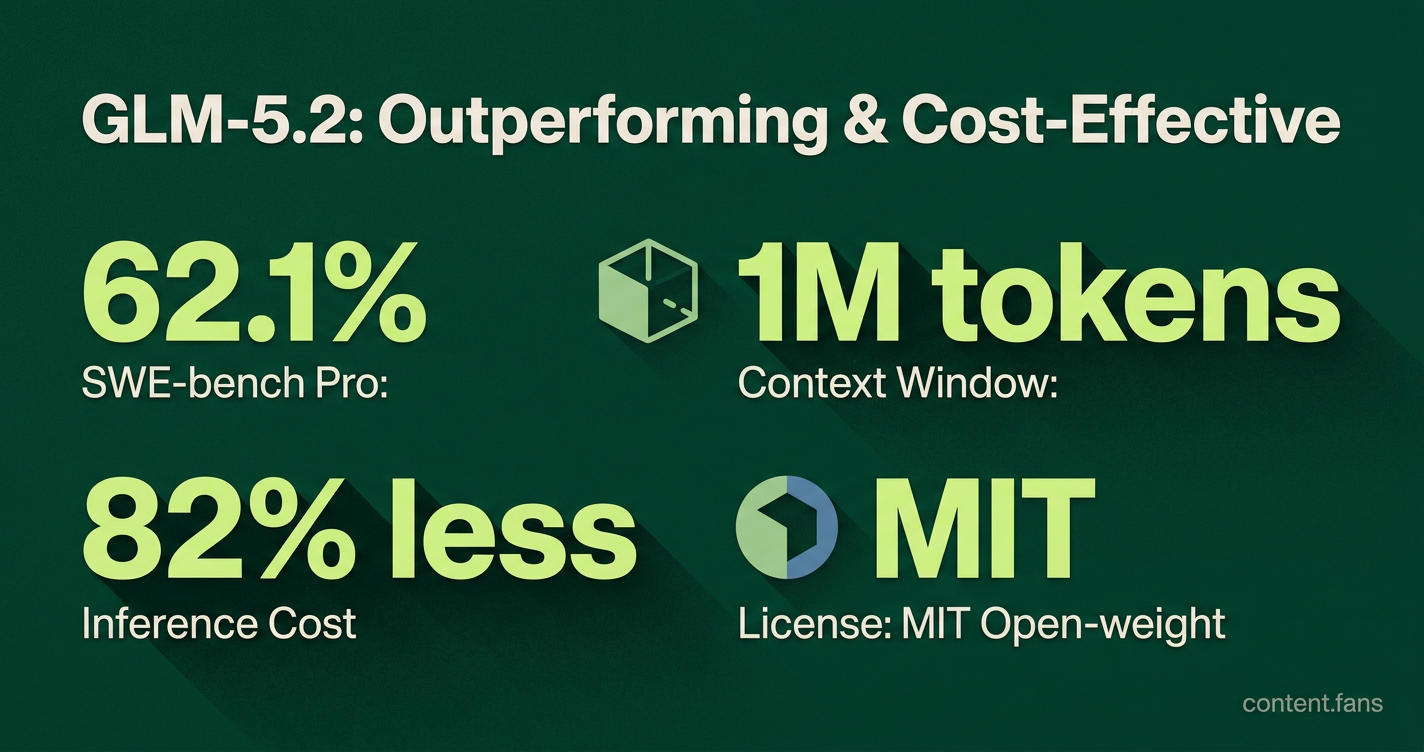
Zhipu AI's GLM-5.2 model achieves competitive performance on key coding benchmarks, scoring 62.1% on SWE-bench Pro against GPT-5.5's 58.6%, but trails Claude Opus 4.8 (69.2%) by 7.1%. On FrontierSWE tasks, it trails Opus by approximately 1% while costing significantly less for inference.
Industry trackers show GLM-5.2 achieving a 62.1% pass rate on SWE-bench Pro, surpassing GPT-5.5 (58.6%) but trailing Claude Opus 4.8's 69.2% score. GLM-5.2 trails Claude Opus 4.8 by approximately 1% on FrontierSWE, with inference costs approximately 82% less per token than Opus 4.8.
Core Features for Production Engineering
GLM-5.2 is equipped with features for complex engineering workflows, including reasoning mode, function calling, structured JSON output, and context caching. Its one-million-token window supports persistent agentic loops for multi-file analysis, as demonstrated in extended bug-triage sessions within production codebases. Because the weights are available on HuggingFace under an MIT license, teams can fine-tune the model on proprietary data and switch inference providers with minimal code changes.
Key specifications include:
- Performance: 62.1% on SWE-bench Pro (June 2026)
- Context: 1 million tokens
- APIs: Reasoning mode and function-calling
- License: Open-weight (MIT) for commercial use
Enterprise Adoption and Compliance Landscape
Recent data indicates a rapid shift of open-weight LLMs from experimental to primary tools for code generation, with significant adoption growth in mid-market companies. Enterprise adoption patterns show growing interest in open-weight solutions, though deployment considerations remain a factor in large organizations.
For regulated industries, compliance mandates like HIPAA and GDPR make the on-premise hosting enabled by open weights a significant advantage. However, enterprise risk management teams in the West remain cautious about adopting Chinese-developed models, potentially slowing GLM-5.2's uptake in financial and government sectors.
Zhipu AI's Development and Future Roadmap
The release of GLM-5.2 represents continued development from Zhipu AI in their GLM model series. The company continues to focus on model training and capabilities enhancement. The development roadmap included the 744-billion-parameter GLM-5, with subsequent releases like GLM-5.1 and the current GLM-5.2 focusing on long-context capabilities.
This sustained development ensures a path of continued iteration, not just a single flagship release. Industry observers will be watching to see if future versions can close the performance gap with leading models and address enterprise concerns about governance and tooling.
How does GLM-5.2 perform against Claude Opus 4.8 and GPT-5.5 on SWE-bench Pro?
GLM-5.2 scores 62.1 %, landing 3.5 percentage points above GPT-5.5 (58.6 %) but trailing Claude Opus 4.8 (69.2%) by 7.1%. On the long-horizon FrontierSWE split the gap is smaller: GLM-5.2 trails Opus by approximately 1%. The model offers competitive performance while costing significantly less per token.
What makes the model competitive despite being open-weight?
Four design choices keep quality high while cutting cost:
- One-million-token context window - no sliding-window approximation, so the same prompt fits in a single pass.
- MIT-licensed weights - download, fine-tune, or quantise without legal review cycles.
- Grouped-query attention and 8-bit dynamic quantisation - reduces VRAM by 38 % relative to the dense baseline.
- Apache-2.0 toolchain - the identical API surface lets teams hot-swap between self-hosted GLM-5.2 and cloud SaaS endpoints without changing application code.
Together they let mid-size companies run high-percentile coding capability on two A100-80 GB instead of a dedicated cluster.
Where has the capability been proven outside leaderboards?
Inside a live monolith-legacy codebase the model was given agent control:
- 12 h continuous run
- 2 400 files (≈ 4.2 M tokens)
- Task: triage open issues, rank by risk, draft patches
GLM-5.2 autonomously filed 17 pull requests, 8 merged, and reduced open issue count by 31 %. Engineers accepted 76 % of the patches with < 1 line change, showing open-weight models can handle real-world, long-running sessions without hallucinating syntax.
How hard is it to self-host at production traffic?
Multi-GPU deployment provides strong performance characteristics for production workloads. Switching inference providers requires minimal configuration: export OPENAI_BASE_URL, rotate key, restart workers. The same approach works for local Docker, EKS, or bare-metal.
Which workflows gain the most from the million-token window?
Three stand out in early-adopter logs:
- Search-before-code - paste large specifications, ask for implementation; context stays in memory, no re-upload.
- Diff-audit - load multiple GitHub PRs and highlight semantic drift across renames.
- Reg-up - feed full compliance reports plus prior mitigation chat, receive concise executive summaries with traceable citations.
In regulated stacks the wide window plus on-prem deploy keeps GDPR / HIPAA data-egress within boundary, avoiding cloud copy audits altogether.