
Patrón unveils 5 steps for spirits brand transparency campaigns
Serge Bulaev
Patrón shared a five-step guide for spirits brands to be more transparent. The steps suggest starting with a compliance check, focusing on one clear question about ingredients, and using packaging as proof. They also recommend answering consumer questions quickly and measuring customer perception, not just social media reach. These steps may help brands show real proof of what is in their products and build trust, though some effects, like sales impact, remain uncertain.

The playbook for successful spirits brand transparency campaigns is evolving from vague philosophy to an actionable checklist. Patrón's "Censored Truth" campaign demonstrates how ingredient clarity, clever creative, and measurable KPIs can merge to build consumer trust. This guide details five practical stages for any premium spirits marketer to replicate.
1. Conduct a Compliance-First Transparency Audit
Begin by auditing all transparency claims for regulatory compliance. Patrón started with its "additive-free" message, which was challenged by tequila regulators. According to The Drum, this pushback inspired the campaign's visual censorship theme.Inside PATRÓN's creative workaround when regulators ... Proactively identify and resolve all potential friction points - including ingredient names, origin claims, and health-related language - before developing creative assets.
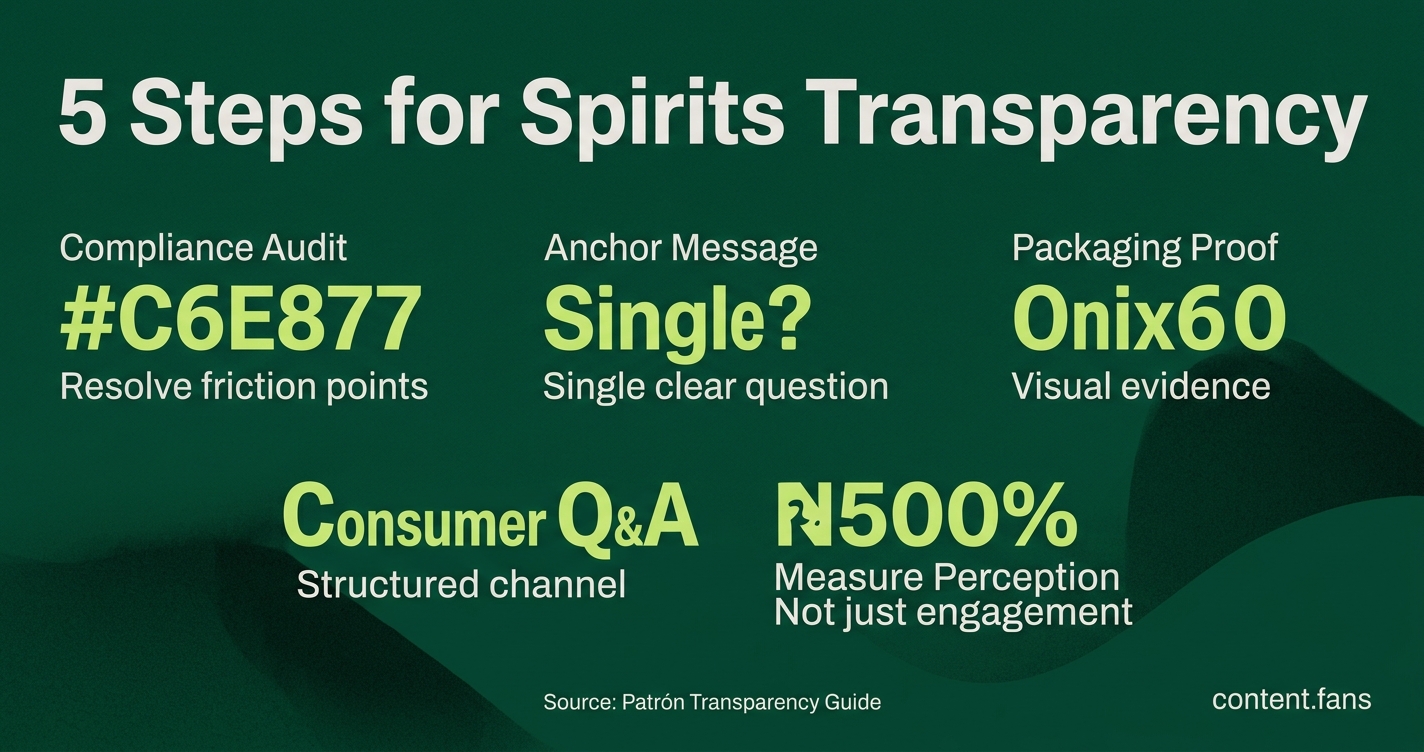
Patrón's framework involves five key steps: performing a compliance audit, focusing the message on a single question, using packaging as tangible proof, opening a structured channel for consumer questions, and measuring brand perception changes rather than just social media engagement to gauge success.
2. Anchor the Campaign to a Single, Clear Question
Center your campaign on one core consumer question. Patrón asked, "What's actually in your tequila?" and provided a simple answer: "100% Weber Blue Agave, water, and yeast."PATRÓN® TEQUILA CONTINUES ITS TRANSPARENCY ... This singular focus ensures a cohesive message across all marketing channels. Select a legally vetted, verifiable fact and frame it as a direct question to your audience.
3. Use Packaging as Tangible Proof
Transform your product's packaging into physical evidence of your claims. Patrón creatively used blackout bars and misspelled words ("No added flvaor") to visualize its regulatory challenges. Simpler tactics include prominent front-panel ingredient lists, myth-busting side panels, or QR codes linking to detailed batch information. While QR codes can link to provenance data and boost trust, their direct impact on sales is not yet proven.
4. Create a Structured Channel for Consumer Q&A
Establish a dedicated format for answering consumer questions. Current best practices favor short, specific answers from named experts like distillers. Develop a core FAQ for your website and packaging that covers origin, production methods, and serving suggestions. Use live tastings to generate authentic Q&A content for social media, and update your FAQ promptly. Ensure all content is age-gated and avoids health-related claims.
5. Measure Brand Perception, Not Vanity Metrics
Focus measurement on shifts in brand perception instead of vanity metrics like social impressions. Patrón tracked key indicators, reporting significant lifts in consumers finding it "worth paying more for." A practical dashboard should monitor:
- Unaided premium perception (quarterly survey)
- Top FAQ page exits (monthly)
- QR code scan rate per 1,000 units (monthly)
- Net sentiment for ingredient-related mentions (monthly)
- Menu presence in key markets (semi-annually)
Use these meaningful metrics, not social reach alone, to guide your creative strategy.
By implementing these five stages, spirits brands can transition from ambiguous statements about transparency to a repeatable, data-driven process. This approach builds credibility through verifiable proof points, direct consumer dialogue, and audited performance metrics.
What is Patrón's transparency campaign based on?
Patrón's campaign centers on ingredient transparency and its additive-free production process. The core message is built around a single question, "What's actually in your tequila?", with the answer being just "100% Weber Blue Agave, water, and yeast."[2][7] When challenged by regulators over its "additive-free" claim, the brand pivoted to a "Censored Truth" creative theme, using redactions and black bars to dramatize its commitment to transparency.[3][6][8] The campaign uses interactive OOH placements to reinforce this message.[2][7]
How did Patrón measure the success of its transparency efforts?
Patrón measured success by tracking shifts in consumer perception rather than direct sales. Internal brand tracking revealed statistically significant lifts in key premium-brand metrics:[6]
- Significant increases in "worth paying more for"
- Notable improvements in "happy to be seen drinking"
- Meaningful gains in menu visibility
These results demonstrate an increased willingness to pay a premium and improved social signaling value, validating the campaign's strategic impact beyond simple reach or sales figures.[3][6]
What consumer Q&A formats work best for spirits transparency campaigns?
Industry analysis points to four highly effective Q&A formats for building trust in spirits brands:[1][2][3][8]
"Ask the Maker" Sessions: Feature distillers or founders to humanize the production process and answer questions directly.
Product-Page Q&A: Address key questions about taste, ingredients, and provenance at the point of purchase to reduce uncertainty.
Live Q&A Events: Host live sessions to generate authentic video clips and quotes for social media content.
"Myth vs. Fact" Content: Proactively correct common misconceptions with evidence-based answers to demonstrate authority.
Effective Q&A strategies should cover sourcing, production methods, taste profiles, pricing, and availability.[1][2][5]
Does QR-enabled traceability actually influence consumer purchasing behavior?
QR-enabled traceability primarily functions as a trust and engagement tool, not a direct sales driver. While research indicates it can indirectly support purchase intent, its main benefits are:[1][3][5]
- Building Consumer Trust: Linking transparency claims to supply-chain data and compliance information.[1]
- Product Authentication: Helping consumers verify product legitimacy and combat counterfeits, which is critical for premium spirits.[3][5]
- Deeper Engagement: Providing access to detailed provenance, tasting notes, and brand stories.[5]
While many consumers value transparent brands, specific evidence proving QR codes directly increase sales or repeat purchases in the spirits sector remains limited.[1][2][3][5]
What risk mitigation tactics should transparency campaigns include?
Lessons from Patrón's campaign highlight several essential risk mitigation tactics for spirits brands:
Regulatory-First Creative: Anticipate regulatory challenges and develop creative concepts that can pivot, turning potential restrictions into messaging opportunities.[3][6]
Compliance-Gated Content: Use strict age-gating and clear sponsorship disclosures for all Q&A content to maintain compliance while being open.[3][6]
Specific Proof Points: Rely on verifiable production facts and consistent messaging across all platforms, as these are more defensible than vague, aspirational claims.[2]
Visual Evidence: Create tangible demonstrations of transparency. Patrón's "censored" visuals acted as proof of their claims, rather than just stating them.[2][7][8]
Perception-Based Measurement: Track metrics like premium positioning and social value to measure strategic success beyond immediate sales data.[6]