
ZaiNar exits stealth, targets $5 billion in GPS alternative deals
Serge Bulaev
ZaiNar is a Silicon Valley startup that recently ended nine years of secrecy and says it is pursuing about $5 billion in contracts for a new wireless location system that does not use satellites. The company claims its technology can use 5G, Wi-Fi, and other networks to provide accurate location data indoors and outdoors, potentially offering advantages over GPS, especially in places where GPS does not work well. ZaiNar may still need to prove its accuracy and pass regulatory checks, and there are concerns about privacy and integration costs. Industry experts suggest the company's success will depend on independent testing, regulatory approval, and transparency in its partnerships.

ZaiNar emerged from nine years of stealth in February 2026 with a wireless-network sensing platform for Physical AI. The Silicon Valley company has moved into a commercial phase, offering a wireless location system that provides positioning, navigation, and timing data without relying on satellites.
By proving its accuracy and successfully clearing regulatory hurdles, ZaiNar's terrestrial-based location technology could fundamentally reshape how industries acquire critical positioning, navigation, and timing (PNT) data.
How the platform differs from GPS
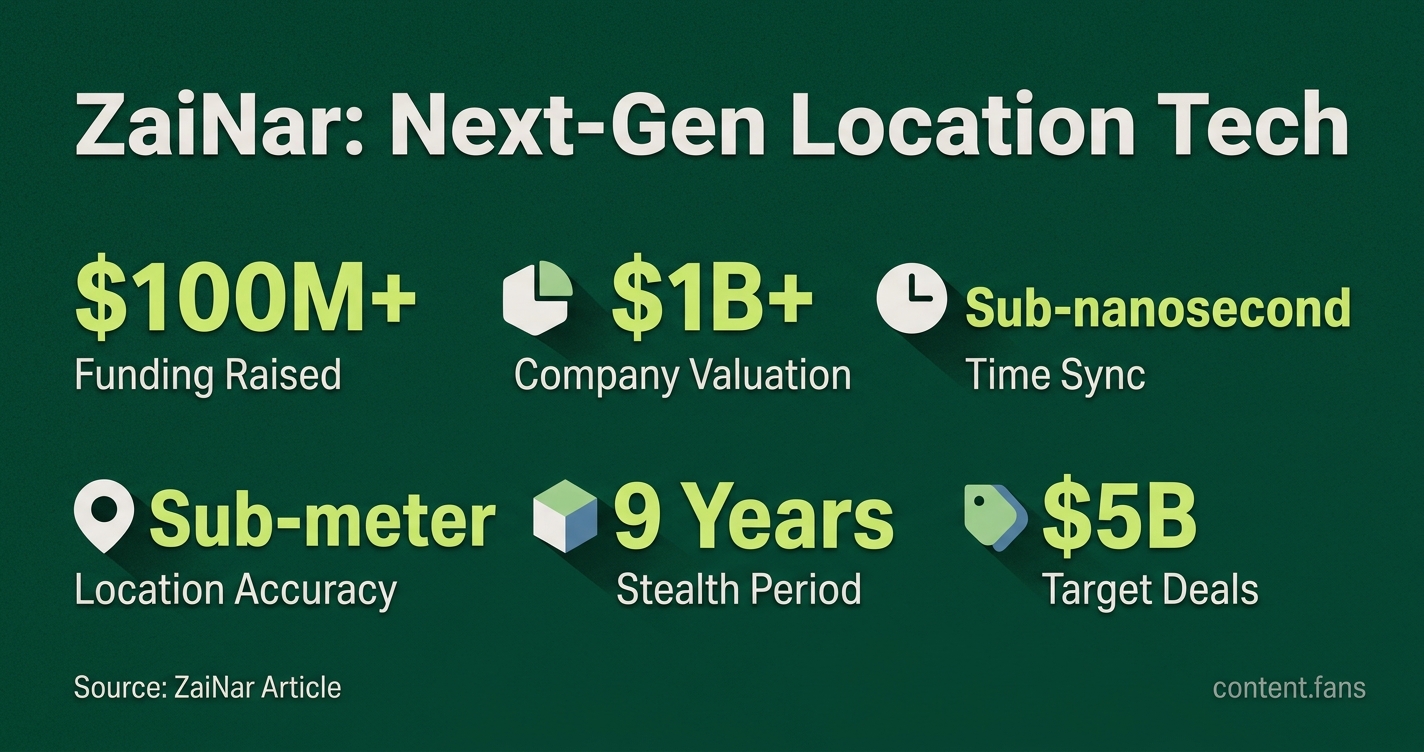
ZaiNar's platform provides precise location data by achieving sub-nanosecond time synchronization across existing terrestrial networks like 5G and Wi-Fi. Unlike satellite-based GPS, this software-driven approach enables accurate positioning indoors, underground, and in dense urban areas where traditional signals are often weak or unavailable.
ZaiNar's technology achieves sub-nanosecond time synchronization using existing 5G, Wi-Fi, and private cellular signals to deliver sub-meter location accuracy. Some reports suggest it can even reach centimeter-level precision indoors and outdoors. As noted on the ZaiNar homepage, superior clock synchronization directly translates to tighter ranging accuracy. This method overcomes common GPS limitations, such as signal degradation indoors, within dense urban canyons, or during jamming events.
Reported advantages:
- Hardware-Free Operation: Requires no new satellites or specialized device hardware.
- Robust Coverage: Functions through walls and underground, overcoming physical barriers.
- GPS Resiliency: Offers a terrestrial backup system resistant to GPS jamming and spoofing.
- Seamless Integration: Designed to integrate with existing carrier and enterprise network infrastructure.
Commercial traction and funding status
In February 2026, ZaiNar announced it had raised over $100 million in funding, achieving a valuation of more than $1 billion. The company also reported securing significant commercial interest through contracts and memoranda of understanding (MOUs). As reported by Location Business News, the funding positions the now commercially available platform for significant growth.
According to investor communications, ZaiNar's deployments are already active across multiple continents in sectors including construction safety, healthcare asset tracking, and robotics coordination. While specific partners have not been publicly named, this is likely due to confidentiality agreements or pending formal announcements.
Market context in 2025
The market for GNSS-independent positioning is expanding rapidly, with industry reports suggesting significant growth potential in the coming years. This demand is fueled by industries requiring resilience against signal jamming and precise indoor location services. While competitors offer solutions like inertial navigation, eLoran, and hybrid sensor fusion, ZaiNar's strategy of using existing cellular and Wi-Fi infrastructure places it squarely in the category of network-based, software-defined solutions.
Hurdles that may slow adoption
Significant hurdles could slow widespread adoption. The technology will face regulatory scrutiny regarding spectrum use, data privacy, and safety certifications. Concerns have been raised about the potential for tracking devices without permission through ambient signal analysis. Furthermore, carriers and enterprises must balance the high cost of integration against the platform's promised benefits. The company must also establish auditable data trails to meet evidentiary standards for legal and transportation applications.
What to watch next
Industry analysts and potential customers will be closely monitoring several key developments to validate ZaiNar's claims:
1. Independent Performance Verification: Publication of accuracy benchmarks from third-party testers, such as academic institutions or network carriers.
2. Commercial Contract Conversion: Announcements of named partners converting their memoranda of understanding (MOUs) into revenue-generating contracts.
3. Regulatory Progress: Official filings or approvals for use in critical sectors like aviation, automotive, and public infrastructure.
4. Privacy and Compliance: The establishment of clear privacy frameworks that address concerns related to ambient signal analysis.
While ZaiNar's commercial ambitions highlight the significant market demand for resilient positioning solutions, its ultimate success and industry impact will depend on delivering verifiable real-world performance and fostering transparent commercial partnerships.
What exactly is ZaiNar promising that GPS cannot already do?
ZaiNar's core promise is delivering sub-meter (and potentially centimeter-level) location accuracy by leveraging existing 5G, Wi-Fi, and private cellular signals. Because all computations are network-based, the technology provides reliable indoor, through-wall, and urban canyon coverage where GPS fails. It also features inherent resistance to the jamming and spoofing that affects satellite-based systems.
How close is the company to turning its pitch into signed revenue?
ZaiNar emerged from stealth in February 2026, announcing over $100 million in funding and a valuation exceeding $1 billion. The company has reported significant commercial interest through contracts and memoranda of understanding, according to management. The company's growth strategy represents the next phase as pilot programs convert into large-scale enterprise and carrier agreements.
Which industries are first in line for the new service?
Initial commercial deployments are focused on key industrial sectors:
- Construction - Enhancing worker safety by creating and monitoring hazard zones.
- Healthcare - Tracking the location of mobile medical equipment within hospital facilities.
- Logistics / supply-chain - Providing end-to-end visibility for assets in yards, warehouses, and during transit.
- Automotive & autonomous shuttles - Enabling precise positioning for autonomous vehicles in urban environments where GPS is unreliable.
Early adopters span North America, Europe and Asia-Pacific, according to the company.
Does ZaiNar require new hardware inside phones, cars or robots?
No. ZaiNar's platform is software-based and does not require new chips or antennas in end-user devices. The company's core intellectual property is its sub-nanosecond time-synchronization software, which operates on standard network hardware. This means any existing device with 5G or Wi-Fi connectivity can theoretically be located without a special app or SIM update - a model that is drawing close attention from privacy regulators.
What hurdles could slow or block mass adoption?
Several key challenges must be overcome for mass adoption. The primary hurdles include securing spectrum-use approvals and managing complex carrier integrations. Additionally, the platform must meet stringent safety certification standards and produce auditable accuracy logs for legal and liability purposes. Finally, achieving significant commercial scale will hinge on converting MOUs into binding, repeatable service agreements at scale.