
Meta tests 'Hatch' AI agent for in-app shopping, summary features
Serge Bulaev
Meta is testing a new AI agent called 'Hatch' that may help with in-app shopping by summarizing chats, competitor offers, and drafting posts. Amazon appears to be using similar AI agents to speed up work tasks and fix problems more quickly in the workplace. Technology like ZaiNar's radio-wave timing might let AI agents find things in physical spaces, like warehouses. These trends suggest search and shopping may move from websites to being handled by AI inside apps, and that content may need to be made so agents can easily use and share it. Experts suggest this could change how people find and buy things, with agents guiding most of the process.

With Meta testing its 'Hatch' AI agent for in-app shopping, the tech industry is accelerating the shift from traditional search to agentic navigation. This trend moves beyond concept to become a budget-line reality, as firms like Meta and Amazon remodel e-commerce for autonomous assistants and new user interfaces.
This activity confirms the next search battleground will be fought within apps, clouds, and chips - not on traditional web results pages.
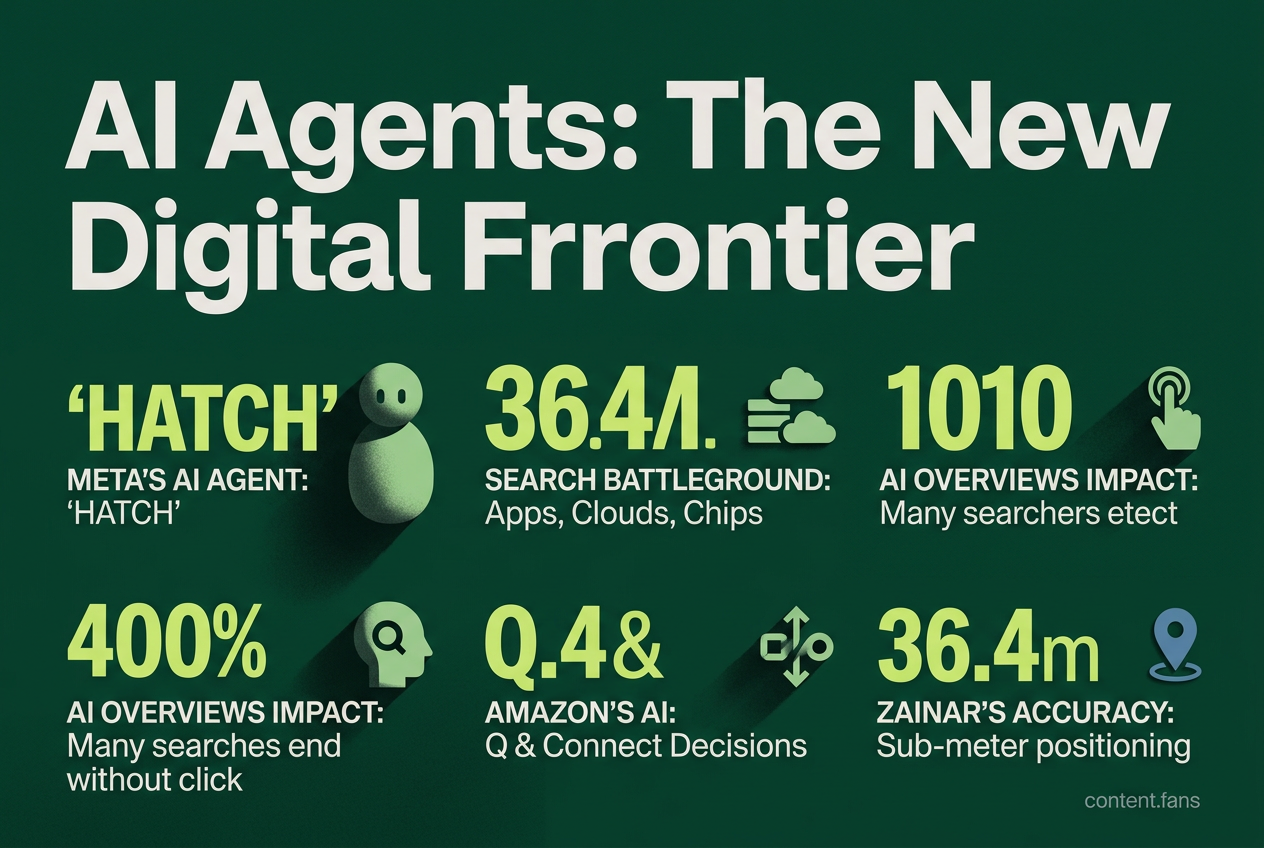
Consumer platforms: Meta pilots agentic shopping
Meta's 'Hatch' AI agent is reportedly being tested for agentic task execution across apps and may support shopping, posting, and other actions. The goal is to create a seamless experience where product discovery, recommendations, and user actions converge within a single social feed, moving beyond traditional websites.
According to reports, key tests for 'Hatch' focus on integrating commerce and social activity. Capabilities include:
- Task execution across multiple apps
- Sending birthday messages on a timer
- Drafting posts from trending topics
This functionality signals a strategic shift where search, recommendation, and action converge within a social feed, reducing reliance on external websites.
Enterprise stack: Amazon turns search into action
In the enterprise sector, Amazon is positioning 'agentic AI' as core workplace infrastructure. At a recent AWS event, the company demonstrated how updates to Amazon Q and Connect Decisions enable agents to identify and resolve cloud incidents or customer issues in seconds. The emphasis is on automated workflow completion over simple information retrieval.
Infrastructure layer: ZaiNar adds physical context
The infrastructure layer is also evolving, with search becoming spatial. Technologies like ZaiNar's radio-wave timing provide the physical context for AI agents by delivering sub-meter positioning accuracy. This precision enables agents, from warehouse robots to field technicians, to locate assets with near-perfect accuracy, making physical navigation data as valuable as text-based queries.
Trend Insight: Search, Agents & Navigation and the marketer's playbook
For marketers, this trend demands a new playbook. With AI Overviews resolving many queries directly, industry reports indicate that a significant portion of searches end without a click. To adapt, brands must prioritize three key tactics:
- Machine-Readable Content: Structure data with schema, entity markup, and clean taxonomy to be easily parsed by AI.
- Citable Answer Blocks: Create content that can be directly cited in AI summaries, treating a mention as a new form of traffic.
- Agent-Ready Commerce: Prepare product feeds and APIs for transactional agents, as the customer journey compresses into a single interface.
The emerging discipline for these practices is being called Generative Engine Optimization (GEO). Regardless of the terminology, brands must adapt to a new landscape where customer journeys are guided by intelligent agents, not just hyperlinks.
What is Meta's 'Hatch' AI agent built to do inside Instagram?
Hatch is being engineered as a task-oriented companion that lives inside Instagram. According to The Information, it is expected to discover products, compare options, surface relevant offers and even initiate checkout steps on a user's behalf. Internal test logs show it already scheduling birthday messages and handling various task executions. By combining social context with product data, Hatch turns the search experience into a proactive commerce flow rather than a traditional keyword hunt.
When will Meta complete internal testing for Hatch and roll it out?
According to industry reports, Meta plans to finish internal testing by the end of June. While a public launch date remains unannounced, sources indicate Hatch is planned for internal testing by end of June, while the separate Instagram shopping assistant is targeted for launch before Q4 of 2026; wider public release timing is not confirmed.
How is Hatch different from the Instagram shopping assistant Meta is also developing?
Hatch is the general-purpose agent that can perform multiple tasks across Instagram, Facebook, WhatsApp and even piloted integrations like DoorDash and Outlook. The second project is a commerce-focused agentic layer that sits inside Instagram only, dedicated to product discovery, deal matching and transaction facilitation. Think of Hatch as your universal assistant, while the shopping tool is a specialised buyer.
What changes should businesses prepare for as agentic shopping takes off?
The shift from "click to purchase" to "agent-initiated purchase" will compress the funnel. Brands must:
- adopt schema-rich product feeds so agents can read real-time prices and stock
- optimise entity authority - the brand, variants, reviews - to be cited inside AI answers
- re-think attribution; credit may flow to the assistant rather than the keyword
Research indicates that a significant portion of all searches now end at the AI answer, cutting traditional page views and display-ad inventory.
How does Meta's approach compare with Amazon and ZaiNar in the broader agentic landscape?
- Meta uses social-graph data to deliver hyper-personal product discovery inside consumer apps.
- Amazon focuses enterprise search-to-action: AWS agents troubleshoot cloud issues, process HR tickets and automate supply-chain queries.
- ZaiNar provides sub-meter location accuracy for robots and field devices, giving agents precise physical-world context that could power future in-store search or delivery optimisation.