
Newmark Secures $7.1B Loan for 1.2GW AI Data Center Campus
Serge Bulaev
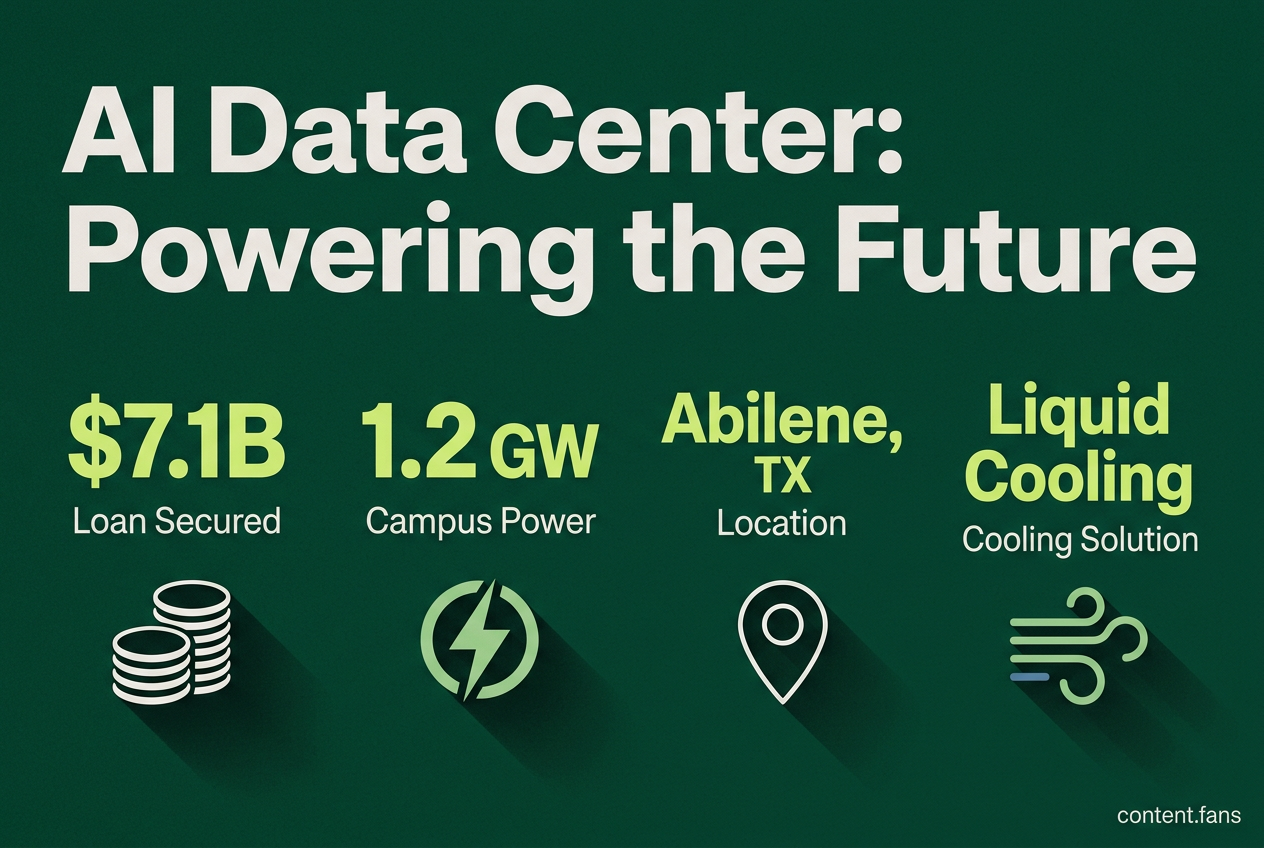
Rising AI workloads may be causing developers to build larger data centers, with new financing structures needed to support these projects. In May 2025, Newmark reportedly arranged a $7.1 billion construction loan for Blue Owl, Crusoe, and Primary Digital Infrastructure to develop the second phase of a 1.2-gigawatt AI campus in Texas. Financing for such projects appears to focus on long-term power contracts and tenant pre-leases. Liquid cooling is becoming important for these data centers, as air cooling might not be enough for higher power densities. The movement of experts from advisory firms to owners suggests that in-house financial skills are becoming more important as the industry grows.

Newmark has secured a landmark $7.1 billion construction loan for a 1.2-gigawatt AI data center campus, signaling a new era in digital infrastructure finance. The deal was arranged for Blue Owl Capital, Crusoe, and Primary Digital Infrastructure in Abilene, Texas, to fund phase two of a 1.2-gigawatt AI data center campus. This project highlights the complex financial structuring now required to support the immense power and cooling demands of AI workloads. As developers build multi-gigawatt facilities, expertise in project finance, tenant pre-leasing, and liquid cooling has become essential. This project was managed by Newmark's recently launched data center practice group, underscoring the rise of specialized teams bridging capital markets and hyperscale engineering.
Capital Stack Options for AI Campuses
Financing for large-scale AI data centers is shifting away from traditional real estate metrics. Lenders now prioritize long-term power purchase agreements and significant tenant pre-leasing commitments as the primary basis for underwriting multi-billion-dollar construction loans, reflecting growing confidence in the cash flow from dedicated AI workloads.
Project-level construction loans, like the one in Abilene, become highly attractive when backed by an anchor tenant with investment-grade credit. For subsequent development phases, sponsors often layer senior loans with mezzanine debt or use sale-leasebacks to recycle equity. Furthermore, infrastructure funds like DigitalBridge are increasingly positioned to take principal equity stakes once a project's initial development risks are mitigated.
Partnerships and Talent Mobility
The flow of talent underscores the maturation of the data center asset class. For instance, Brent Mayo, who led the Newmark capital markets team for the Abilene transaction, transitioned from the brokerage to the investor DigitalBridge. This high-profile move suggests that sophisticated capital-markets expertise is migrating from advisory firms to principal investors seeking to build in-house financing and structuring capabilities.
Operational Design for GPU Density
The extreme power requirements of AI infrastructure are forcing a wholesale shift in operational design. According to industry reports, AI training clusters are requiring increasingly high power densities per rack, making conventional air cooling insufficient for many applications. Industry leaders like Schneider Electric identify liquid cooling as a critical enabler for these high-density workloads. Advanced facilities targeting high-density configurations are implementing sophisticated solutions, including direct-to-chip cooling, modular coolant distribution units (CDUs), and predictive control systems to scale cooling capacity efficiently.
Template: Lender Term Sheet Checklist
A comprehensive term sheet is critical for aligning technical delivery with capital deployment. Lenders and borrowers should use the following checklist to frame negotiations, ensuring that key risks are addressed upfront. This proactive alignment can lower perceived concentration risk for credit committees and accelerate syndication timelines.
- Borrower and recourse structure
- Collateral package (land, shell, MEP, contracted GPUs)
- Tenant revenue coverage and pre-lease thresholds
- Power procurement strategy, including capacity reservations and cost pass-throughs
- Cooling design milestones tied to construction draws and performance testing
What makes this large-scale loan for Newmark's AI campus unusual?
Size and speed: According to industry reports, this represents one of the largest single-tranche construction loans for a U.S. data-center project and closed in an accelerated timeframe after term-sheet launch.
Construction-only risk: Unlike corporate revolvers that rely on an operating portfolio, the loan is non-recourse project finance secured only by the Abilene land, permits, and future cash-flows of the campus.
AI-linked collateral: Lenders accepted GPU-rich tenant leases as the primary repayment source, reflecting growing comfort with AI workload visibility and significant pre-lease coverage.
How did Newmark structure debt around GPU density and power loads?
Tranche A: A 5-year floating-rate note priced at SOFR + 275 bps with an 18-month construction period and two 12-month extension options; interest is capitalized until mechanical completion.
Tranche B: A 7-year mini-perm at SOFR + 325 bps that begins amortizing only after the campus reaches significant critical load capacity and meets specified debt service coverage requirements.
Cooling covenant: Borrowers must maintain efficient PUE performance verified quarterly; failure triggers margin adjustments plus cash-sweep provisions.
Why did lenders accept a large single-site concentration?
Staged draw: Capital is released in significant milestones tied to independent engineer sign-off on power-on to rack, limiting exposed capital at any one time.
Hyperscale pre-leasing: A substantial portion of campus capacity is already under long-term lease agreements, providing significant forward revenue visibility.
Texas grid upside: The site sits inside ERCOT with dual 345 kV feeds and a co-located solar PPA that provides favorable blended power costs for multiple years.
What operational benchmarks are written into the loan covenants?
- High rack density requirements on substantial white-space by specified timeline
- Direct liquid-cooling requirements for significant portion of total heat rejection capacity
- Network latency requirements to Dallas-Fort Worth metro fiber hubs
- Tier III-equivalent uptime verified by Uptime Institute throughout construction
Failure to meet consecutive quarterly requirements triggers technical-default provisions including cash-flow sweeps until cure.
How does Brent Mayo's move to DigitalBridge affect future mega-deals?
Mayo led the capital-markets structuring for both the Abilene transaction and other major facilities. His departure to DigitalBridge signals a shift from advisory to principal-side investing, potentially accelerating DigitalBridge's direct origination of large-scale AI financings.