
Warner's AI Agent Bill aligns US regulations with EU AI Act
Serge Bulaev
Sen. Warner's AI Agent Bill may bring US rules closer to the EU AI Act, focusing on logging, consent, and human oversight. The bill could require companies to keep logs for six months, tell users when an AI agent is used, and report incidents quickly, similar to EU rules. There might also be new requirements for agent identity certificates, but these are still being developed. Experts suggest that businesses who prepare early could avoid higher costs and be ready for global regulations. Some estimates suggest that up to 40 percent of AI agent projects could be stopped by 2027 due to compliance problems.

Sen. Warner's AI Agent Bill is set to significantly impact businesses by aligning proposed US regulations with the comprehensive EU AI Act. The EU AI Act is an enacted regulation that entered into force in August 2024. Key overlaps in logging (6 months), user disclosure, and human oversight are established requirements of this regulation. For enterprises, treating this bill as a blueprint for future global AI obligations is crucial for mitigating costs and gaining a competitive edge.
What the draft bill adds to an already crowded rulebook
The proposed legislation introduces key requirements for companies using AI agents, including mandatory six-month data logging, clear user disclosure when interacting with an AI, and swift incident reporting. It also anticipates a system for agent identity certificates, aligning with emerging NIST standards for AI governance and security.
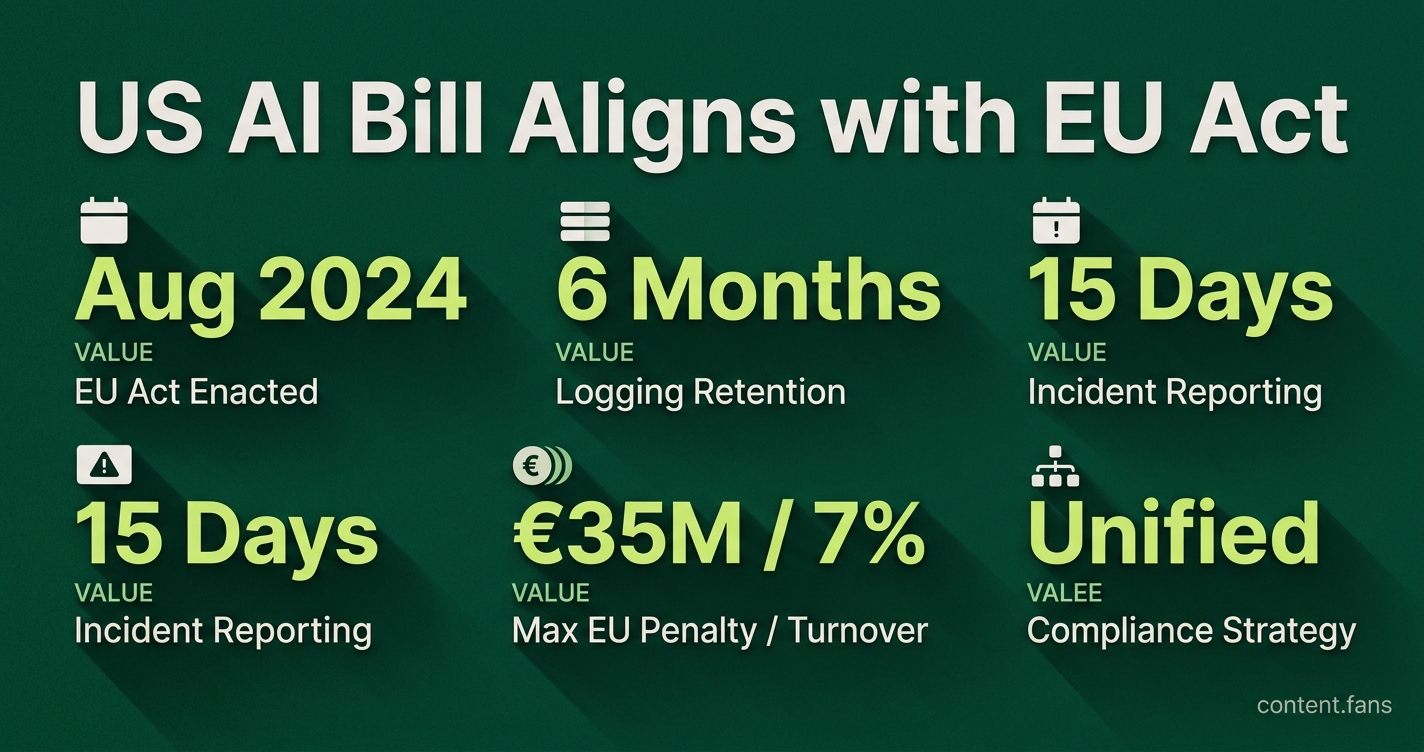
Sen. Warner's bill text mirrors several high-risk controls from European law. The EU AI Act requires Fundamental Rights Impact Assessments and technical documentation/conformity assessments. Beyond logging and disclosure, the proposed US bill also points toward mandated "agent identity certificates" and references impact assessments, reflecting a global convergence of AI regulations. Penalties for non-compliance in the EU can reach €35 million or 7% of global turnover for specific infringements, suggesting a model for potential US deterrents. This alignment increases the likelihood that businesses will need a unified compliance strategy for state, federal, and international rules.
Translating legal text into engineering and product backlogs
- Inventory AI Agents: Catalog all AI agents, including those in SaaS tools. Classify them by autonomy level, data access, and business impact.
- Limit Privileges: Implement a secure execution layer with sandboxing and role-based API keys to quickly contain any misbehaving agents.
- Ensure Log Integrity: Deploy tamper-evident logging to capture prompts, reasoning, and actions. Retain logs for at least six months to meet regulatory standards.
- Prioritize User Transparency: Integrate clear consent and disclosure mechanisms into user interfaces, ensuring transparency even when agent context changes.
- Document for Compliance: Maintain detailed conformity assessments and model cards with release artifacts to demonstrate "compliance by design."
Short-term and medium-term roadmaps
Short-Term Roadmap (Next 6 Months):
- Categorize existing agents based on high-risk definitions from EU and Singapore frameworks.
- Revise privacy notices to detail agent functions, data usage, and options for human oversight.
- Establish an incident response plan for material events with a 15-day reporting window, mirroring EU Article 73.
Medium-Term Roadmap (6-18 Months):
- Embed ISO 42001 controls into the software development lifecycle (SDLC) for automated traceability.
- Renegotiate vendor contracts to focus on shared liability rather than just feature sets. Prioritize vendors with SOC 2 Type II or ISO 27001 certifications.
- Begin piloting agent identity certificates in line with NIST's Model Context Protocol to prepare for federal procurement requirements.
Vendor screening under aligned regimes
As regulatory frameworks converge, vendor selection criteria are shifting dramatically. While certifications are becoming prerequisites, deep evidence of red-team testing and robust role-based access control (RBAC) now determines which vendors make the shortlist. Gartner predicts that a significant number of AI agent projects could be stopped by 2027 due to compliance gaps, not technical failures. This underscores a critical takeaway: thorough vendor diligence is now more valuable than rapid proof-of-concept deployment. This new reality demands that engineers build for robust logging, product managers design for transparent user consent, and legal teams draft contracts that account for cross-border enforcement.
How does Warner's AI Agent Bill compare to the EU AI Act?
The EU AI Act is already enforceable for high-risk systems; Warner's proposal mirrors its core obligations: technical documentation, automatic logging, human oversight, and pre-deployment transparency. The draft U.S. bill adds an interoperability clause that pushes vendors toward open protocols like NIST's Model Context Protocol, ensuring U.S. and EU markets can rely on the same audit trails and consent flows.
Which enterprise systems are in scope?
Any agent that touches personal data, makes autonomous decisions, or acts without real-time human approval is covered. That includes recruiting bots, credit-scoring agents, customer-service avatars, and internal workflow agents with access to HR or finance records. Edge case: even a "read only" agent that re-identifies users from anonymized logs is classified as high-risk.
What compliance requirements must be addressed?
- Inventory - a live register of every agent, owner, data accessed, autonomy level.
- Risk file - answers to the five board questions (worst action, accountability, kill-switch timing).
- Golden audit trail - six-month tamper-evident log with reasoning chain, human override, and alternatives considered.
- Front-end notice - real-time disclosure that the user is talking to an AI.
- Escalation playbook - 15-day incident-reporting path to regulators and internal security.
How do engineering teams limit blast radius?
Least-privilege tokens, sandbox containers, and immutable snapshots are now baseline. Best practice combines RBAC with temporal permissions that auto-expire after a task window. Red-team simulations run continuously using MITRE ATLAS scenarios; drift alerts are wired to the SOC so rogue behaviour triggers an automatic quarantine loop.
What happens if we skip compliance?
The financial exposure under the EU AI Act can reach up to €35 M or 7% of global turnover for specific infringements, while similar penalties are being proposed in the U.S. bill. Gartner predicts that a significant number of agentic AI projects will be canceled by end of 2027 due to escalating costs, unclear business value, and inadequate risk controls. Conversely, firms that bake governance in from day one shorten sales cycles in Europe and may qualify for U.S. federal procurement once the Warner bill passes.