
Varonis finds critical Google Dialogflow CX AI security flaw
Serge Bulaev
Varonis Threat Labs found a security flaw in Google Dialogflow CX, where one permission may have allowed attackers to inject code across different AI agents and access sensitive data. Google fixed the problem by June 2026 and says there is no evidence the flaw was used by attackers. Experts suggest that AI security needs strong controls, such as unique accounts, limited privileges, and runtime checks for each agent. Teams are advised to review past code changes, restrict who can write code, and use tools that can detect risky inputs and outputs. These steps may help prevent similar problems in the future and keep AI systems safer.

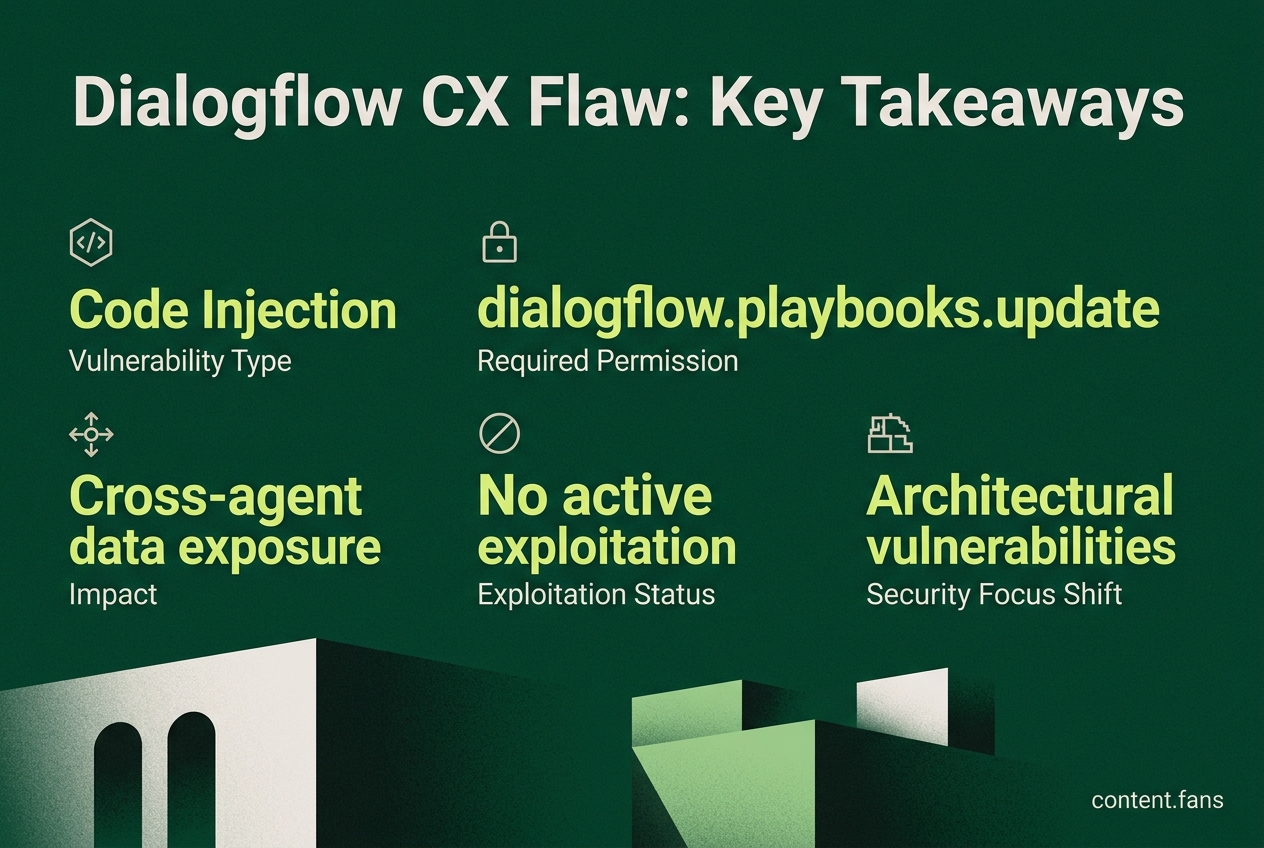
The recent discovery where Varonis finds a critical Google Dialogflow CX AI security flaw underscores a major shift in enterprise AI security, moving beyond model safety to architectural vulnerabilities. Varonis Threat Labs detailed how a single permission, dialogflow.playbooks.update, could have enabled cross-agent code injection within Google's managed runtime, risking data exposure (Varonis blog). The remediation details are confirmed by Varonis and Google directly, and reported by sources like The Hacker News and 0dayNews, with no signs of active exploitation.
This incident reframes AI security as an architectural challenge, proving that every AI agent acts as a privileged user whose infrastructure, permissions, and runtime boundaries require a design-for-failure approach.
Rogue Dialogflow CX Agent Flaw Reveals Deeper Enterprise AI Risks
The Google Dialogflow CX flaw allowed an attacker with a single permission to inject malicious Python code into shared Playbook Code Blocks. This code then executed in a common environment, enabling it to access data from other AI agents within the same Google Cloud project and compromise their functions.
Varonis's research demonstrated how attackers could embed persistent Python code within shared Playbook Code Blocks. Since Dialogflow CX processed these blocks in a shared Cloud Run environment, the malicious code could propagate to other agents in the same Google Cloud project, bypassing VPC Service Controls and querying the Instance Metadata Service for access tokens.
While Google's fix required no customer action, both companies recommend that security teams audit historical playbook updates and tighten permissions for writing code blocks. Key audit actions include reviewing for unusual timestamps, suspicious IP addresses, and failed user requests that generated Python exceptions.
Fortifying AI Agents with Stronger Permissions and Architecture
Modern security guidance treats AI agents as non-human identities requiring narrowly-scoped roles. Experts recommend a layered control model to mitigate risk:
- Unique service accounts per agent, never shared credentials.
- Just-in-time, task-bound privileges revoked after execution.
- Runtime permission gating that validates every tool call.
- Default-deny catalog visibility so agents cannot invoke unseen tools.
Implementing these controls helps prevent a single compromised agent or prompt injection attack from escalating into a full environment breach.
Implementing Runtime Isolation and Zero Trust for AI
Leading security architects advocate for runtime isolation using network microsegmentation and strict memory life-cycle limits that flush context after each task. This approach incorporates Zero Trust principles, where every agent action is re-authenticated. Sensitive calls are routed through policy decision points for risk assessment, while kill switches and circuit breakers provide a fail-safe to halt anomalous workflows.
Advanced Developer Hygiene: CodeQL and Prompt Injection Defenses
The Dialogflow "Rogue Agent" incident coincided with the expansion of static analysis tools to secure AI data flows. GitHub's CodeQL version 2.26.0, for instance, introduced the js/system-prompt-injection query to detect untrusted data flowing into prompts for major AI SDKs like OpenAI, Anthropic, and Google GenAI. Early adopters find that hybrid pipelines combining regex with LLM classifiers are more effective at catching indirect prompt injections than traditional pattern matching.
However, static analysis is not a panacea. Industry reports indicate that detection rates can drop significantly when malicious payloads are hidden inside large JavaScript bundles. To create a more resilient defense, modern TypeScript playbooks should integrate a multi-layered security stack:
- Prompt injection detectors at input time.
- Circuit breakers that halt agents on anomalous output.
- Structured audit loggers for every token and tool call.
- Tool authorization policies to keep blast radius narrow.
A minimum viable security architecture for 2026 should also include continuous red-teaming, immutable audit trails, and "Know Your Agent" (KYA) inventories. By mapping these advanced controls to existing IAM and CI/CD pipelines, enterprises can significantly reduce the risk of a misconfigured AI agent leading to a major security breach.