
Anthropic Explores Custom AI Chip With Samsung For Cost, Performance
Serge Bulaev
Anthropic is in early talks with Samsung about making a special AI chip, but there is no agreement or design yet, and any new chip may take at least 18-24 months to arrive if they decide to move forward. Custom chips may help companies save costs, boost performance, and reduce reliance on a single supplier. Most businesses cannot afford to create their own chips, so they should look at what their technology partners offer. Experts warn that building and using custom hardware can be risky and take a long time. These early talks suggest that AI firms may see having control over hardware as important for the future, even if results take years to appear.

Leading AI research lab Anthropic is exploring a custom AI chip with Samsung to optimize performance and costs, a move signaling a broader industry trend. As AI models grow, labs face significant constraints in power, bandwidth, and GPU supply, pushing them to seek greater control over their hardware stack. This shift toward vertical integration of chips and data centers could reshape supplier dynamics and presents new considerations for enterprise AI buyers.
The Strategic Push for Custom AI Silicon
Anthropic is pursuing custom silicon to gain greater control over AI model performance, reduce operational costs, and diversify its supply chain. By co-designing hardware and software, the lab aims to unlock efficiency gains and reduce its reliance on a limited number of commodity chip suppliers like Nvidia.
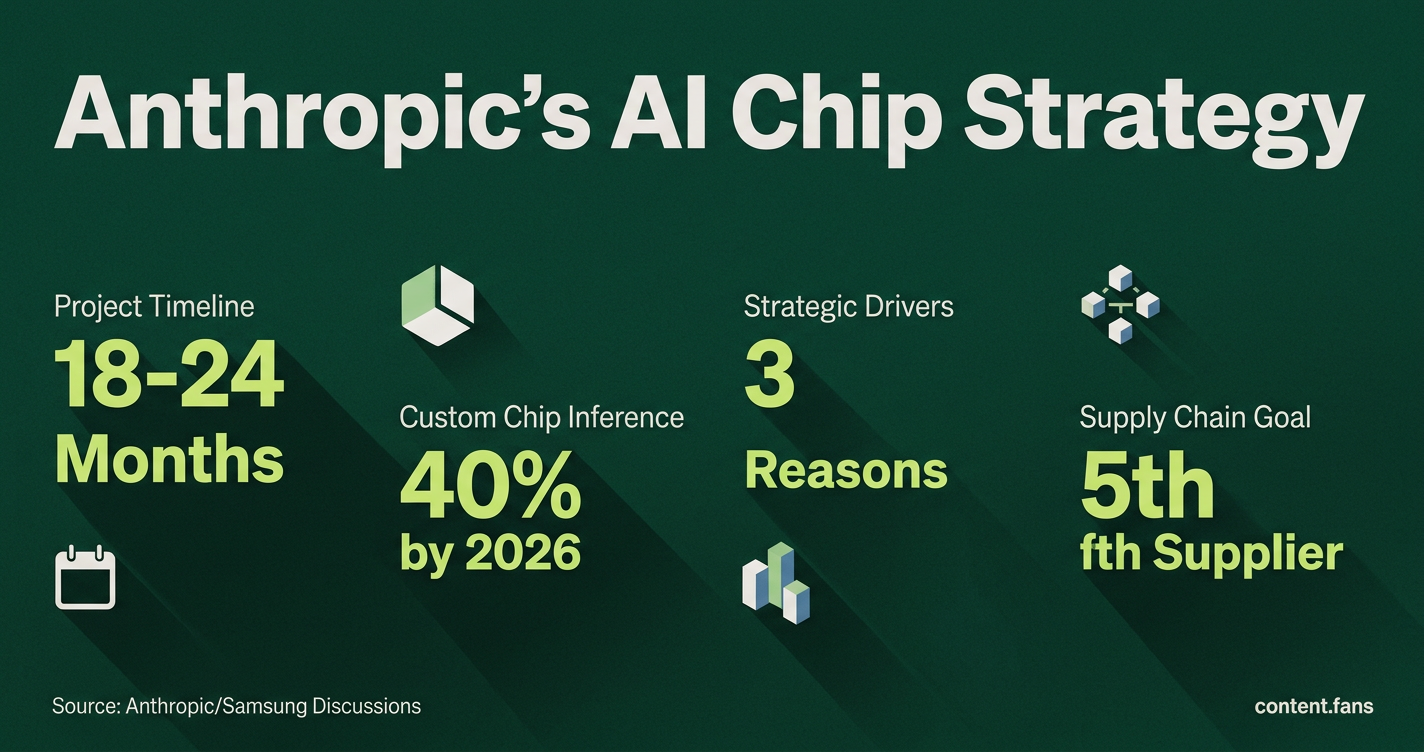
According to industry reports, Anthropic is in discussions with Samsung for a custom AI accelerator. However, sources clarify that no contract or design work has started, with any potential chip at least 18-24 months away from delivery.
The strategic drivers for this vertical integration are threefold:
1. Cost Optimization: Specialized ASICs can significantly lower the cost-per-token compared to general-purpose GPUs.
2. Performance Control: Co-designing models and hardware unlocks unique energy and performance efficiencies unattainable with commodity parts.
3. Supply Chain Diversification: A partnership with Samsung would add a fifth parallel silicon supplier to reduce single-supplier risk, but Anthropic explicitly stated it will continue working with Nvidia, not reduce dependency on it.
The Enterprise Playbook for AI Infrastructure
Since most enterprises cannot justify the massive investment for bespoke chips, they must adopt a different strategy. Custom silicon captures nearly 40% of inference workloads in 2026. Custom chips are captive to their builders (AWS, Google, Microsoft, Meta) and not available to rent, creating a scale barrier for enterprises.
Enterprise leaders should therefore focus on a partner-centric approach with a clear operational lens:
- Identify Cost-Sensitive Workloads: Pinpoint applications where cost-per-token is a primary bottleneck.
- Query Partner Roadmaps: Ask cloud and infrastructure partners about their plans for specialized inference hardware.
- Negotiate for Efficiency Gains: Structure service-level objectives (SLOs) to share in the cost savings from more efficient chips.
- Build Internal Expertise: Use every partnership as an opportunity to upskill internal teams and increase operational autonomy.
While on-premises solutions can meet strict latency or data residency requirements, they come with significant engineering risks and long lead times, especially when integrating specialized hardware.
Broader Competitive and Market Implications
Deeper control of the hardware stack is already influencing investment patterns and valuations. According to industry reports, Anthropic's recent funding round included strategic investments from Samsung, SK Hynix, and Micron, signaling that chip makers are vying for preferential access to leading AI labs.
Combined hyperscaler capex reaches $660-690 billion in 2026, with the four US hyperscalers committing $630-690 billion in 2026 CapEx. This spending is aimed at orchestrating multiple AI models across integrated systems, suggesting future competitive advantage will come not from a single "best model" but from the masterful orchestration of specialized chips, interconnects, and software.
The Anthropic-Samsung dialogue serves as a crucial early indicator for enterprise leaders. Although still exploratory, it confirms that top AI labs see hardware control as a long-term strategic imperative. Consequently, businesses must evaluate AI providers based on their access to and integration of proprietary silicon, advanced networks, and efficient data center operations.
What is the current status of Anthropic's custom chip discussions with Samsung?
As of mid-2026, Samsung and SK Hynix have invested in Anthropic and are strategic infrastructure partners; Micron has granted Anthropic a supply deal. The discussions center on potentially producing a custom AI chip using Samsung's advanced process technology, but no contract, design work, or manufacturing has begun. Anthropic has publicly stated only that its diversified hardware strategy remains pivotal to its operations, declining to confirm specifics about the Samsung conversations.
Why would Anthropic want a custom chip when it already uses TPUs, Trainium, and Nvidia GPUs?
The talks illustrate a broader strategic imperative: custom silicon can optimize model performance, cost, and energy efficiency when designed specifically for an AI lab's workload patterns. If realized, the Samsung chip would serve as Anthropic's fifth parallel silicon supplier, not a replacement for existing partnerships. This reflects a calculated diversification strategy to spread supply chain risk while gaining architectural advantages for Claude's specific demands.
How long would it take to bring a custom Anthropic-Samsung chip to production?
Industry timelines suggest 18-24 months for first samples and approximately 36 months to reach production capacity - assuming the exploratory talks advance to committed development. This extended horizon underscores why Anthropic recently hired a former OpenAI custom chip engineer to lead in-house silicon efforts. The lengthy design cycle also explains why Anthropic maintains its multi-vendor strategy, as custom chips require significant capital and long lead times.
What does this mean for enterprise AI leaders making build-versus-partner decisions?
The emerging consensus favors a "partner-and-grow" model over internal silicon development. Custom ASICs require millions of units to spread non-recurring engineering costs - a threshold virtually no enterprise can meet. Instead, leaders should:
- Avoid building proprietary silicon, as the scale economics overwhelmingly favor hyperscalers.
- Select partners optimized for inference workloads, where custom ASICs deliver superior efficiency.
- Prioritize vendors with vertical integration, as platforms powered by specialized chips offer superior cost-per-token economics.
The strategic calculus has shifted from "build vs. buy" to identifying partners who can transfer knowledge rather than just deliverables, making internal teams more capable over time.
Could regulatory or geopolitical factors affect this partnership?
Supply chain resilience and manufacturing geography increasingly influence AI infrastructure decisions. Samsung's advanced manufacturing capabilities represent a strategic alternative to TSMC-dominated production. Anthropic's recent funding round notably included Samsung, SK Hynix, and Micron as strategic partners, suggesting deliberate supply-chain diversification. For enterprises, this signals that the geographic distribution of silicon manufacturing may become as strategically important as cloud region selection.