
Irys Unveils Trust-First Legal AI After Public Live Demo
Serge Bulaev
Irys showed its new legal AI tool in a live demo, letting lawyers see how it works and why trust and transparency are important. The system may help lawyers by showing its sources and reasoning, making it easier to check its work. Early users report the tool saves time and increases efficiency, but not all lawyers fully trust AI yet. New rules in the EU soon may require AI tools to be more open about how they work. Irys's demo suggests the company is focusing on building trust to encourage more lawyers to use their AI.

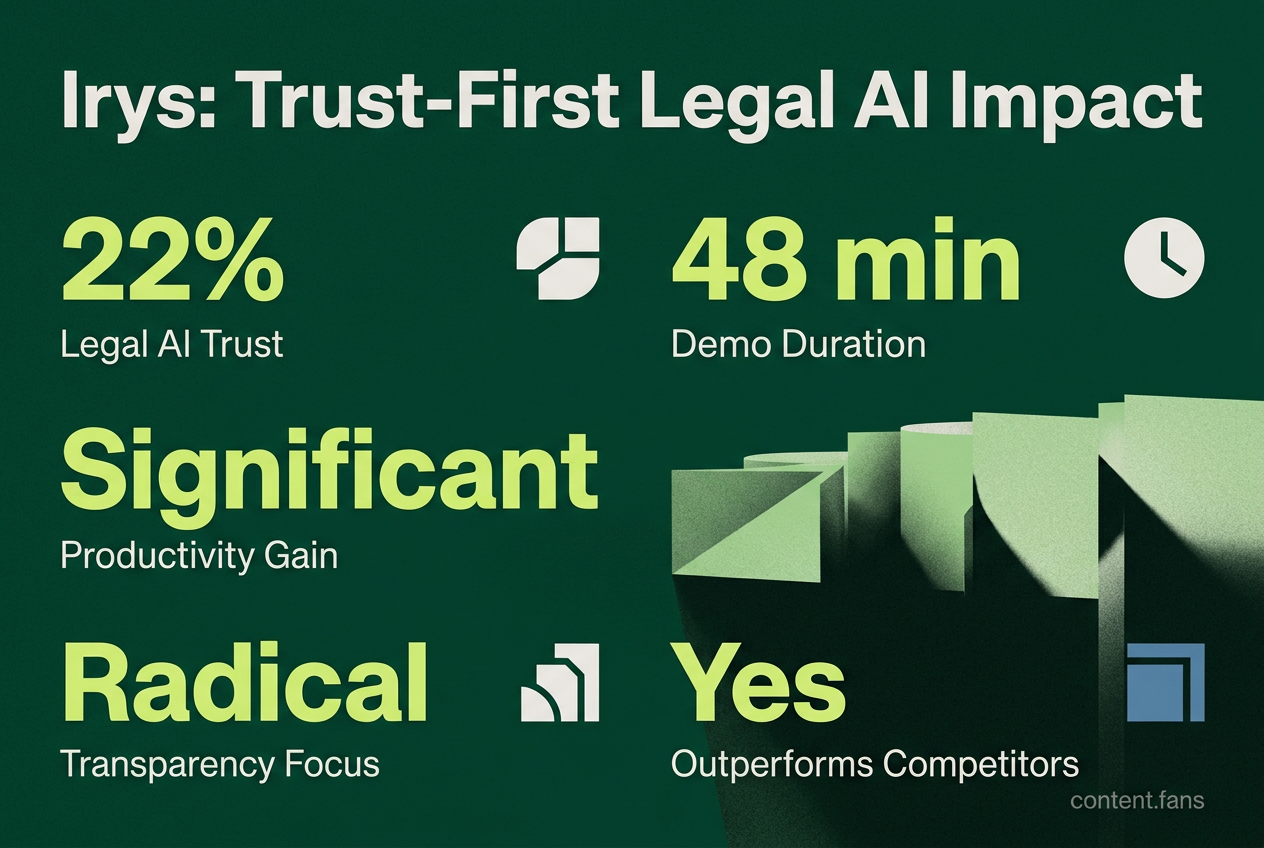
In a recent public live demo, Irys unveiled its trust-first legal AI, giving lawyers a rare look inside its powerful research and drafting system. During the 48-minute walkthrough, co-founder Sabih Siddiqi emphasized transparency over raw accuracy as the key to adoption by skeptical legal professionals. The demo highlights how legal-specific AI is transforming the industry by directly addressing the profession's critical "trust problem" in automated systems.
Irys Prioritizes Verifiability Over Raw Accuracy
Irys is a legal AI platform designed to build trust through radical transparency. It enables lawyers to verify every AI-generated claim by showing its reasoning and linking directly to primary source documents, countering the "black box" problem that forces attorneys to re-check all work and lose productivity.
Siddiqi framed AI adoption as a matter of verification cost. When lawyers cannot trust an AI's output, they must re-check every citation, which eliminates any productivity gains. Irys solves this by exposing its complete reasoning trace, linking each generated statement to its source. The platform also suggests targeted redlines within a document instead of generating new text from scratch. The full 48-minute session is available on YouTube in the official Irys demo.
Key features shown during the stream:
- Matter-level knowledge graph that ties filings, exhibits, and deadlines together
- Drafting assistant that proposes redlines with inline source verification
- Personalization stack that honors firm style guides without re-training on client data
- Citation engine that uses a mix of publicly accessible primary sources, licensed integrations, and user-uploaded documents
Proven Gains: Early User Outcomes
Testimonials on the company's Irys One platform page show significant efficiency gains. According to industry reports, many legal professionals are experiencing substantial reductions in draft turnaround time and research hours, with some users reporting significant daily time savings on analysis tasks.
Furthermore, an independent technical review found that Irys outperformed established legal AI tools like Harvey and CoCounsel. The platform has received recognition for its competitive pricing structure and transparent approach, which has been noted as a key factor for reducing adoption risk among midsize firms.
Addressing the Legal AI Trust Gap and Regulatory Pressure
Industry surveys from 2024-2026 reveal a significant trust gap, with only 22% of in-house legal teams fully trusting AI outputs. This hesitation is linked to a lack of transparency, with industry reports indicating that a significant portion of major legal AI vendors do not fully disclose their underlying language models, and only a small number commit to notifying clients of model changes.
Regulatory pressure is also mounting. The EU AI Act, set to take effect in August 2026, mandates that users be informed when interacting with an AI and that generated content is labeled as such. In response, forward-thinking vendors are prioritizing features like reasoning traces, source linking, and robust data privacy.
Why a Transparent Demo Matters Now
While most product demos avoid technical details, Irys dedicated significant time to explaining its multi-layer verification stack. By showing lawyers how citations are checked in real time, the company shifted the conversation from abstract accuracy claims to concrete, verifiable evidence. This transparent approach signals a new strategy for winning over skeptical buyers in a market facing new transparency regulations.
What exactly did the 48-minute Irys demo show legal teams?
Co-founder/CEO Sabih Siddiqi and head of product Christian walked viewers through a live litigation matter, spotlighting four modules:
- Research pipeline - uses a mix of publicly accessible primary sources, licensed integrations, and user-uploaded documents with citation verification capabilities
- Drafting assistant - proposes targeted redlines instead of regenerating entire paragraphs
- Matter-level knowledge graph - auto-infers case posture, jurisdiction, and procedural stage from uploaded pleadings
- Personalization stack - learns individual writing style and client-specific language
Throughout, the UI displayed a reasoning trace so lawyers could see why the model suggested each change.
Why does Irys frame adoption as a "trust problem," not an accuracy problem?
Only 22% of legal teams fully trust their current AI outputs, even when the answers are statistically "correct." Opaque systems force lawyers to re-verify every citation, erasing productivity gains and creating malpractice risk. Irys attacks the trust gap with:
- Attribution: every proposition links to an underlying source
- Minimal surface area: redline-level edits keep the lawyer in control
- No training on user data - attorney-client privilege is preserved by design
Because trust is conditional, Irys grounds its answers in the firm's own documents, not generic web data.
How fast are firms seeing real productivity gains?
According to industry reports, early adopters are experiencing:
- Significant reductions in research-and-draft turnaround
- Substantial time savings per partner on case-prep tasks
- Notable improvements in complaint-response time for high-volume litigation
Across the market, many AI-using lawyers report saving a significant portion of their workweek, equivalent to substantial billable hours per year.
How does Irys pricing compare with incumbent legal AI?
Industry reports indicate that Irys offers competitive pricing compared to heavy-use wrappers or competing platforms such as Harvey, which often run significantly higher monthly costs once overage fees are counted. Irys includes unlimited research across its comprehensive case corpus at a flat rate.
Where can I watch the demo or start a trial?
The full 48-minute session is available on the Irys demo page and a free trial (no credit card) lets firms upload their own matters to test the trust stack.