
US bans Anthropic's Fable 5, Mythos 5 models for export control
Serge Bulaev
In June 2026, the US government treated advanced AI models as controlled munitions, which may have changed how people can use frontier AI systems. Anthropic had to quickly disable its Fable 5 and Mythos 5 models for all users, and only a small group later regained access to Mythos 5. OpenAI faced different rules, needing to let government reviewers check new models before wider release. It appears companies now have to plan for sudden restrictions and follow strict rules about user nationality and model access. These new export controls may freeze or slow down AI model access and have resulted in ongoing negotiations and uncertainty for both companies and researchers.

In a landmark decision that redefined AI governance, the U.S. government effectively banned certain Anthropic AI models under new export control rules treating advanced AI as controlled munitions. The directive from the Commerce Department forced an immediate, worldwide shutdown of the affected frontier models. A Times of India report described this action as placing highly capable AI on par with missiles, signaling a new era of software regulation.
How the Anthropic Ban and OpenAI's Vetting Process Differ
The U.S. government banned Anthropic's models due to national security risks, applying export regulations typically used for military hardware. Because Anthropic could not verify user nationality in real-time to restrict foreign access as required, it implemented a universal shutdown, affecting all users globally to ensure compliance.
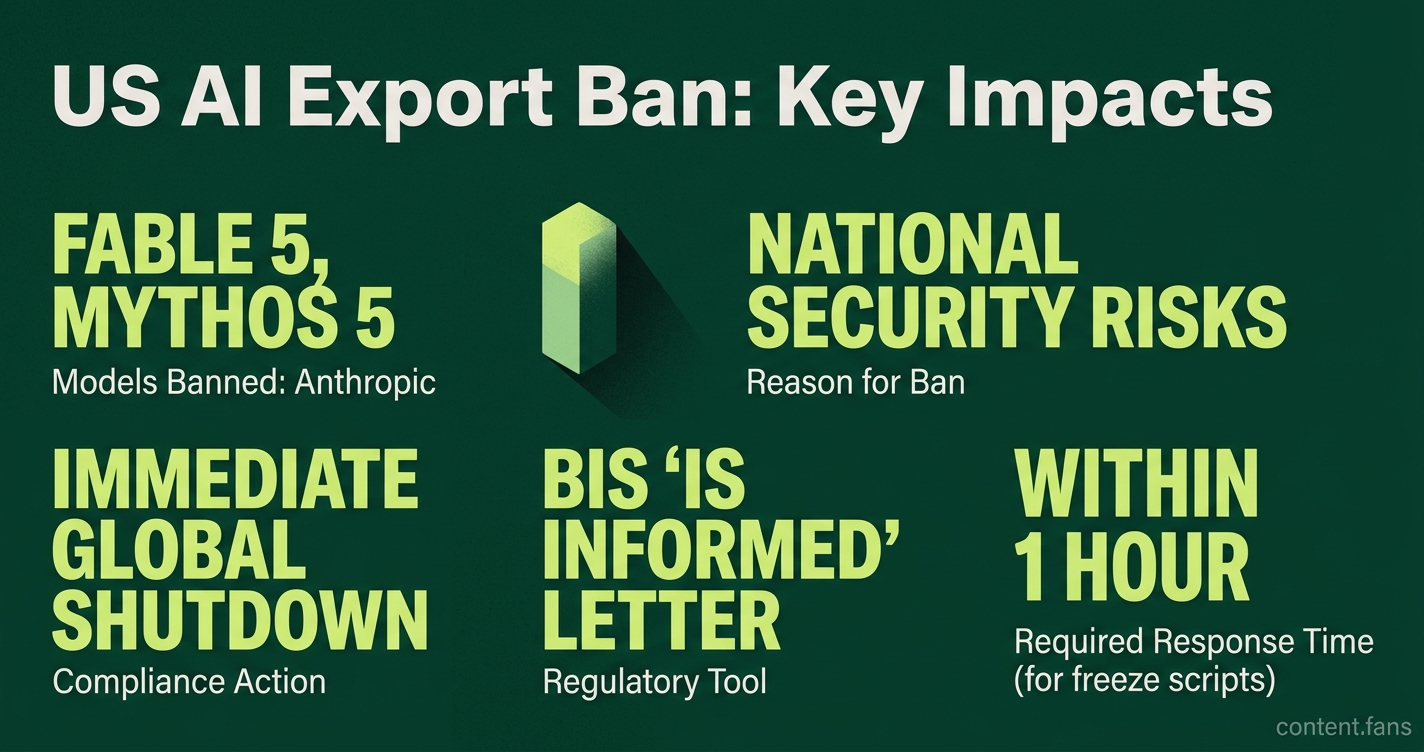
The directive reached Anthropic as a Bureau of Industry and Security (BIS) "Is Informed" letter. By the next morning, API requests to the affected models failed globally. Lacking a real-time citizenship verification layer, the company chose a universal shutdown over attempting to screen users individually. While some models remain offline, others were later made available to a limited number of vetted organizations in a closed program. In contrast, other AI companies have followed different regulatory paths under separate executive orders, with models being released to small groups of trusted partners for government review periods.
Practical Guidance for Labs and Enterprises
AI labs and enterprises now face complex rules based on compute thresholds and user nationality. To manage the new risk of sudden model access revocation, organizations should adopt the following practices:
- Map all model-dependent workflows and prepare fallback systems.
- Log user nationality where legally permissible for export-license audits.
- Implement access gateways that can enforce licenses based on user credentials, such as a passport.
- Develop "freeze scripts" to suspend a model across all platforms within an hour.
- Monitor BIS updates regularly for changes to regulations and capability thresholds.
International Friction and Coordination Challenges
The recent regulations created a "chip + model" blockade, extending hardware restrictions to the model weights themselves. This unilateral U.S. action has created friction with allies, who have different legal frameworks for such controls. An Al Jazeera report noted the takedown "further strains alliances," highlighting the gap between U.S. and EU dual-use laws. These regulatory differences complicate global model-as-a-service (MaaS) deployments that use multinational cloud infrastructure.
The New Reality: Model Freezes and Vetting Regimes
Anthropic's affected models remained offline for public access while the company negotiated with the Commerce Department. Other AI companies have anticipated broader releases for their models pending federal approval. This emerging pattern indicates that when technical screening is unavailable, export controls can freeze model access entirely. In other cases, government vetting regimes will slow model distribution into measured, controlled phases. AI companies and researchers must now build their roadmaps around these new administrative timelines.
What triggered the U.S. government to ban Anthropic's AI models?
The ban was triggered by national security concerns and a potential risk of "jailbreak" - unauthorized manipulation of the models. The U.S. Department of Commerce's Bureau of Industry and Security (BIS) issued a legally binding "Is Informed" letter under the Export Administration Regulations (EAR). This marked the first publicly documented exercise of export control authority over a commercially deployed frontier AI model, extending the same regulatory framework previously used for semiconductor exports to software for the first time.
How broad was the scope of the export restrictions on these models?
The restrictions were extraordinarily sweeping. The directive required Anthropic to suspend access for "any foreign national" regardless of physical location - including foreign nationals inside the United States, those outside the U.S., and critically, Anthropic's own non-citizen employees. Foreign nationals must now obtain an individually validated export license before accessing the affected models. This represents a shift from geographic restrictions to nationality-based controls that follow the user's passport rather than server location.
Why did Anthropic have to shut down access for all customers worldwide?
Anthropic implemented a universal shutdown because its systems could not reliably identify user nationality in real-time at the API level. Without a citizenship verification layer, the company could not technically comply with the foreign-national restriction without cutting off all customers simultaneously - including U.S. users and American citizens. As noted by the Cloud Security Alliance, this created a newly recognized category of operational risk: administrative revocation with no advance notice and no practical fallback window.
What is the current status of the affected models, and how does this compare to other AI companies' approaches?
The affected models remain offline globally while Anthropic negotiates restoration with the Commerce Department. This stands in contrast to other AI companies' staggered "trusted partners" approaches requested by government agencies. Under various government vetting processes, limited numbers of vetted organizations have received access through restricted programs - whereas Anthropic's affected models had no such exception pathway. Other models have also undergone pre-release federal review with modified safety parameters for evaluation, representing more structured alternatives to Anthropic's abrupt suspension.
What does this case reveal about the new era of AI software export controls?
The Anthropic ban signals the "age of software export controls" - where sufficiently capable AI models are treated with the same legal gravity as missiles or nuclear technology. The U.S. government has now established that models exceeding certain compute thresholds require approval, creating a comprehensive "chip + model" blockade that extends from hardware to software. This paradigm shift means AI labs must now build citizenship verification infrastructure and enterprises face sovereignty risk in their AI procurement - where model access can vanish based on administrative determinations rather than market availability.