
Unilever shares fall 7% after McCormick deal sparks investor doubt
Serge Bulaev
Unilever shares fell about 7% after the company said it might sell its Foods division to McCormick, and McCormick shares also dropped. Some investors worry the deal may not create lasting value and raises questions about the price and debt involved. Past break-ups in the food sector suggest the market only supports them if companies show clear benefits and careful planning. Many investors appear to want more details before supporting the deal. The success of this deal may depend on future growth, how much debt the companies take on, and how the separated companies perform after the split.

A reported proposal involving Unilever's Foods division and McCormick has unsettled investors, causing Unilever shares to fall and prompting intense scrutiny of the deal's strategic logic. Following the announcement, McCormick's shares also declined, highlighting widespread market unease about the transaction's valuation and the debt required to finance it FoodNavigator-USA summary.
The negative reaction fuels a broader debate on whether large-scale corporate break-ups in the food sector create durable shareholder value. This skepticism was crystallized when veteran fund manager Terry Smith sold his Unilever stake, arguing the company had "abandoned its promised operational focus" for activist-driven deals. Evidence from recent food industry spin-offs suggests the market now demands clear operational benefits and disciplined financial planning before supporting such restructurings.
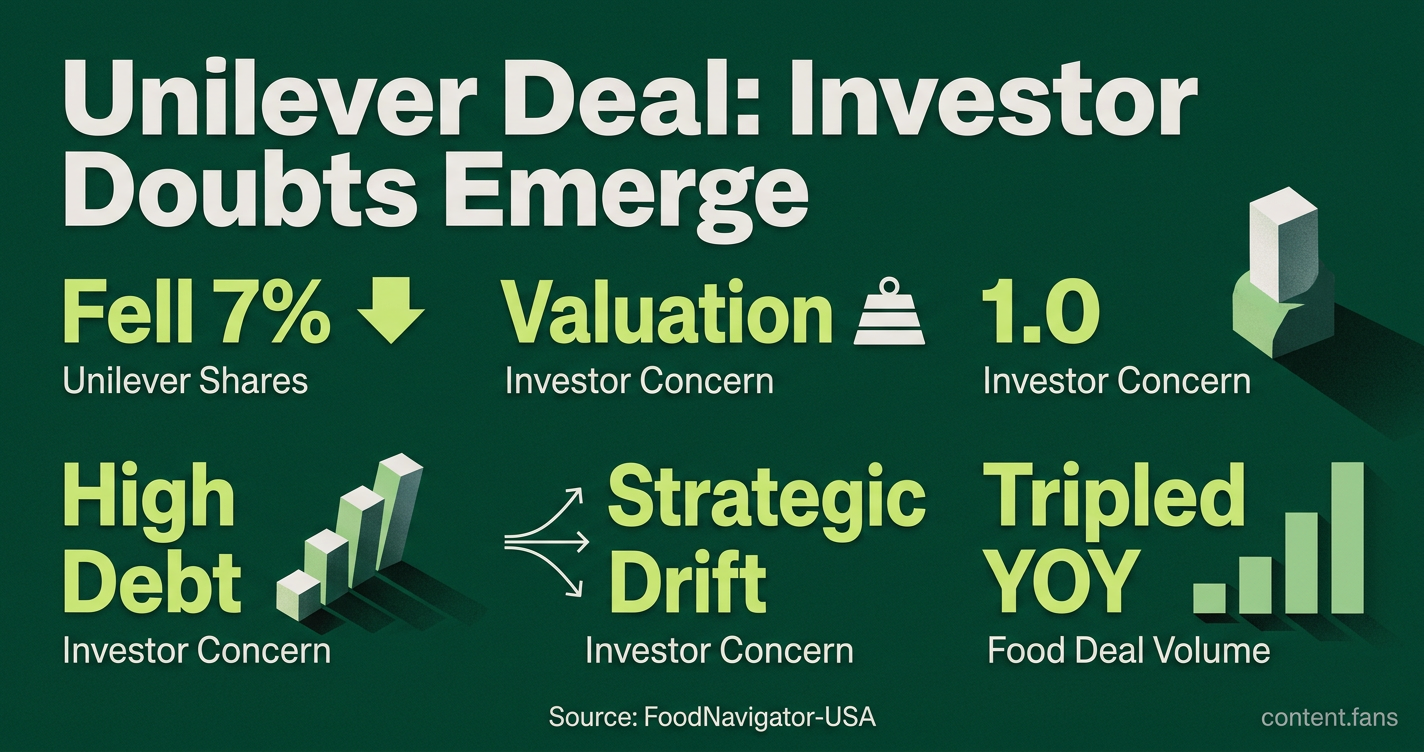
Key Investor Concerns Driving the Sell-Off
Investors reacted negatively to the proposed McCormick deal due to concerns over its strategic rationale, valuation, and high debt load. Skepticism centers on whether the deal creates real value or is a risky, activist-driven move that overpays for the assets and burdens the new entity with excessive leverage.
Market skepticism is concentrated in three main areas:
- Strategic Coherence: Critics question whether Unilever is drifting from its stated focus on high-growth personal care and home products.
- Valuation Fairness: Industry reports suggest concerns that the proposed valuation may lack a sufficient control premium for the Foods portfolio.
- Execution Risk: The combined entity would carry significant leverage, raising doubts about McCormick's capacity to integrate a business nearly double its own size.
How Past Food Sector Splits are Shaping Sentiment
Recent corporate separations provide cautionary tales for investors:
- Kellogg: After its 2023 split into WK Kellogg and Kellanova, share prices initially rose but later stabilized as the market assessed their stand-alone cost structures, proving a rerating is not guaranteed.
- Kraft Heinz: The company has outlined plans to separate into two public companies to "unlock long-term shareholder value." However, analysts immediately noted the need for precise disclosure on stranded overhead costs and future capital allocation.
- Middleby: A proposal to spin off its high-margin food-processing equipment arm highlights the potential for a valuation uplift, but only if the market rewards a pure-play focus.
What Moves the Needle for Investors in Food M&A
While branded food deal volume has tripled year-on-year, buyers are highly selective, according to research from Capstone Partners. Advisory firm BMO Capital Markets notes that a significant portion of transactions involve strategic acquirers reshaping portfolios, not just chasing scale. This suggests investors reward deals that:
- Reduce complexity without sacrificing diversification benefits.
- Preserve the pricing power and cash-generating ability of the core business.
- Maintain clear environmental, social, and governance (ESG) standards in the newly formed entity.
Unilever has claimed the deal "creates two stronger businesses, both positioned to win," but many shareholders are withholding support pending detailed financing terms and a clear ESG roadmap.
Outlook: Key Metrics That Will Determine Success
To gauge whether this break-up adds long-term shareholder value, analysts will closely track three key indicators:
- Post-deal organic revenue growth for both companies.
- Leverage trends relative to management guidance.
- Any rerating of the separated shares 6 to 12 months after the deal closes.
How Unilever and McCormick perform against these metrics will likely shape investor appetite for future large-scale restructurings across the entire packaged food industry.
Why did Unilever shares drop after the McCormick deal was announced?
Markets voted with their feet. Unilever closed at $55.45 on 2 April, down from $59.98 only three days earlier, and McCormick fell in tandem. Investors gave four main reasons:
- Strategic drift: Fund manager Terry Smith sold his entire stake, saying the company "abandoned its promised operational focus in favour of activist-driven break-ups."
- Activist overhang: The transaction was linked to Nelson Peltz, creating fear that short-term investor pressure, not industrial logic, is steering the board.
- Valuation gap: Industry reports suggest concerns about the proposed valuation, encouraging shareholders to question whether the price tag includes sufficient premium.
- Debt shock: The combined entity will carry significant leverage, and McCormick must integrate a business twice its size while finding substantial yearly cost synergies.
How does this reaction compare with earlier food industry splits?
Recent separations show a clear pattern: the market no longer hands out an automatic "conglomerate discount" cure. Kraft Heinz, AB Foods/Primark and Middleby all promised to "unlock shareholder value," yet investors now ask for proof before they bid prices up.
In recent food M&A, strategic buyers account for a significant portion of deals and they target:
- better-for-you or high-protein brands (representing a growing number of branded takeovers)
- functional beverages and fresh snack niches
- assets that come with pricing power and clear manufacturing synergies
The takeaway: a focused story helps, but only if margins and growth can beat the standalone costs.
What concrete concerns do shareholders still have about the Unilever-McCormick structure?
- Integration risk: McCormick has never digested an asset this large; disruption could stall Unilever's own momentum.
- ESG dilution: Some funds want written guarantees that the new group keeps Unilever-level sustainability standards.
- Cash-flow strain: The substantial financial commitment leaves McCormick little room to invest in growth while de-leveraging.
- Lost diversification: Unilever becomes more beauty/home-care heavy, exposing income to different cyclical swings.
Are there examples where food spin-offs did create long-term value?
Yes, but they share three traits that sceptics say the Unilever deal lacks:
- Clean operational profiles: Middleby's food-processing spin-off will separate a high-margin industrial unit from a tech-driven kitchen-equipment core.
- Investor-fit narratives: AB Foods will list Primark separately so fashion retail cash flows no longer mask grocery volatility.
- Balance-sheet headroom: Kraft Heinz's planned split is designed so each new company can carry its own debt and target M&A in its lane.
Without similar clarity, the market's first instinct is to sell first and ask later.
What would reassure investors from here?
- A detailed 24-month integration roadmap with quarterly cost-synergy milestones.
- A pledge to keep net-debt/EBITDA at manageable levels within three years, backed by disposals if necessary.
- ESG covenants baked into the merger agreement, not just side letters.
- Evidence that the deal improves organic sales growth for both sides, not just scale for scale's sake.
Until those answers land, Unilever's share decline may remain the market's baseline vote.