
Tungsten Automation outlines 3-layer stack for Enterprise AI Agents
Serge Bulaev
Tungsten Automation suggests that building enterprise AI agents is moving from single large agents to organized groups of smaller, specialized agents. Most current systems use a three-layer stack with a controller that delegates tasks to these specialists. It appears that separating prompts, rules, and logic, along with using typed JSON interfaces, may help with debugging and lower errors. Since regulations are still catching up, companies often follow their own standards and use strong safety controls like audit trails and automatic testing before releases. The typical approach seems to be starting with a simple prototype, adding more features in stages, and using templates to check security and performance as the system grows.

As enterprises race to build AI agents for complex workflows, the architectural blueprint is solidifying. A 3-layer stack for Enterprise AI Agents, highlighted by Tungsten Automation, is becoming the industry standard, moving development from monolithic super-agents to orchestrated ensembles of specialists. This framework addresses the core challenge of bounded autonomy - giving agents enough independence to be useful while keeping them constrained enough to be safe. For teams implementing this model, Tungsten Automation provides detailed guidance on enterprise AI agent design patterns.
What makes the three-layer architecture essential for enterprise AI agents?
The three-layer stack is essential because it separates an agent's high-level task (Workflow), its tools and reasoning logic (Capability), and its safety controls (Production). This separation enables bounded autonomy, ensuring agents are both useful and accountable while making complex, multi-agent systems easier to debug and govern.
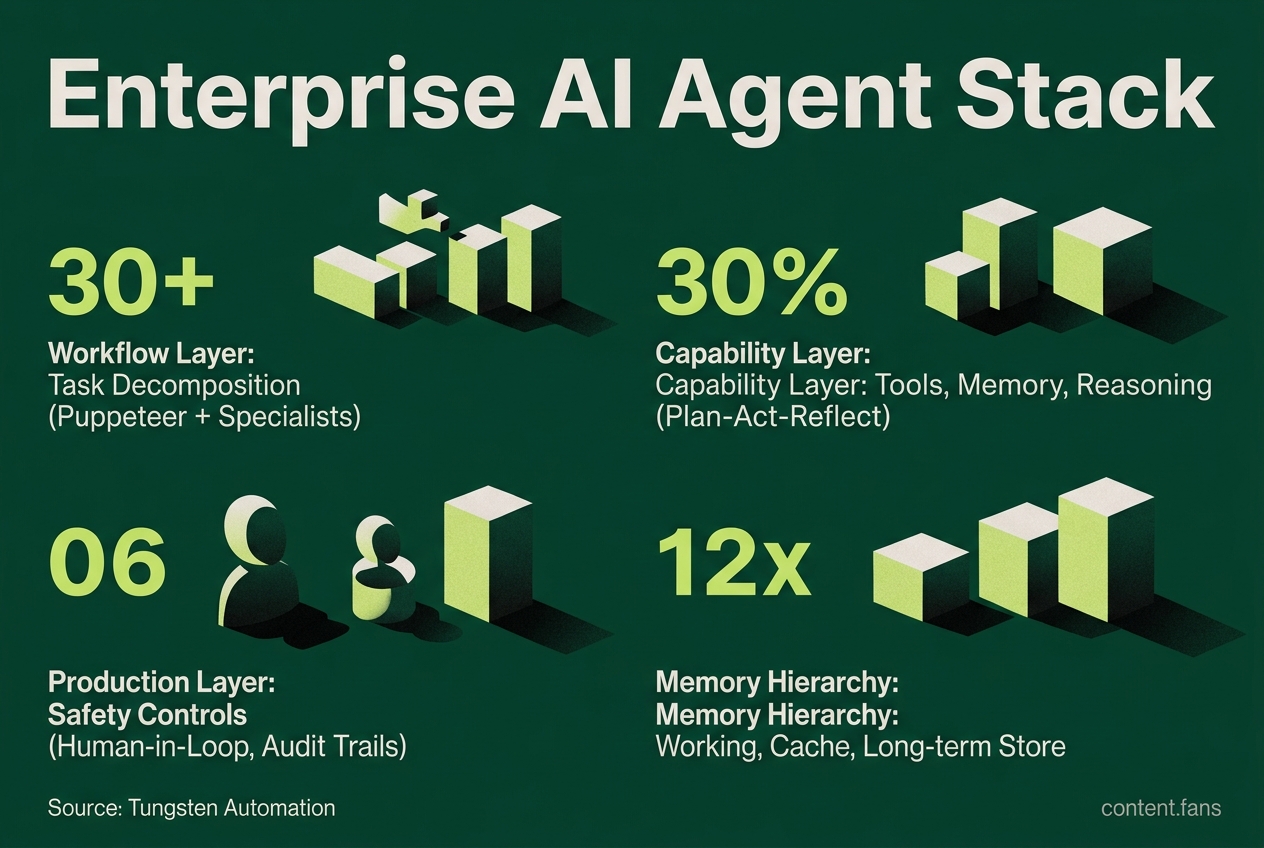
This architecture organizes the system into clear strata. The Workflow layer handles task decomposition using the "Puppeteer + Specialists" model, where a controller breaks objectives into subtasks for specialized workers. The Capability layer provides the tools, memory, and reasoning patterns, like Plan-Act-Reflect loops, to verify outputs. Finally, the Production layer enforces Human-in-the-Loop checkpoints, circuit breakers, and immutable audit trails required for compliance and safety. Without this separation, agents become unmanageable "black boxes" when failures occur.
How does the "Puppeteer + Specialists" pattern improve agent reliability?
This pattern improves reliability by treating AI agents as a coordinated team rather than a single, all-powerful model. The Puppeteer, or orchestrator, handles high-level planning and synthesis, while Specialist agents focus on narrow domains like research, coding, or data retrieval. This approach makes failure points more visible and isolated, reducing error rates in multi-step workflows.
It also supports an "earned complexity" model: teams can start with a single agent and tools, adding specialist agents only when measurable quality improvements justify the added coordination overhead. This helps avoid the "over-agenting" trap, where complex architectures introduce latency and new failure modes without providing commensurate benefits.
How should teams approach memory and data architecture?
The recommended approach uses a three-tier memory hierarchy: Working Memory for immediate context, a Cache for retrieved information, and a Long-term Store for persistent knowledge. Best practices strongly emphasize using typed JSON interfaces for communication between agents rather than free-text "chattiness." This structured approach reduces the risk of hallucinations and makes data pipelines more predictable.
For writing data, enterprises should implement queue-and-approve patterns, where agents propose changes that humans or rule systems must approve before execution. Starting with read-only access and graduating to supervised write-access is a key strategy to limit risk during early deployments.
What governance and safety mechanisms are essential?
Because technology is outpacing regulation, enterprises must lean on voluntary standards and robust internal controls. A comprehensive safety framework includes a zero-trust stance that treats every agent as a distinct identity with just-in-time, scoped permissions. Key safeguards include immutable audit trails for compliance, continuous automated red-teaming to find vulnerabilities before each release, and circuit breakers that halt cascading failures when agents malfunction or disagree.
Furthermore, runtime permission gating evaluates access decisions at the moment of action based on real-time context, rather than relying on static permissions. Every agent must have a distinct, verifiable identity with permissions that auto-revoke upon task completion.
What is a practical roadmap for deploying enterprise agents?
The consensus in the field points to a staged rollout that avoids premature complexity and builds capabilities incrementally:
- Ship a prototype: Start with a simple prompt-chained prototype for a single, well-defined workflow.
- Add dynamic routing: Introduce dynamic routing and a tool registry as workflow inputs begin to diversify.
- Incorporate memory: Persist short-term memory in a cache and add Retrieval Augmented Generation (RAG) only after measuring tangible quality gains.
- Expand to multi-agent orchestration: Scale to a multi-agent system only when specialization demonstrably improves accuracy and efficiency.
By following this structured roadmap and referencing resources like the Agentic Design Patterns 2026 guide, enterprise teams can navigate the complexities of agentic AI and build robust, production-ready systems.