
Trump's EO 14409 Creates AI Cybersecurity Clearinghouse, Frontier Model Access
Serge Bulaev
President Trump signed Executive Order 14409, which may help address AI cybersecurity risks by setting up a voluntary framework for AI developers and telling agencies to improve their cyber defenses with AI. The order creates an "AI Cybersecurity Clearinghouse" to help share and fix AI vulnerabilities, and suggests that certain high-risk AI models, called "covered frontier models," could be reviewed by the government before release. The order appears to encourage, but does not require, companies to give the government early access to these models. Industry responses suggest the framework might become important for doing business with the government, and the voluntary label could become an international standard for powerful AI systems.

On June 2, 2026, President Donald J. Trump signed Executive Order 14409, establishing a new federal framework to address AI cybersecurity risks. The order directs federal agencies to enhance their cyber defenses using AI and introduces a voluntary structure for AI developers, centered on a new clearinghouse for AI vulnerabilities and a pre-release access program for high-risk "covered frontier models."
Immediate Agency Deadlines
The order sets an aggressive timeline. According to industry reports, the Department of the Treasury, in collaboration with the NSA and CISA, must establish an "AI Cybersecurity Clearinghouse." According to the official text of Executive Order 14409, this body will coordinate vulnerability scanning and patch distribution. Concurrently, key national security agencies are directed to prioritize their own network cyber defenses, while CISA must issue binding operational directives to accelerate the deployment of AI-enabled defensive tools across civilian federal agencies.
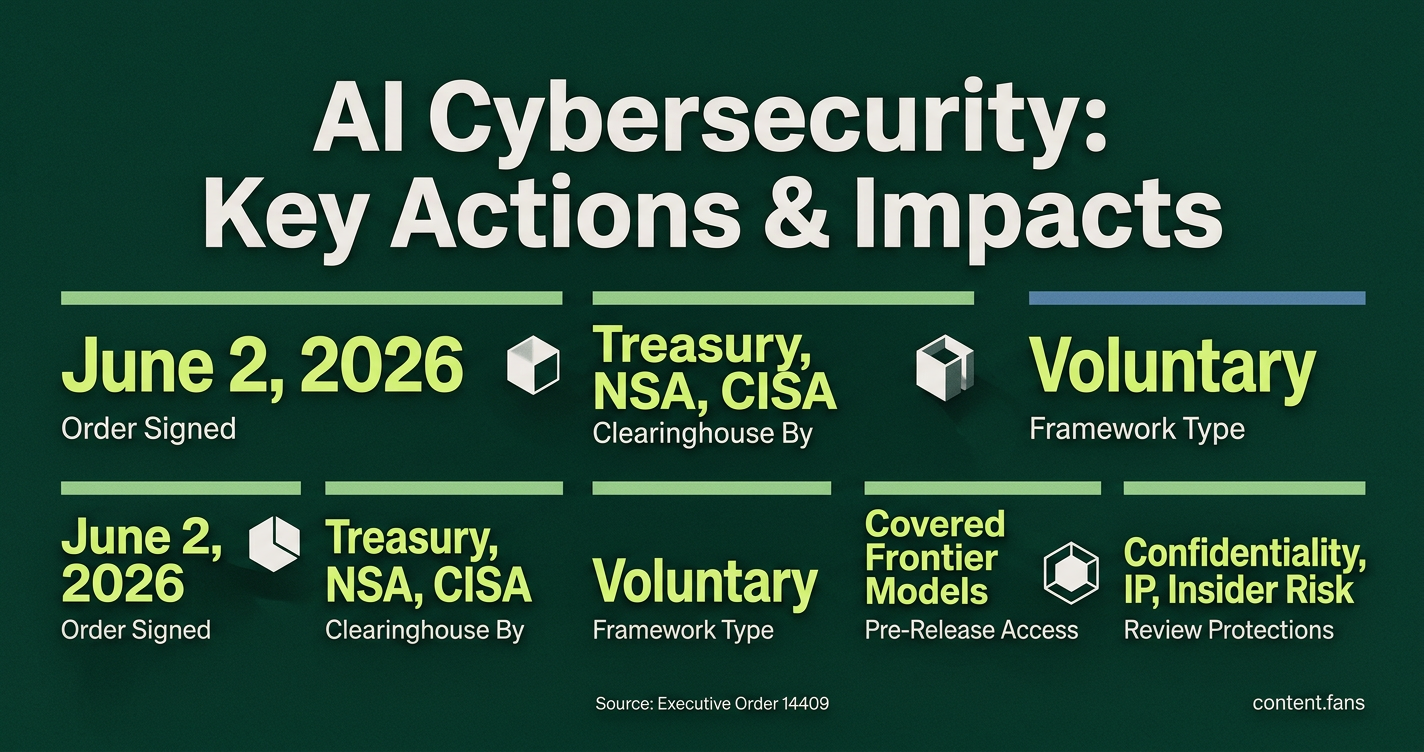
Executive Order 14409 establishes a voluntary framework for AI security. It creates an AI Cybersecurity Clearinghouse for vulnerability sharing and invites developers of high-risk "frontier models" to provide the government with pre-release access for review, aiming to bolster national cyber defenses against AI-driven threats.
Tasks and the Frontier Model Benchmark
According to industry reports, key agencies including Treasury, NSA, and CISA must develop a classified benchmarking process to identify AI systems with "advanced cyber capabilities." Once the NSA Director applies this benchmark, an AI can be designated a "covered frontier model." The order invites developers of these models to grant the government significant pre-release access for security review, a step that legal analysis from Skadden confirms does not institute a mandatory licensing requirement link.
What Pre-Release Access Entails
Government access to pre-release models will occur under strict confidentiality, intellectual property, and insider risk protections. Following this federal review period, developers are permitted to share the same model with "trusted partners," a category that includes critical infrastructure operators. According to analysts at Lazard, this government review window precedes any wider public or commercial release, fundamentally altering traditional product development timelines link.
Early Industry Responses
The policy's voluntary nature has drawn significant industry analysis:
- Industry observers note that while the framework is voluntary now, it will likely shape federal procurement standards in the coming years.
- Market analysts suggest that market pressures may make participation an informal prerequisite for vendors aiming to secure government-related contracts.
- Security experts advise companies to begin mapping their AI assets and developing incident response plans specifically for AI-generated threats.
Criminal Enforcement Priority
The executive order addresses enforcement priorities regarding AI misuse. Legal experts note that the offensive use of frontier models could create significant liability for both individual users and the organizations deploying them.
Clearinghouse Functions
The new AI Cybersecurity Clearinghouse is tasked with several core functions. It will coordinate and deconflict vulnerability scanning activities, validate discovered security flaws, rank threats by remediation urgency, and distribute patches to participating stakeholders. While the Treasury Department must open the clearinghouse to private sector and critical infrastructure entities, the order explicitly states that participation remains optional.
Global Ripple Effects
Analysts from Skadden and Lazard highlight that the "trusted partner" channel could extend to both allied governments and essential entities like rural hospitals. Consequently, international enterprises are already conducting gap analyses to determine if their AI products might meet the classified U.S. benchmark. This trend suggests the voluntary American framework could evolve into a de facto international standard, as global critical infrastructure operators seek security assurances before integrating powerful generative AI models.