
OpenAI debuts Agent Plugins standard with AWS, Microsoft, and Vercel
Serge Bulaev
OpenAI has launched an Agent Plugins open standard, with early support from companies like AWS, Microsoft, and Vercel. This standard may help make it easier to use agent tools across different AI platforms by letting one package work on many clients, such as ChatGPT and VS Code. The standard is managed by a technical committee and focuses mainly on how plugins are packaged and loaded, while other details are left to each client. Some experts say the open governance could encourage trust, but full compatibility between all systems is still uncertain. The long-term success may depend on more companies adopting the standard and working together.

On August 6, 2026, Vercel published the new Agent Plugins open standard, an initiative developed with a steering committee of industry leaders including Amazon, Cursor, Microsoft, OpenAI, and Vercel. The standard introduces a portable format for agent skills, enabling developers to build a single plugin that works across diverse clients like ChatGPT, VS Code, and Cursor. This move aims to reduce integration overhead and accelerate the distribution of AI capabilities. Public governance of the standard is intended to build community trust.
What the 1.0.0 spec includes
The 1.0.0 specification is overseen by a technical steering committee with members from Amazon, Cursor, Microsoft, OpenAI, and Vercel. The standard intentionally maintains a narrow scope, focusing specifically on how a plugin is bundled, discovered, and loaded. Higher-level functions like installation and marketplace management are left to individual client applications.
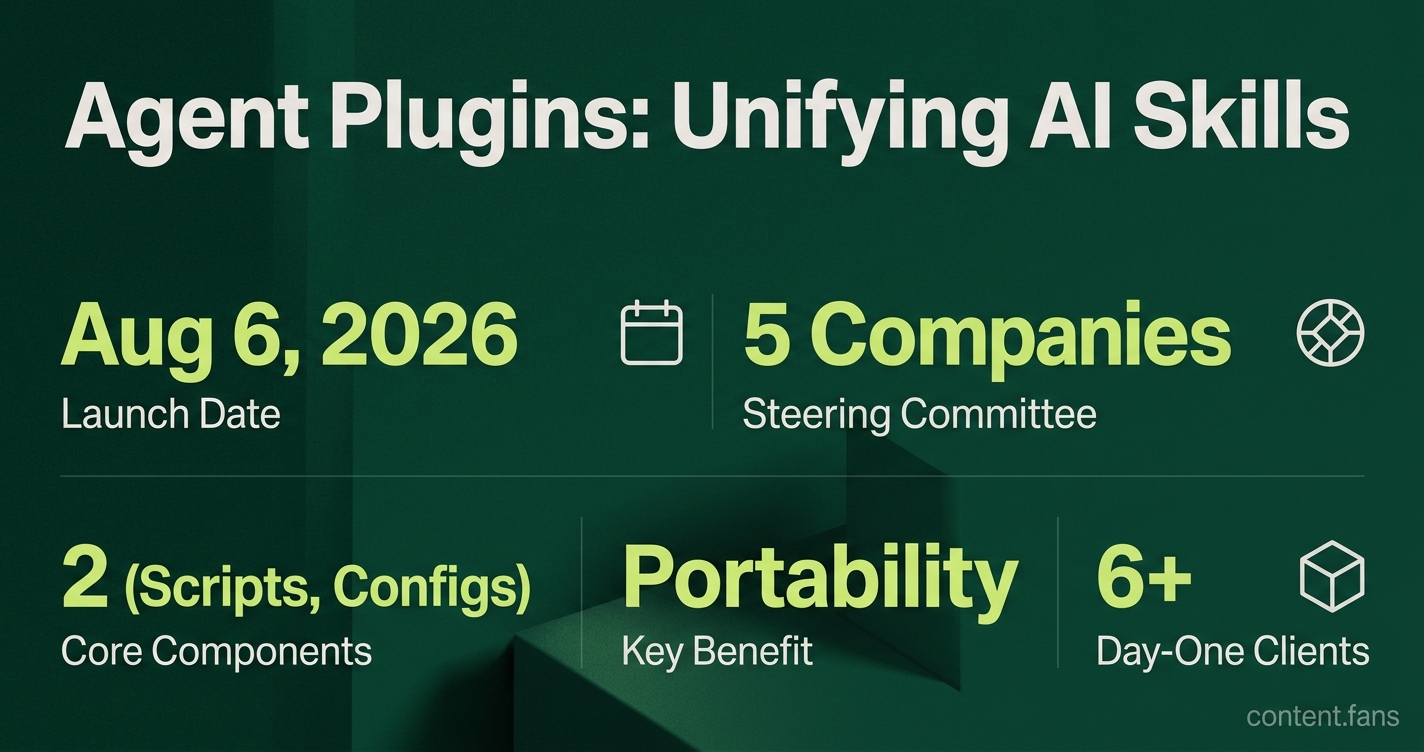
The Agent Plugins standard is an open specification for creating portable AI agent extensions. It defines how to package reusable skills and tool connectors so that a single plugin can run across multiple clients, such as ChatGPT and VS Code, reducing developer friction and accelerating feature distribution.
According to the specification, each plugin package contains two main components:
- Agent Skill scripts: These provide the core reusable logic for workflows.
- MCP server configurations: These files connect the plugin to external tools or data sources.
Every plugin bundle also includes a manifest for version and dependency validation, ensuring the portability that is central to the initiative. An AWS announcement describes the standard as "open, vendor-neutral, and developed in public," confirming that the AWS Agent Toolkit is already compliant with the specification link.
Early ecosystem signals
The standard launched with immediate support from a range of popular AI clients. An official OpenAI launch thread confirmed day-one compatibility for Codex, ChatGPT, Cursor, GitHub Copilot, Kiro, and VS Code link. Further reporting from 9to5Mac highlights that Vercel originally initiated the proposal before the group of five companies co-authored the final standard link. With both AWS and Kiro announcing active implementations, the specification appears to be a practical tool rather than a purely theoretical exercise.
Governance and openness
To foster trust and prevent vendor lock-in, the technical steering committee operates under a transparent governance model with public decision logs, similar to other successful cloud-native projects. However, industry analysts caution that while this is a positive step, the standard's scope is currently limited to the packaging layer. Key areas like memory formats, runtime behavior, and permission models are not yet standardized, meaning full, seamless interoperability between all agent systems remains an open question.
Why portability matters
For developers building AI agent extensions, portability directly addresses the significant pain point of redundant integration work. The Agent Plugins standard allows a single package to run unchanged across multiple clients, which promises to dramatically reduce maintenance overhead and accelerate the distribution of new agent capabilities. The initiative's long-term success will ultimately depend on broad industry adoption, the development of supporting tools, and the participation of other major AI players like Anthropic and Google.
What are Agent Plugins and why did Vercel create them?
Agent Plugins is an open, vendor-neutral standard for packaging reusable AI-agent extensions. Vercel published the v1.0.0 specification on August 6, 2026, with the goal of making agent skills and MCP (Model Control Plane) server configurations portable across compatible clients. Rather than rebuilding integrations for every platform, developers can now package an agent skill once and load it into multiple tools - from ChatGPT and Codex to Cursor, GitHub Copilot, Kiro, and VS Code - without custom adapters.
The standard focuses specifically on packaging, discovery, and loading, leaving higher-level concerns like marketplaces, permissions, and sandboxing to each client implementation.
Which companies are guiding the standard's development?
The Technical Steering Committee includes five founding members: Amazon, Cursor, Microsoft, OpenAI, and Vercel. According to launch reporting, Vercel initiated the proposal, and representatives from all five companies collaboratively shaped the 1.0 specification. AWS has publicly confirmed its role as a founding member and already made its AWS Agent Toolkit compatible with the standard.
The committee operates with fully public technical governance - technical decisions and specification development are handled transparently rather than behind closed doors.
How does this improve interoperability for developers?
The standard creates a "small interoperability floor" that reduces integration friction in two key ways:
- Agent Skills - reusable instructions and scripts for workflows can be packaged once and reused
- MCP servers - connectors to tools, data, and services via standardized transport/configuration become portable
Early coverage suggests this could replace multiple client-specific integration variants with a single bundle, lowering maintenance burden and accelerating deployment of agent workflows across products.
What are the limitations of the Agent Plugins approach?
The standard intentionally does not unify every aspect of agent operation. Installation flows, permission models, marketplaces, and user interfaces remain client-specific. It also does not eliminate broader fragmentation in memory formats, session-state models, or runtime behavior across vendors. Agent Plugins complement rather than replace higher-level interoperability protocols like MCP itself or emerging agent-to-agent communication standards.
Why does industry collaboration on this matter now?
The 2025-2026 period has seen accelerating momentum toward portable agent tooling, with parallel standardization efforts including MCP, Google's A2A, and others. Vercel's launch with established cloud and platform vendors signals an attempt to preempt ecosystem fragmentation before it solidifies - similar to how early web standards shaped browser extension markets. The presence of major cloud providers (AWS, Microsoft) alongside developer platforms (Vercel, Cursor) suggests both infrastructure-scale and workflow-scale investment in making agent capabilities more shareable.