
Cursor AI IDE Passes $2 Billion Annual Revenue Mark
Serge Bulaev
Cursor, an AI coding IDE, has reportedly passed $2 billion in annual revenue, with its growth compared to early phases of companies like Stripe. This revenue milestone may have been reached quickly, as reports suggest Cursor doubled its run rate in about three months, though figures are not audited. The company's hiring model appears focused on quality and speed, using direct outreach and practical trials for candidates. Cursor faces rising competition from various rivals offering lower prices or different features, but its main strengths seem to be its all-in-one IDE and enterprise focus. The company's future position in the market may change as other tools improve and pricing pressures persist.

The Cursor AI IDE, a four-year-old AI-native coding environment, has reportedly achieved significant revenue milestones in recent months. This rapid ascent is fueled by a developer-centric design, with engineers praising its seamless, agent-driven workflow that has become integral to their daily process.
Cursor's journey provides key insights into revenue scaling in the AI era, the role of a specialized talent strategy, and its competitive standing in a crowded market.
Explosive Revenue Growth and Market Momentum
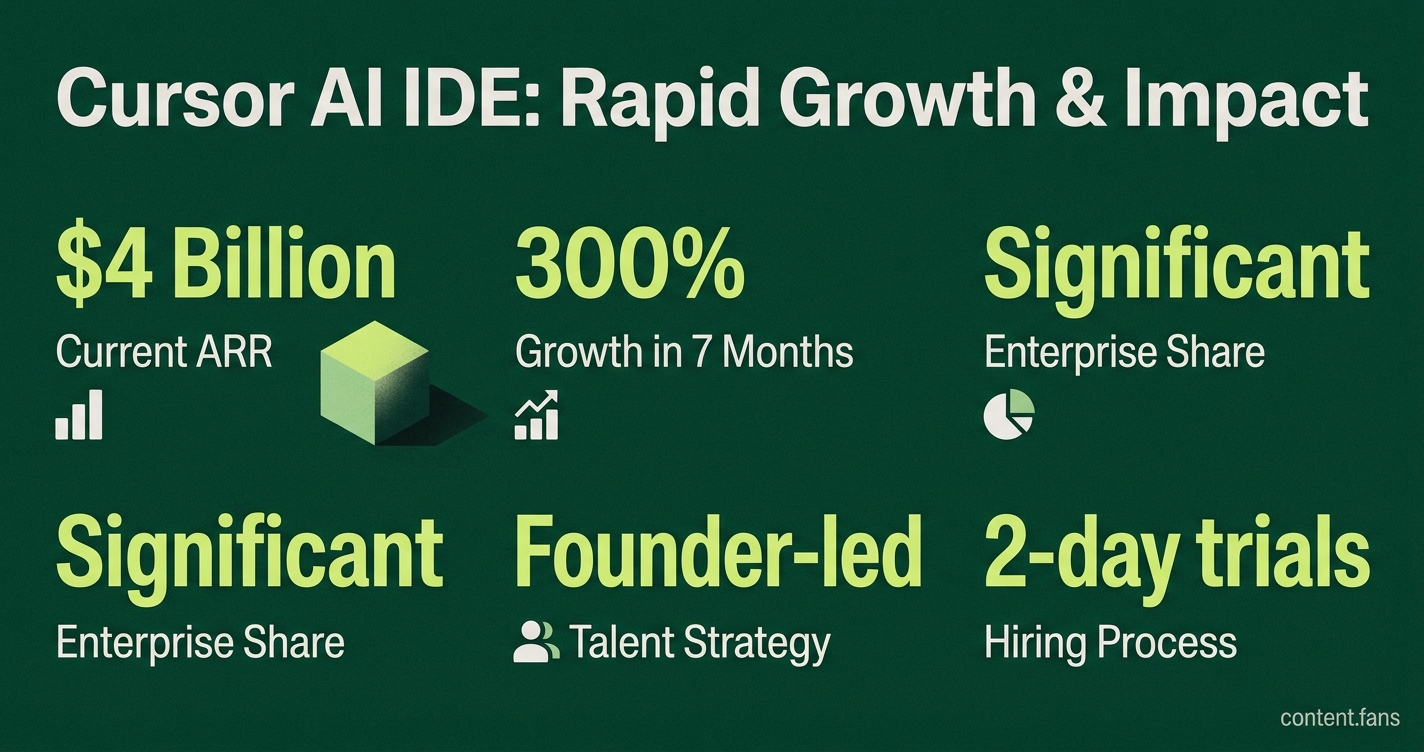
Cursor's explosive growth stems from its AI-native design, which creates a highly efficient workflow for engineers. This strong product-market fit, combined with a strategic focus on enterprise adoption and a founder-led talent strategy, has enabled the company to scale its revenue at an unprecedented pace.
According to industry reports, Cursor has achieved substantial revenue milestones throughout 2025 and 2026. This achievement represents rapid growth over several months, with enterprise clients now accounting for a significant portion of total revenue.
| Date | Publicly Reported ARR |
|---|---|
| Nov 2025 | ~ $1 billion |
| Feb-Mar 2026 | $2 billion+ |
| Apr 2026 | $3 billion |
| May-Jun 2026 | $4 billion |
It is important to note that these are press-reported run-rate figures, not audited financial statements, yet they illustrate the incredible slope that Cursor's product and hiring teams are navigating.
A Talent Strategy Built for Speed and Quality
Cursor's recruiting strategy is as aggressive as its growth. Reports from Business Insider detail CEO Michael Truell personally persuading candidates and using two-day work trials instead of traditional interviews. This high-touch model is what recruiting lead Adam Ward describes as an "executive-search style" process for every role, prioritizing both speed and quality.
Key practices shaping Cursor's talent acquisition include:
- Direct founder outreach to passive candidates.
- Two-day practical trials that replace standard whiteboard interviews.
- Persistent and early closing conversations.
- Acqui-hires to rapidly gain domain expertise.
- Community sourcing via an active Discord server.
Analysts suggest this intensive approach ensures high code quality but may create hiring bottlenecks as the company scales.
Competitive Landscape in 2026
In the 2026 market, Cursor is often seen as the benchmark AI IDE, but a fragmented landscape presents specialized competitors. Roundups from Builder.io highlight Windsurf as a direct alternative, while Zapier points to GitHub Copilot as the leading low-cost extension. Meanwhile, tools like Claude Code are gaining traction for specific use cases like terminal-based autonomous refactoring.
| Segment | Closest Rival | Reported Edge Over Cursor |
|---|---|---|
| AI IDE Fork | Windsurf / Devin Desktop | Different UI roadmap |
| IDE Extension | GitHub Copilot | Works inside existing editors, about $10 per user per month |
| Terminal Agent | Claude Code | Larger context windows, visible step sequences |
| Open-Source | Cline, Continue.dev | Self-hosting and no license fee |
Price pressure is a significant factor across the market. While competitors like GitHub Copilot offer lower price points, Cursor is positioned as a premium AI coding environment with features such as agent mode, background agents, and business/enterprise plans.
While the AI developer tool market is in constant flux, Cursor's current playbook offers a compelling case study. Its combination of aggressive revenue goals, a highly selective talent strategy, and deep product focus demonstrates how a new entrant can outmaneuver incumbents while staying true to core developer needs.