
Tensormesh Raises $20M for AI Inference Optimization
Serge Bulaev
Tensormesh, a San Francisco startup, raised $20 million to improve AI inference for businesses by using caching to lower costs and speed up responses. The company says its technology may help reduce the need for expensive GPUs by reusing answers to repeated prompts. Investors include AMD Ventures and CoreWeave, and the money will go toward more engineers and hardware partnerships. It appears the demand for AI inference savings is growing, but the company has not shared any customer names or independent results yet. Some analysts suggest it is still uncertain how quickly large companies will start using these types of caching solutions.

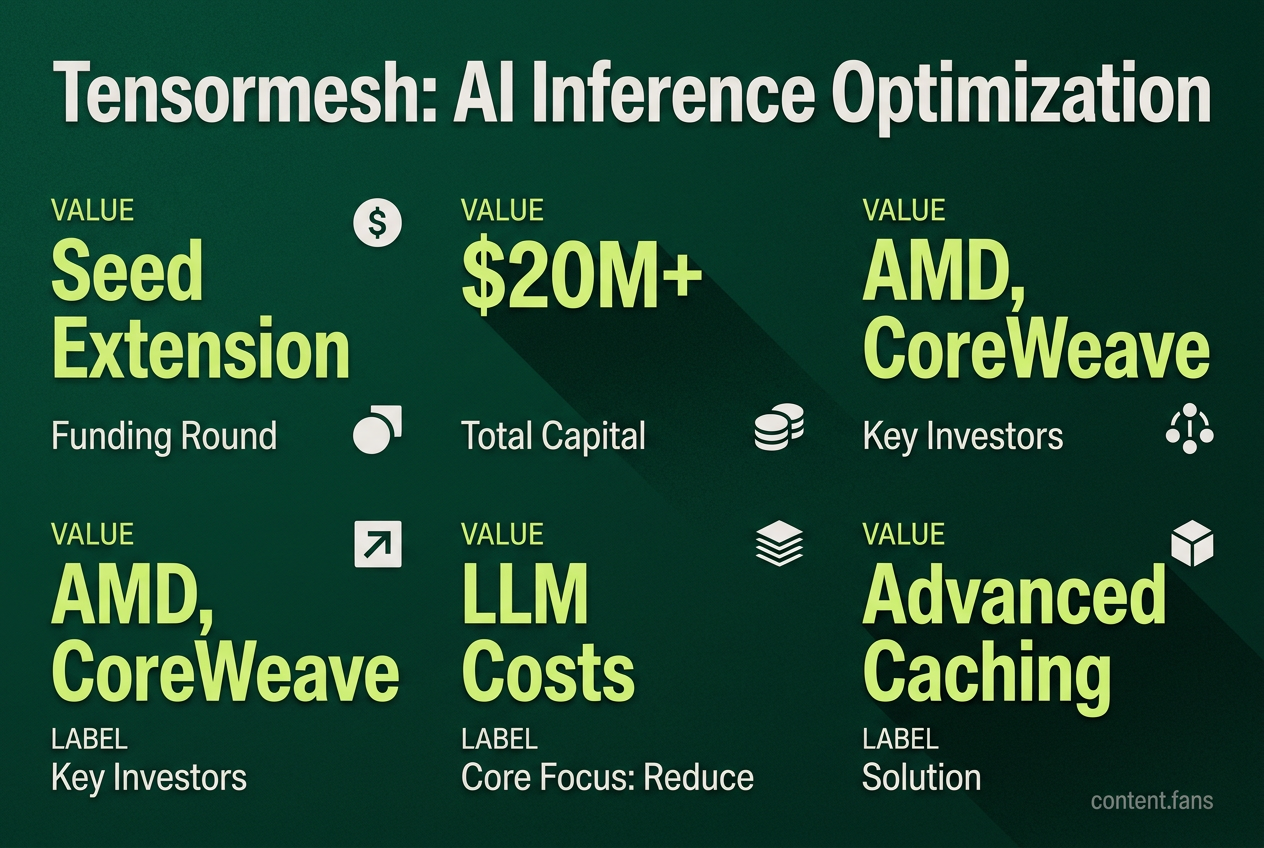
Tensormesh, a San Francisco startup focused on AI inference optimization, announced it has raised funding in a new round. According to a report from The SaaS News, this seed extension brings the company's total capital to a significant amount.
The year-old company aims to reduce the high costs and latency associated with large language model (LLM) deployments by optimizing the inference layer through advanced caching and serving-engine enhancements.
Who wrote the check
Tensormesh develops a caching platform to make AI inference cheaper and faster for businesses. By reusing computations for repeated or similar user prompts, its technology reduces reliance on expensive GPU hardware, directly addressing a major cost center in enterprise AI deployments.
In a company blog post, Tensormesh identified the investors as AMD Ventures, CoreWeave, NVentures, Valley Capital Partners, and Laude Ventures. The capital is designated for enhancing hardware integrations with AMD and NVIDIA and expanding its LMCache platform for prompt and KV-cache reuse.
- Round Type: Seed extension
- Total Funding: Significant amount raised
- Lead Investors: AMD Ventures and CoreWeave
- Use of Funds: Engineering expansion, hardware partnerships, and LMCache platform development
Why caching matters in 2026
The need for inference optimization is driven by massive market growth. According to industry reports, spending in this sector is expected to grow substantially as companies aim to manage GPU costs. Caching provides a direct solution by allowing repeated or similar prompts to bypass redundant computation. Major cloud providers have reported that prompt caching can significantly reduce input token costs and lower latency.
This trend is set against the backdrop of the broader enterprise AI market, which industry analysts project will experience substantial growth in the coming years. This significant growth explains the strong investor interest in AI infrastructure companies like Tensormesh, even as funding for consumer-facing apps has slowed.
Market landscape and possible rivals
Industry trackers point to three key trends shaping the market for AI inference optimization:
- Growing Edge and Hybrid Use: Increased adoption of hybrid and edge inference is creating demand for localized caching.
- Focus on Efficiency: Businesses are prioritizing cost-per-token and throughput metrics over raw model performance.
- Anticipated Consolidation: Standalone optimization tools are expected to be integrated into larger serving platforms in the coming years.
The competitive landscape includes both established cloud providers with built-in caching and emerging startups focused on orchestration. Tensormesh differentiates itself by operating at the infrastructure layer, offering a hardware-agnostic cache engine compatible with accelerators from AMD, NVIDIA, and other specialized providers.
What comes next
While Tensormesh has not disclosed revenue figures, this funding round indicates strong investor confidence in the demand for AI cost-saving middleware. The company plans to dedicate its new engineering resources to developing features like automatic similarity detection, multi-tenant cache security, and real-time observability tools for monitoring cache hit rates.
Future plans may also include a product for on-premises inference clusters, evidenced by the company's interest in edge partnerships. However, Tensormesh has yet to name public customers or provide independent performance benchmarks. Industry analysts will be looking for third-party validation of its latency metrics and signs of adoption by large enterprises as a key indicator of future success.