
Taylor Swift, McConaughey Trademark Voices to Combat AI Deepfakes
Serge Bulaev
Taylor Swift and Matthew McConaughey are trying to use trademark law to protect their voices and images from being copied by AI deepfakes. They filed for trademarks because current laws may not cover new AI-made voice recordings. Experts say this is a new way to use trademark law, and it is not clear yet if it will work. Some new laws may help in the future, but they are not in place yet. This move may mostly help famous people with money, and it could shape how AI companies use celebrity voices and images.
Taylor Swift and Matthew McConaughey are leveraging trademark law to protect their voices and likenesses in the fight against AI deepfakes. This pioneering strategy uses trademark filings as a primary shield against unauthorized voice cloning and synthetic videos, marking a novel test of intellectual property law where federal legislation remains limited.
In response to multiple deepfake incidents, including fake endorsements and explicit images, Taylor Swift filed three federal trademark applications in May. An NBC News report details these include a sound mark for "Hey, it's Taylor Swift" and a design mark of her on-stage likeness.
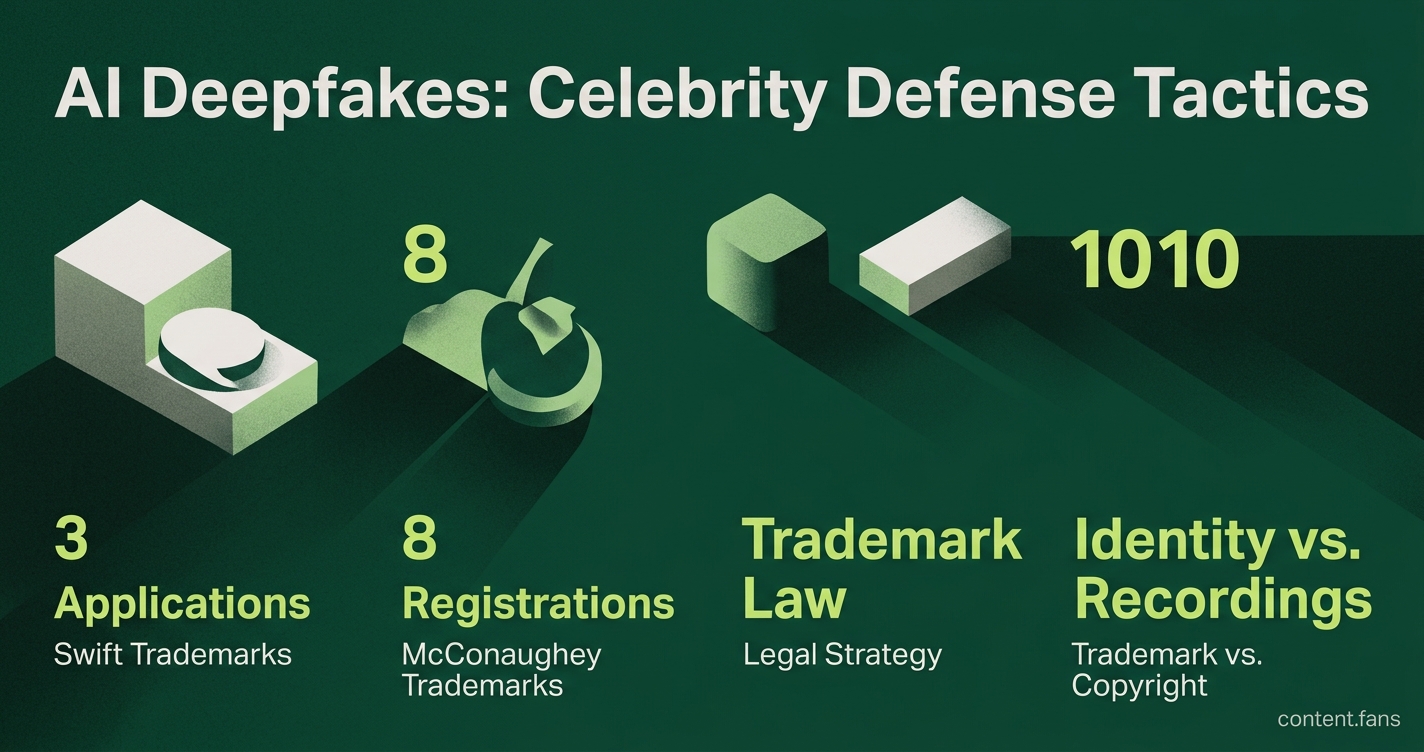
Similarly, Matthew McConaughey's legal team filed eight registrations in January to cover his voice, image, and famous catchphrase, "Alright, alright, alright." According to The Independent, the objective is to prevent AI from commercially exploiting the actor's persona without permission. Attorney Josh Gerben described the strategy as "a novel application of trademark law that has not been legally tested."
Celebrities Move to Trademark Voices and Likenesses to Combat AI Deepfakes: why trademark instead of copyright?
Celebrities are using trademark law because it protects identity markers used in commerce, such as a unique voice or catchphrase. Unlike copyright, which only covers specific recordings, trademark can be used to fight new, AI-generated performances that create a false endorsement, filling a critical legal gap.
Copyright law protects fixed, original recordings, but not the inherent qualities of a person's voice. This creates what attorney Josh Gerben calls a "legal void," as AI models can generate entirely new vocal performances. Trademark law, however, protects identity markers used in commerce and may provide a more effective tool for pursuing false endorsement claims.
False endorsement claims under the Lanham Act are well established, but whether they succeed in a particular voice-cloning case depends on the facts and applicable precedent. Trademark law requires proving commercial use or consumer confusion, and according to industry reports, it is unclear if a cloned voice by itself constitutes infringement. Future legal battles will likely depend on how the synthetic content is used and distributed.
Where federal law stands today
Current federal legislation offers limited protection. The TAKE IT DOWN Act is primarily about removal of non-consensual intimate imagery and should not be described as a general law covering all celebrity impersonations or political deepfakes unless the statutory text expressly says so. Broader legislation, such as the proposed NO FAKES Act, which would criminalize unauthorized voice replicas, has not yet passed. This legislative gap is a key reason artists are turning to trademark law as a proactive measure.
Practical impact on AI developers
These legal actions are expected to have significant implications for AI developers, who may now face:
- Increased requirements for permission before training models on celebrity data.
- The need to implement filters to block protected likenesses and phrases.
- Higher compliance costs and legal risks as case law develops.
While legal experts note that the high cost of trademark registration may limit this strategy to well-funded celebrities, these filings are establishing a critical test case. The outcome could fundamentally shape how AI companies are permitted to use celebrity identities in the future.