
Tariffs, Iran conflict raise US inflation, retail prices
Serge Bulaev
Recent tariffs and conflict involving Iran may be raising costs for U.S. businesses and households, especially at stores and gas stations. Oil prices and shipping costs have gone up due to unrest in the Strait of Hormuz, and these increases appear to be affecting prices of everyday goods. Many companies are reacting by changing suppliers, moving production, or holding more inventory, which could add to costs. Food prices might climb faster than overall inflation, and experts suggest there is a risk of both higher prices and slower economic growth. Future changes in tariffs or energy markets might continue to add uncertainty for businesses and consumers.

Recent tariffs and the Iran conflict are raising U.S. inflation and retail prices, directly impacting households at the gas pump and grocery store. This dual pressure stems from increased import duties and geopolitical turmoil in the Strait of Hormuz, which has driven up oil, freight, and insurance costs. According to corporate surveys and central bank analysis, these shocks are rippling through supply chains and translating into higher prices for everyday goods.
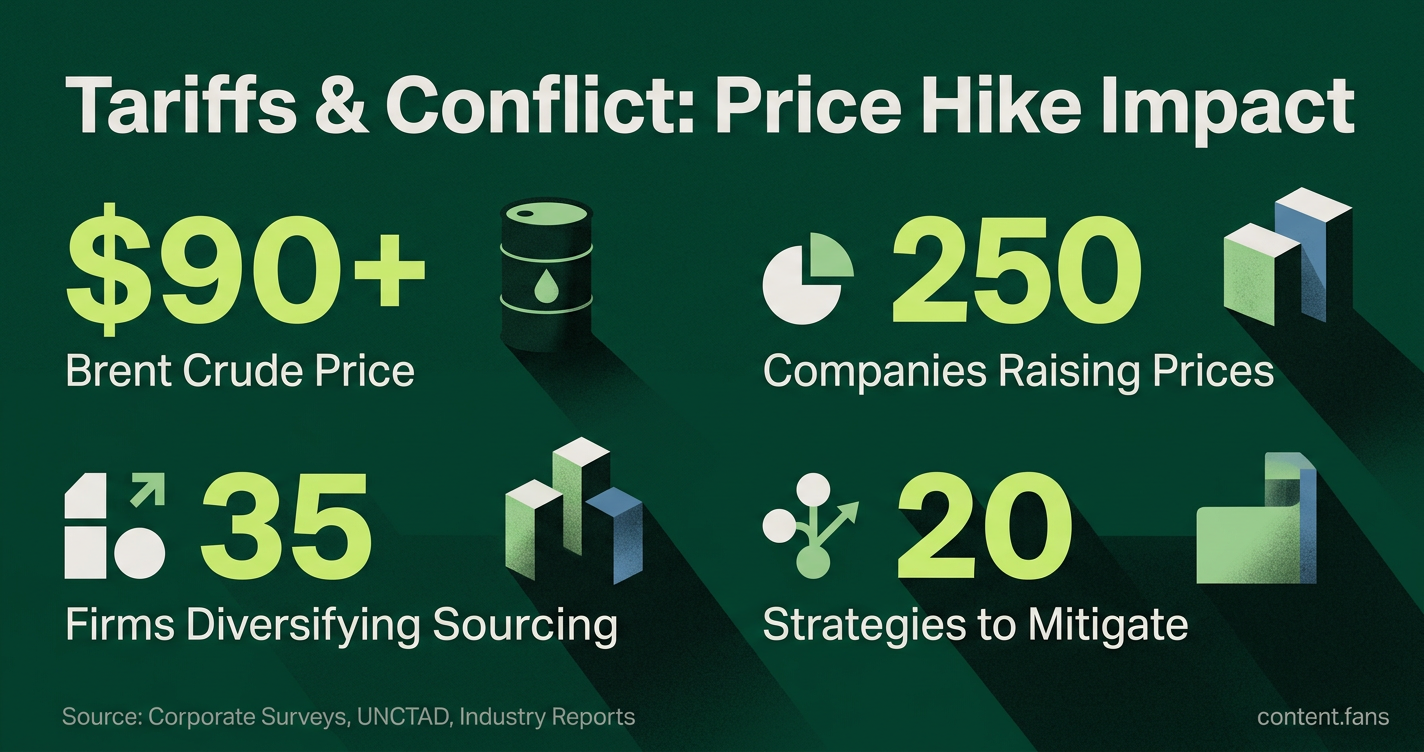
Evidence shows these cost pressures were building even before the conflict escalated. Industry reports have connected tariffs to declining consumer confidence, with executives noting rising costs prior to the conflict. As hostilities in Iran intensified, Brent crude surpassed $90 a barrel. This prompted UNCTAD to warn that surging energy, fertilizer, and transport costs could elevate food prices globally, compelling businesses to pass these increases on to consumers to protect their margins.
Geopolitical Shocks Drive Widespread Inflation
Geopolitical tensions and trade tariffs directly inflate business operating costs through higher prices for fuel, freight, and imported goods. Unable to absorb these escalating expenses, companies are compelled to pass them on to consumers, resulting in higher retail prices for groceries, gasoline, and general merchandise.
Industry analysts have highlighted the severity of the situation, modeling scenarios where the conflict disrupts a significant portion of the global oil supply - a shock they argue would be among the largest in geopolitical history. Such an event would significantly raise U.S. headline inflation, starting with a sharp increase in gasoline prices. These higher fuel costs would then cascade into trucking, packaging, and distribution, causing price hikes across numerous product categories.
Retailers are actively responding to these pressures. Recent industry surveys reveal that a significant number of supply-chain leaders have increased consumer prices to absorb higher costs. Meanwhile, many companies have altered their sourcing to avoid tariff-affected nations. This environment of continuous adjustment has been described by the National Retail Federation as the "new normal" for logistics.
How Companies Are Responding
In response, corporate procurement teams are focusing on mitigating key cost drivers, including energy and freight rates, tariff-affected imports, farm inputs like fertilizer, and consumer staples. To limit their exposure to these volatile costs, firms are implementing three primary strategies:
- Supplier Diversification: Companies are shifting production away from single countries. Industry reports indicate that a significant number of firms moved some volume out of China in recent years, expanding into other parts of Asia and North America.
- Nearshoring: To shorten lead times, businesses are moving time-sensitive assembly to Mexico and Canada, a trend noted in recent industry guidance.
- Increasing Safety Stock: Many firms are holding more inventory for critical products to buffer against supply chain disruptions, a practice recommended by industry experts.
While these measures increase working-capital costs, they provide a crucial cushion against sudden shocks. The value of this resilience was highlighted when industry reports indicated that the Iran conflict disrupted a significant portion of global shipments within weeks.
What the Data May Indicate for Consumers
Data indicates that consumers are bearing the brunt of these costs, particularly at the grocery store. Industry reports suggest that food-at-home inflation has outpaced the overall Consumer Price Index (CPI) in recent periods. As noted by FoodNavigator-USA, food manufacturers face "swift and stiff" increases in fuel and fertilizer costs, leaving them little room to absorb expenses. This trend supports analysts' conclusions that energy shocks rapidly translate into higher food prices and can elevate household inflation expectations.
Beyond immediate price hikes, some analysts warn of a potential stagflation risk - a combination of rising inflation and slowing economic growth. Although Reuters reported global equity market volatility following the initial missile strikes, the relative stability of the U.S. market suggests investors believe domestic companies can successfully pass on higher costs to consumers.
Compounding these challenges is ongoing policy uncertainty. Future changes to tariffs could force businesses to overhaul supply contracts, shipping routes, and financial strategies. Experts assert that sustained operational stability will require continued supply chain mapping, flexible contracts, and regional inventory hubs until energy markets stabilize and trade policies become more predictable.
1. How exactly do tariffs and the Iran conflict translate into higher sticker prices for U.S. shoppers?
Both forces raise the operating costs that businesses have to absorb or pass on.
- Tariffs add a direct surcharge on imported goods; industry surveys found that many executives raised consumer prices to offset recent tariff-driven expenses.
- Iran-linked tensions push Brent crude above $90 (UNCTAD) and trigger freight, fuel, and fertilizer spikes. Industry reports indicate food-at-home prices have risen significantly year-over-year - more than the broad CPI.
Both shocks hit the same supply lines, so firms rarely have leftover margin to cushion shoppers.
2. If fighting in the Strait of Hormuz stopped tomorrow, would prices drop right away?
No.
Even an immediate cease-fire would leave structural vulnerabilities intact. Diversions around the Cape of Good Hope have already added 10-14 extra sailing days and forced carriers to pre-book insurance at record premiums. Reverting routes takes weeks, and inventories purchased at elevated freight and energy levels still have to clear shelves. Industry analysis warns that single-source dependencies and lean buffers will keep "latent upward pressure on prices" even after geopolitical flare-ups subside.
3. Which everyday products are seeing the steepest mark-ups?
- Groceries - fertilizer and diesel spikes feed straight into farm-gate prices; industry reports show significant food-at-home inflation.
- Restaurant tabs - food-away-from-home is forecast to jump significantly as operators pass through higher ingredient and haulage costs.
- General merchandise - industry surveys found that many manufacturers and retailers hiked shelf prices after new tariff rounds.
- Gasoline - each $10 move in Brent adds roughly 25-30 cents to the national average, and analysts estimate a Persian Gulf cutoff could lift annual U.S. CPI by over one percentage point.
4. What are leading U.S. companies doing right now to shield themselves - and consumers - from the next shock?
- Diversification: Industry reports indicate that many firms moved at least some volume out of China recently, splitting orders among Vietnam, India, Mexico, and Southeast Asia.
- Nearshoring: Mexico's share of U.S.-bound manufacturing is growing fastest; logistics companies note re-routed final assembly can trim lead times by 2-4 weeks versus Asia.
- Safety stock: instead of ultra-lean inventories, firms hold significantly more buffer on critical SKUs according to industry experts.
- Risk mapping: procurement teams now run 30/90/180-day roadmaps that trigger alternate sourcing or expedited air freight if choke-points widen.
5. How long should shoppers expect these elevated price levels to last?
Most forecasters see gradual, not rapid, relief.
- Industry projections suggest food inflation above overall CPI through the coming periods.
- Analysts suggest a sustained oil-risk premium of $10-15 per barrel even after a cease-fire.
- Retailers report they will hold higher inventory buffers permanently, adding to systemic logistics costs - a drag akin to an embedded tariff.
In short, expect prices to drift down only when new supplier networks mature and inventories re-price at lower baselines, a process most executives peg at 12-24 months.